
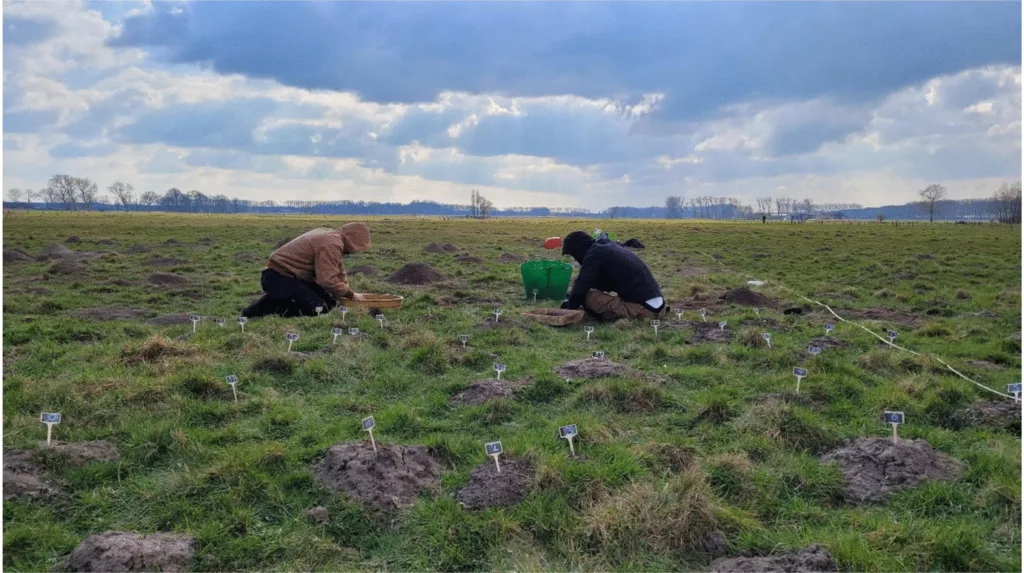
In a Belgian nature reserve, an unlikely group of excavators has been helping archaeologists uncover the remains of a medieval estate. Their work requires no archaeological equipment, excavation permits, or even an interest in history. They are simply moles, digging tunnels beneath the grass.
Researchers from Ghent University have recovered 2,810 archaeological fragments from 814 molehills near the historic town of Damme, revealing evidence of a 13th- to 14th-century brick gatehouse. The discovery offers a glimpse into a medieval rural settlement that had disappeared from historical records centuries ago.
The study, published in the Journal of Archaeological Method and Theory, demonstrates how the natural digging activities of moles can help archaeologists investigate buried heritage without undertaking conventional excavations. The researchers combined the recovered material with geophysical measurements, historical maps, drone imagery, and soil investigations to reconstruct part of the lost estate.
How 814 Molehills Became an Archaeological Survey
The investigation took place near Damme in West Flanders, within the historic Zwin region. During the Middle Ages, Damme served as an important outer harbour for Bruges, connecting the prosperous trading city to maritime routes across Europe.
The surrounding countryside contained numerous moated farmsteads, often built on artificially raised platforms and enclosed by water-filled ditches. Such estates served residential and agricultural purposes, while their moats also reflected the social standing of their occupants.
Many disappeared through centuries of agricultural development. Others survived beneath grasslands that escaped modern ploughing, preserving archaeological remains but making them difficult to investigate through ordinary surface surveys.
This is where the moles come in. As they excavate their tunnels, the animals push small quantities of soil to the surface. When their tunnels pass through archaeological deposits, fragments of pottery, brick, and other materials can emerge inside the resulting molehills.
At Damme, archaeologists systematically recorded the location of 814 molehills using GPS equipment. They then sieved the soil through a six-millimetre mesh, collected the recovered objects, and examined them in the laboratory.
Of the 814 molehills, 421 contained archaeological material. Together, they yielded 2,810 fragments weighing just over two kilograms, including construction debris, pottery, metal objects, and pieces of natural stone.
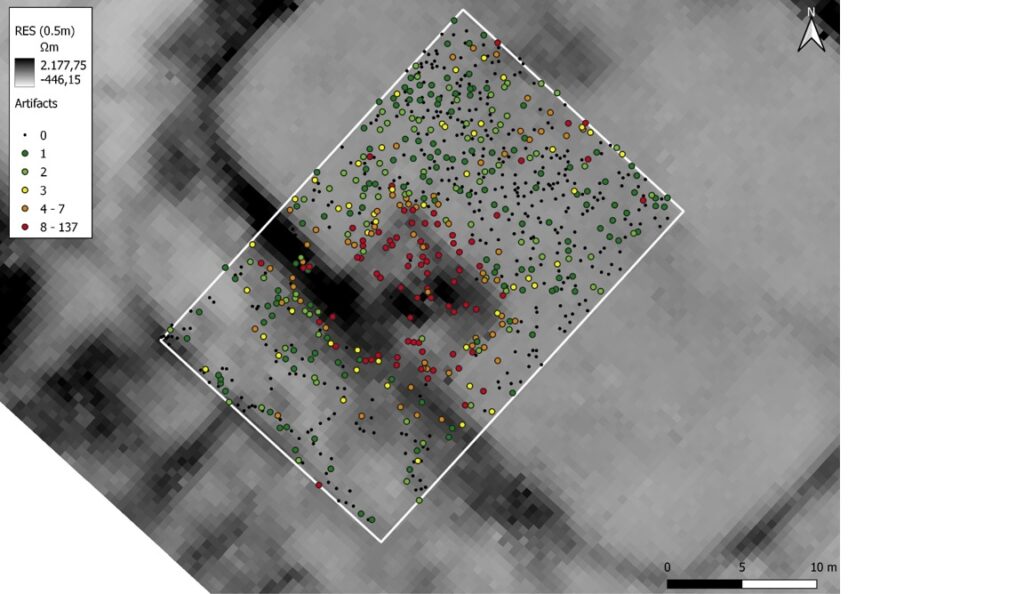
Distribution of finds in molehills compared to ohm resistivity data using a 0.5-m configuration. Distribution of all finds in the vertical drone image, overlooking the entire site. Credit: Verliefden, J., 2026 – Ghent University
A Medieval Gatehouse Hidden Beneath the Grass
The finds were not evenly distributed across the surveyed area. A particularly rich concentration of archaeological material appeared above a rectangular feature measuring approximately 10 by 8 metres. Earlier geophysical measurements had already detected the underground anomaly, while soil cores confirmed the presence of substantial brick deposits.
The combination of evidence allowed the researchers to identify the structure as a brick gatehouse associated with a large medieval farmstead.
The interpretation was strengthened by additional traces on the opposite side of the surrounding moat. Two parallel anomalies probably represent the remains of a bridgehead, while a linear depression extending toward the site may mark an old access road.
The recovered pottery helped establish the chronology. Among 294 ceramic fragments, local greyware dominated the assemblage, followed by redware, with smaller quantities of decorated pottery and imported stoneware. Although the pottery spans approximately the 12th to 15th centuries, most dates to the 13th and 14th centuries.
Construction materials provided further clues about the building itself. Red and light-red bricks, mortar, roof or floor tiles, slate fragments, and iron nails suggest a substantial structure that incorporated brickwork and timber.
The building’s precise appearance remains uncertain because it has not been excavated. However, the researchers identified a close architectural parallel in the surviving medieval gatehouse of Huysmanhoeve, a historic estate in Eeklo, Belgium.
The discovery also adds an unexpected chapter to the area’s history. A map produced by Flemish cartographer Pieter Pourbus in 1574 depicts two moated sites near Damme, but shows no buildings standing on them. The new evidence indicates that at least one of those sites once possessed a substantial medieval entrance structure, apparently abandoned before the map was drawn.
Remarkably, the surrounding moats and earthworks still correspond closely to the landscape recorded by Pourbus more than 450 years ago.
Why Archaeologists Are Paying Attention to Moles
The technique, sometimes called molehill archaeology or moleology, is not entirely new. Earlier investigations have used molehills to recover archaeological material from sites in Belgium, Britain, and elsewhere.
The Damme study advances the method by combining the systematic investigation of molehills with several complementary surveying techniques.
The researchers found that the distribution of recovered objects could help locate buried structures even without prior geophysical information. Interestingly, the moles tended to avoid areas containing dense building remains, but the fewer molehills above those areas often contained greater concentrations of archaeological material.
This makes the method particularly useful for protected grasslands, where conventional excavation may be restricted or undesirable. It also offers a relatively inexpensive way to investigate medieval rural sites threatened by intensive agriculture and development.
For archaeologist Jaan Verliefden of Ghent University, the animals’ reputation as garden pests conceals their scientific value.
“Moles may dig up our gardens, but their molehills offer archaeologists a mountain of information about the medieval past hidden beneath the grass,” he said in the university’s announcement.
The researchers nevertheless emphasize an important distinction: archaeologists should take advantage of naturally occurring mole activity, not deliberately introduce the animals to archaeological sites. Their tunnelling can damage buried remains, even when it provides valuable information.
At Damme, however, the moles had already done the digging. The archaeologists’ contribution was to turn the scattered fragments into evidence of a medieval building that had vanished from the historical landscape.
Verliefden, J., Trachet, J., Verhegge, J., De Smedt, P., & De Clercq, W. (2026). Small Heaps on Large Mounds: Where Mole Activity Meets Moated Sites: Re-evaluating and Refining Molehill Archaeology in the Shadow of the Zwin City Damme (Belgium). Journal of Archaeological Method and Theory. https://doi.org/10.1007/s10816-026-09819-8
