
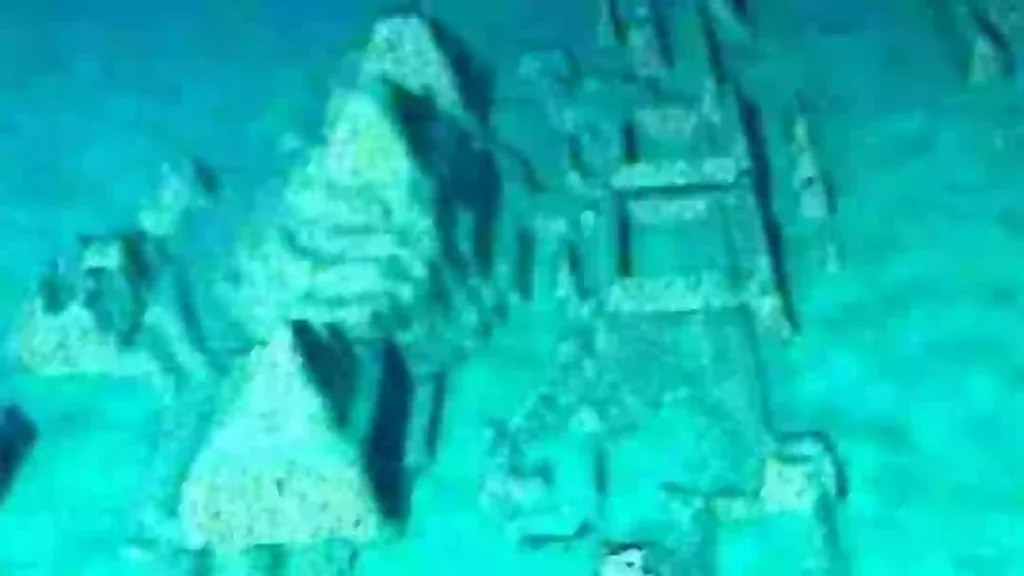
Recently, a mysterious discovery has resurfaced on social media, reigniting debates and curiosity worldwide: the so-called “lost city” said to lie beneath the waters off the coast of Cuba. More than 20 years ago, this underwater site first caught the attention of archaeologists and scientists, but it has remained largely unexplored since. Given the renewed interest online, we’ve taken a closer look at the international reports and expert opinions surrounding this fascinating — yet still unconfirmed — find that could potentially rewrite parts of human history.
In 2001, a Canadian research team reported finding massive stone structures deep beneath the ocean’s surface, suggesting the remnants of a once-thriving urban center. If confirmed, the site could be over 6,000 years old, making it about 1,500 years older than the Pyramids of Giza. But to this day, the mystery remains unsolved.
A Discovery Beneath the Waves
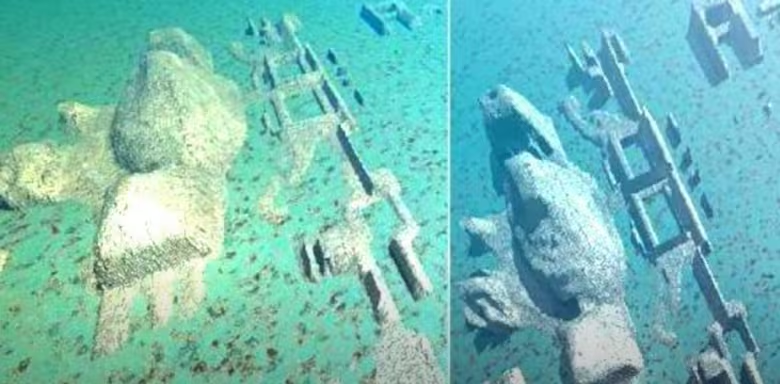
According to a BBC report from the time, the researchers — part of the Canadian exploration group Advanced Digital Communications — were mapping the seafloor near Cuba using sonar equipment when they detected what appeared to be “symmetrically organized stone structures”. These formations resembled city streets and organized layouts, unlike random rock formations typically seen on the ocean bed.
Intrigued, the team deployed an underwater robot to capture close-up footage. As reported by LadBible, the robot’s cameras revealed “huge, smooth blocks with the appearance of cut granite” protruding from the seabed at a depth of around 650 meters (2,133 feet). Such precision-cut blocks are often associated with advanced architectural capabilities.
Older Than the Pyramids?
Preliminary assessments suggested the structures could date back approximately 6,000 years. If accurate, this would place them well before the construction of Ancient Egypt’s most iconic monuments. In simple terms: humans at the time would have already been capable of building sophisticated structures long before Egyptian civilization rose to prominence.
This implication alone would require a significant rethinking of early human history. As the original Canadian team noted, such construction would demand not only advanced engineering skills but also a level of social organization not typically associated with that era.
A Cautious Approach
Despite the potential significance, the researchers urged caution. Speaking to the BBC in 2001, they emphasized that while the site “could have been a large urban centre”, it would be “totally irresponsible to say what it was before we have evidence.” The excitement was palpable, but so was the recognition that science demands rigorous proof.
That proof has been hard to obtain. Attempts to revisit and study the site in greater detail stalled, and according to multiple reports, no major follow-up expeditions have taken place since around 2005.
Geological or Man-Made?
Manuel Iturralde, a senior researcher at the Natural History Museum in Cuba, inspected the available data and described the formations as “extremely peculiar” in an interview with National Geographic. He admitted finding it difficult to explain them geologically but reminded the public that “nature is able to create some really unimaginable structures.” What looks man-made at first glance, he cautioned, may turn out to be a quirk of geology.
Depth is another complicating factor. The site lies roughly 650 meters below sea level. For man-made structures to sink to such a depth, Iturralde explained, they would need to be around 50,000 years old, far predating known advanced civilizations. While sea levels in the Caribbean have risen over millennia, they have not risen enough in the last 6,000 years to account for that depth.
The Atlantis Connection
Unsurprisingly, the discovery reignited speculation about the legendary lost city of Atlantis. One unidentified individual even claimed the Cuban site might mark the ruins of that mythical metropolis. But as the BBC noted at the time, extraordinary claims require extraordinary evidence — and in archaeology, public fascination does not replace hard data.
An Unfinished Investigation
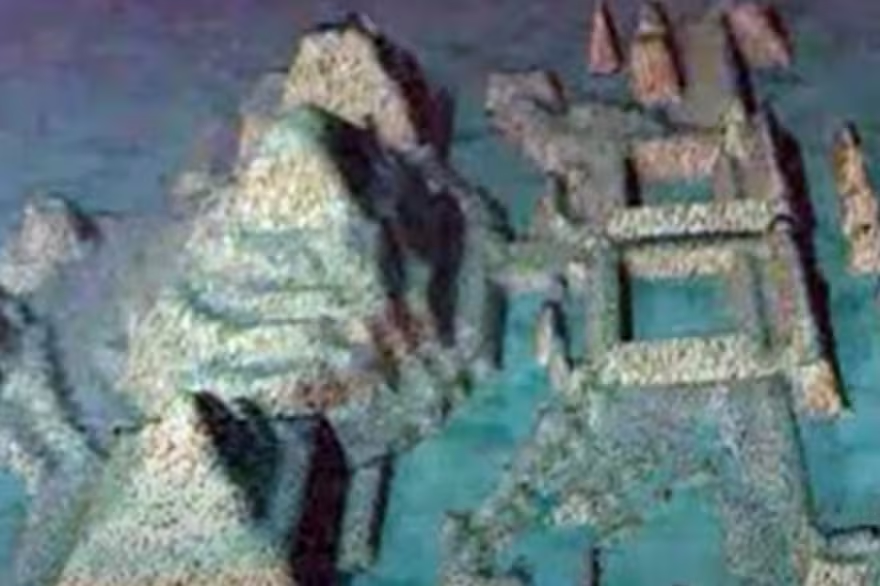
For now, the so-called “Cuban underwater city” remains a tantalizing mystery. While images and sonar readings hint at something extraordinary, the lack of comprehensive study leaves open the possibility that the structures are entirely natural. Without more in-depth exploration, the debate between geology and archaeology will continue.
What is certain is that our oceans still hide secrets — some that could rewrite history, and others that will humble our expectations. Until further expeditions shed light on this deep-water enigma, it remains exactly what scientists have called it: a fascinating but unverified hypothesis.
BBC News, 2001 — “Symmetrically organized stone structures” reported off Cuba’s coast.
LadBible — Underwater robot footage reveals “huge, smooth granite-like blocks.”
National Geographic — Statements from Manuel Iturralde, Natural History Museum of Cuba.
Cover Image Credit: Ancient Architects
