

Animal remains collected from caves and rocky sites along Lebanon’s Mediterranean coast more than a century ago are revealing an unexpectedly detailed picture of how hominins hunted and moved through the landscape as far back as 400,000 years ago. The evidence suggests that these ancient groups knew where animals gathered, returned to productive hunting grounds at particular times of year, and lived in a coastal environment that remained remarkably resilient through major swings in global climate.
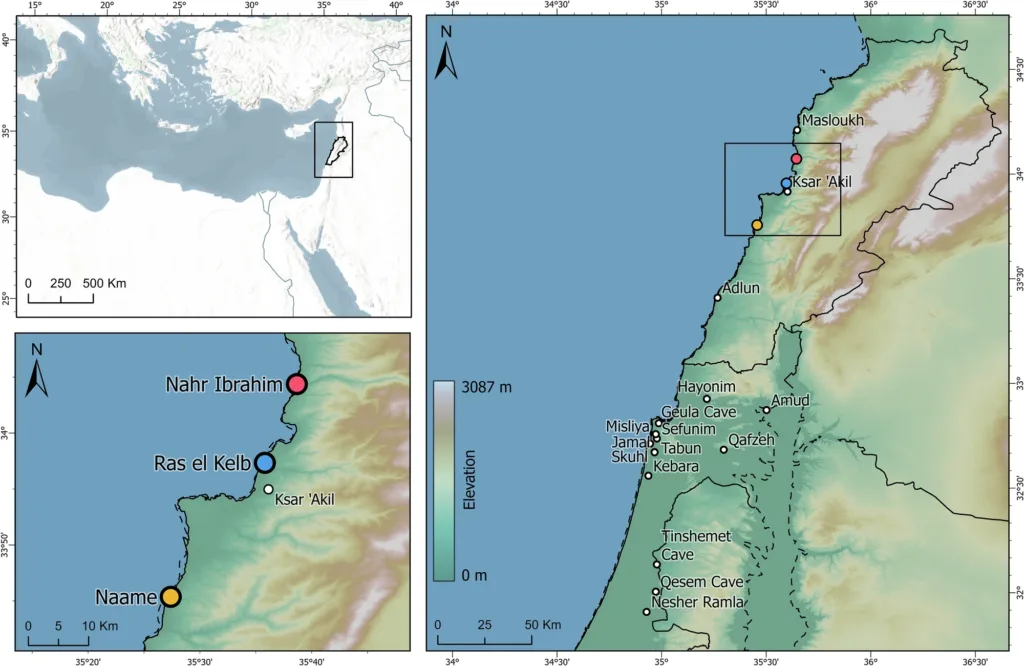
Two studies published in Communications Earth & Environment examined long-overlooked collections from three Paleolithic sites: Ras el-Kelb, Nahr Ibrahim and Naame. Together, the sites preserve evidence spanning roughly 400,000 to 100,000 years ago, making them one of the longest paleoecological records yet reconstructed for the central Levant.
The research also fills an important geographical gap. Much of what archaeologists know about Paleolithic life in the Levant comes from sites farther south, while Lebanon’s record has received far less attention, partly because decades of political instability disrupted archaeological research.
Century-old collections gain new dates
Many of the bones from Ras el-Kelb and Nahr Ibrahim were collected more than 130 years ago by Jesuit scholar Godefroy Zumoffen. The Naame material was recovered during later work in the 20th century. Today, the collections are held by the Museum of Lebanese Prehistory at Saint Joseph University of Beirut.
Until now, however, their age remained poorly constrained. Researchers selected five fossil teeth for direct dating, establishing an age of about 402,000 years for Ras el-Kelb and around 245,000 years for Nahr Ibrahim. Most of the Naame material belongs to a much later period, around 100,000 years ago.
These dates transformed museum collections with uncertain chronology into evidence covering several major phases of the Pleistocene. Rather than representing one continuous occupation, the three sites provide snapshots of hominin life at different moments across roughly 300,000 years.
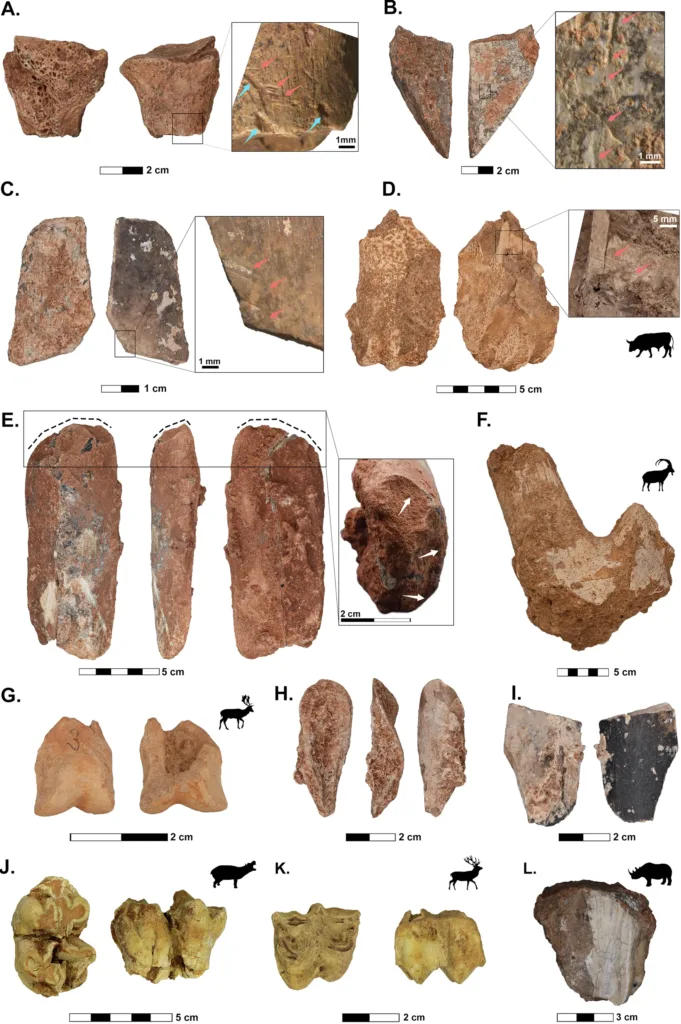
Researchers examined 721 animal remains from the collections, identifying animals including aurochs, fallow and red deer, wild goats, rhinoceroses and hippopotamuses. The species alone show that Lebanon’s Pleistocene coast looked very different from the landscape seen there today.
Hunters targeted animals at the right place and time
Bones from Naame preserve some of the clearest signs of human activity. Cut marks show that carcasses were butchered, long bones were broken to reach their marrow, and some remains had been exposed to fire. Researchers also identified a simple worked bone object that may have served as a tool.
Evidence from Nahr Ibrahim includes butchery marks on an aurochs bone. At Ras el-Kelb, direct cut marks were not found, but burned bones and stone tools show that hominins were active in the surrounding landscape.
The age of the hunted animals adds another clue. Prime-age adults dominate all three collections, accounting for about 82 percent of the animals at Naame, 70 percent at Nahr Ibrahim, and all of the individuals represented in the Ras el-Kelb sample. Although the researchers caution that early collecting practices may have favored larger and better-preserved bones, the overall pattern is consistent with active hunting rather than simply scavenging animals that had died naturally.
The prey was also far from easy. Aurochs were powerful wild cattle, while rhinoceroses represented an even larger and potentially dangerous target. Their presence suggests that hominins were capable of exploiting some of the most rewarding large animals available in the landscape.
Microscopic wear preserved on animal teeth provided another piece of the story. Aurochs and rhinoceroses at Ras el-Kelb appear to have been hunted during a restricted part of the year, while fallow deer from Naame and Nahr Ibrahim show similar seasonal patterns.
Researchers believe some of these hunting episodes probably took place toward the end of the dry season, when animals became easier to predict as they moved through particular habitats and searched for water and food. The evidence from Ras el-Kelb and Nahr Ibrahim represents the earliest zooarchaeological indication of seasonal hunting yet identified in Lebanon.
Rather than wandering randomly through the landscape, these groups appear to have understood where different animals were most likely to be found. Mountainous areas around Nahr Ibrahim offered opportunities to hunt wild goats, while the estuarine environment near Ras el-Kelb attracted animals including rhinoceroses.
A surprisingly stable world along the Lebanese coast
A second study examined chemical signatures preserved in 58 fossil teeth from the same sites. Carbon and oxygen isotopes allowed researchers to reconstruct the vegetation, water availability and seasonal conditions experienced by animals living there.
The results point to a surprisingly persistent Mediterranean environment. Even as global climate shifted through repeated glacial and interglacial periods, woodland, shrubland and more open patches continued to form a productive ecological mosaic along Lebanon’s coast between roughly 400,000 and 100,000 years ago.
The animals were overwhelmingly feeding on plants associated with C3 vegetation, which dominates woodland and Mediterranean environments rather than the dry tropical grasslands represented by C4 plants. Different species occupied different parts of this landscape: deer favored more wooded settings, while aurochs and rhinoceroses used relatively open areas.
This stability may have made the central Levant particularly attractive to hominin populations. Reliable water, vegetation, and diverse prey would have provided resources even when conditions elsewhere became less favorable.
That matters because the Levant formed one of the most important corridors connecting Africa with Eurasia. Different hominin populations moved through this region repeatedly during the Pleistocene, including populations associated with some of the earliest movements of Homo sapiens beyond Africa.
The researchers cannot determine which hominin species created the Lebanese animal assemblages, and the evidence should not be attributed specifically to Neanderthals or modern humans. What the bones do show is something more fundamental: whoever these hunters were, they understood their environment well enough to exploit different habitats, target large prey and organize at least some hunting around seasonal opportunities.
The findings also challenge the idea that Paleolithic groups across the Levant faced essentially the same environment. While parts of the southern Levant became increasingly dry and open, Lebanon’s Mediterranean coast retained productive woodland habitats that may have acted as an ecological refuge.
More than a century after many of the fossils were first collected, the old museum boxes are therefore providing a new view of Paleolithic Lebanon. They reveal not simply what animals lived there, but a landscape in which hominins repeatedly adapted their movements and hunting strategies to a rich and surprisingly resilient Mediterranean world.
Russo, G., Rivals, F., Duval, M. et al. Lebanese faunal legacy collections uncover 400,000 years of woodland resilience and distinct hominin ecological strategies. Commun Earth Environ 7, 706 (2026). https://doi.org/10.1038/s43247-026-03926-w
Russo, G., Bibi, F., Tsimopoulou, C. et al. Long-term ecological stability in the Pleistocene central Levantine corridor revealed by enamel isotopes from Lebanon. Commun Earth Environ 7, 705 (2026). https://doi.org/10.1038/s43247-026-03925-x
