
For more than two centuries, the walls of Pompeii have been studied, photographed, and catalogued. Yet new research shows that some of the city’s most intimate voices—scratched lightly into fragile plaster nearly 2,000 years ago—have remained invisible until now. Using advanced 3D imaging and computational photography, researchers have uncovered previously unseen graffiti depicting gladiatorial combat and personal declarations of love, offering rare insight into everyday emotions in the Roman world.
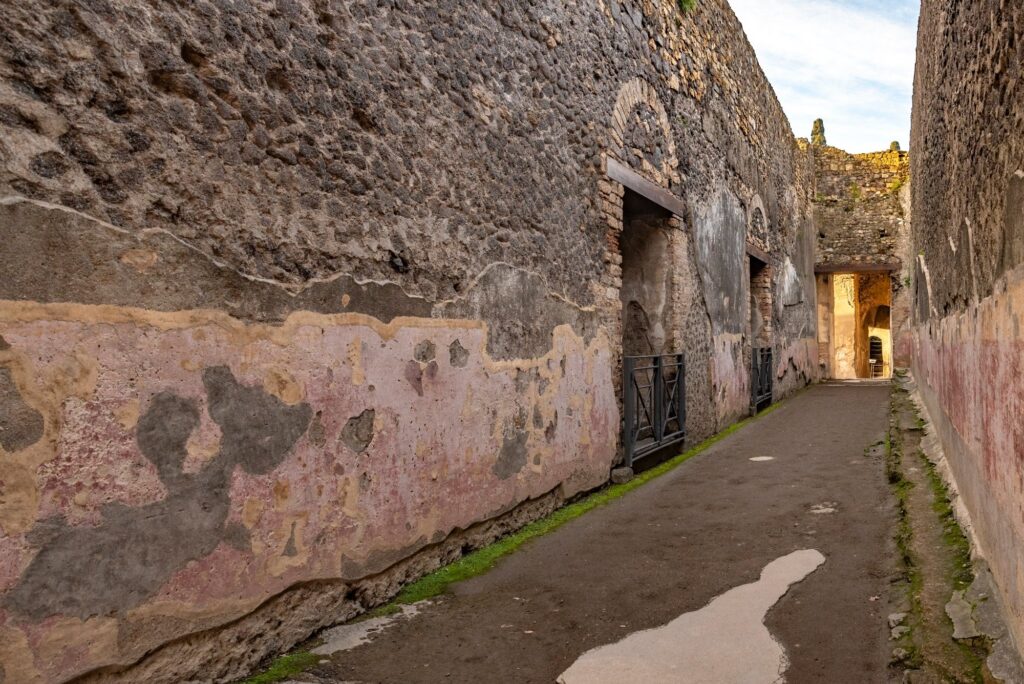
The discoveries were made inside a long, narrow corridor connecting Pompeii’s theater complex, a space once crowded with spectators, passersby, and idle conversation. Although the corridor was first excavated in 1794, many of its inscriptions were too shallow or eroded to be read with the naked eye. That changed with the application of Reflectance Transformation Imaging (RTI) combined with photogrammetry and epigraphic analysis.
A Corridor That Preserved Ordinary Voices
The corridor stretches roughly 27 meters (about 90 feet) and runs between Pompeii’s large open-air theater and its covered theater. Archaeologists have long known it contains one of the densest concentrations of graffiti in the city. These markings range from names and insults to drawings of animals, ships, and gladiators.
What makes this space exceptional is not just the quantity of graffiti, but its social character. Unlike official inscriptions carved for permanence, these marks were informal, spontaneous, and personal. They were left by ordinary people—spectators, locals, travelers—recording fleeting thoughts in a public place.
Until recently, however, scholars suspected that many inscriptions had already been lost to time. The new study proves otherwise.
How 3D Imaging Revealed the Invisible
The research team, led by scholars from Sorbonne University and the University of Québec in Montréal, deployed RTI across the entire corridor. This technique photographs a surface under dozens of controlled lighting angles, allowing software to simulate raking light from any direction. Even the faintest incisions become visible.
To enhance accuracy, the team integrated RTI data into a high-resolution 3D model created through photogrammetry. Each graffito was digitally mapped, annotated, and linked to spatial data showing its precise position on the wall.
As a result, researchers documented around 300 graffiti, including 79 previously unpublished inscriptions that had never been identified before.
Gladiators Carved from Memory
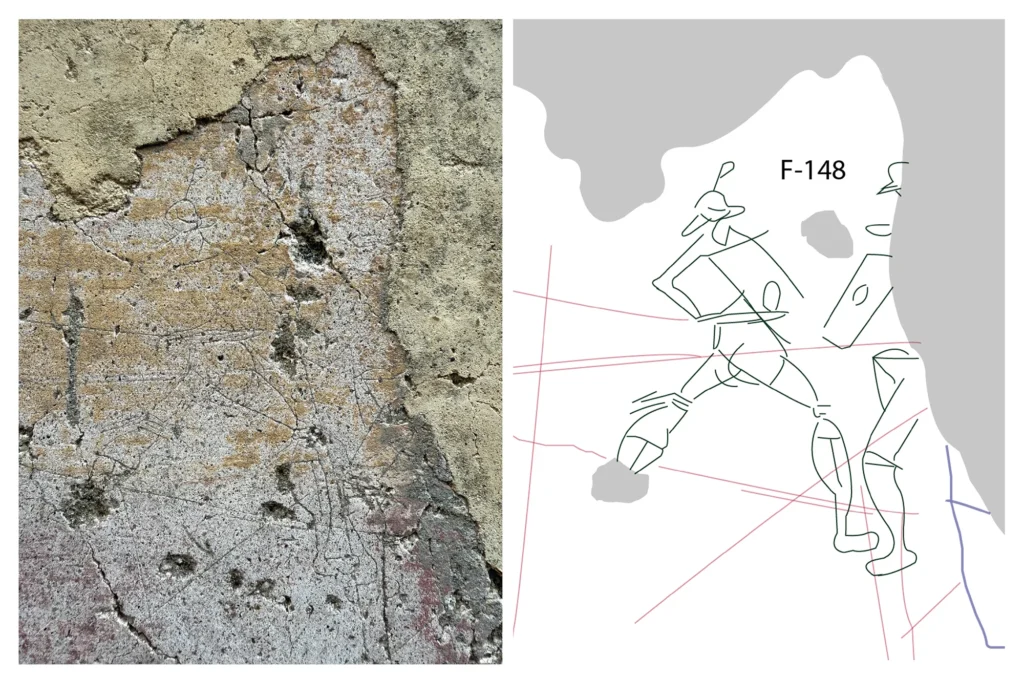
Among the most striking discoveries is a lightly incised drawing of two gladiators locked in combat, positioned near a staircase leading to the theater seating area. Each figure measures only about 10 centimeters (four inches) high, yet the scene conveys remarkable motion.
One gladiator leans backward while advancing his right leg, sword raised, shield forward. His opponent mirrors the stance. The composition suggests movement, balance, and tension rather than static symbolism.
Researchers note that while gladiator graffiti are common in Pompeii, this example stands out for its fluid lines and confident execution. The artist appears to have drawn from memory rather than observation, transforming the spectacle of the arena into a personal visual recollection.
This matters because it shifts how scholars understand popular imagery in Roman cities. Rather than passively copying official art, ordinary people actively re-imagined what they had seen, embedding lived experience into public space.
A Love Message Interrupted by Time
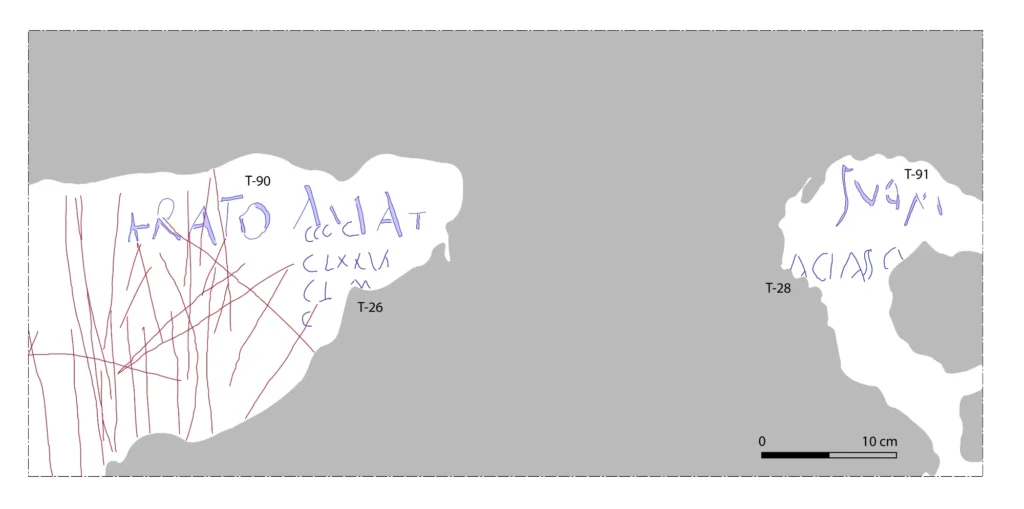
Another newly revealed inscription offers a quieter, more intimate perspective. Fragmented by erosion, the text reads simply: “Erato amat…”—“Erato loves…”
The rest of the message is missing, but palaeographic analysis suggests it once continued across the wall. The name Erato is attested elsewhere in Roman contexts, often associated with enslaved or freed women.
This incomplete sentence echoes other known love inscriptions from the same corridor, including a famous declaration in which a woman named Methe professes love and asks Venus for divine favor. Together, these texts show that emotional expression—affection, desire, longing—was as much a part of Pompeii’s public spaces as political slogans or jokes.
Preserving a Fragile Archive of Human Life
Beyond discovery, the project has a preservation goal. By digitally recording the corridor in extreme detail, researchers have created a lasting archive of inscriptions that are actively deteriorating due to weather exposure and aging plaster.
According to the Archaeological Park of Pompeii, protective measures are already underway, including plans for an overhead covering to shield the corridor from further damage. Digital documentation ensures that even if the physical graffiti fade, their content will remain accessible for future study.
As Pompeii’s director has emphasized, technology is not replacing archaeology—it is expanding it, opening new rooms within a city that continues to speak long after its destruction.
Why These Discoveries Matter
These findings do more than add new drawings to a catalog. They reshape our understanding of literacy, memory, and emotional expression in the Roman world. Graffiti were not random vandalism; they were acts of presence.
A gladiator scratched into plaster, a name written in love—these are not grand historical narratives. They are human ones. And thanks to 3D technology, voices once thought lost are speaking again.
Autin, L., Le Guennec, M.-A., & Letellier-Taillefer, É. (2026). “Bruits de couloir”: Shedding new light on ancient graffiti. e-Journal degli Scavi di Pompei, 2026(1). Parco Archeologico di Pompei.
Cover Image Credit: Corridor running through Pompeii’s theater district. Archaeological Park of Pompeii.
