
8 February 2026 The Future is the Product of the Past

Ancient Waiting Bench Discovered Outside Pompeii’s Villa of the Mysteries

Archaeologists have uncovered an extraordinary find during the latest excavations at the Villa of the Mysteries: an ancient waiting bench positioned directly in front of the villa’s monumental entrance.

While long queues of visitors are a common sight today at Pompeii’s most famous domus, the discovery suggests that the image of people waiting outside this celebrated residence was already familiar nearly 2,000 years ago.

A Bench for Clients, Laborers, and Travelers

The bench, made of cocciopesto (a type of waterproof Roman concrete), was not meant for art lovers eager to admire the villa’s world-renowned Dionysian frescoes. Instead, it likely served clients seeking favors from the villa’s powerful owner, local laborers hoping for work, and wayfarers traveling the road that once linked Pompeii to Boscoreale.

In ancient Rome, patrons would receive their clientes each morning in a ritual known as the salutatio. These individuals, often of lower social rank, relied on their patron for support in legal matters, financial loans, or daily survival. In exchange, they offered loyalty and political backing during elections.

“Sometimes those waiting outside did not know if they would even be received that day,” explained Gabriel Zuchtriegel, Director of the Archaeological Park of Pompeii. “People killed time by scratching graffiti into the walls—fragments of names, dates, or idle remarks that have survived to this day.”


📣 Our WhatsApp channel is now LIVE! Stay up-to-date with the latest news and updates, just click here to follow us on WhatsApp and never miss a thing!!


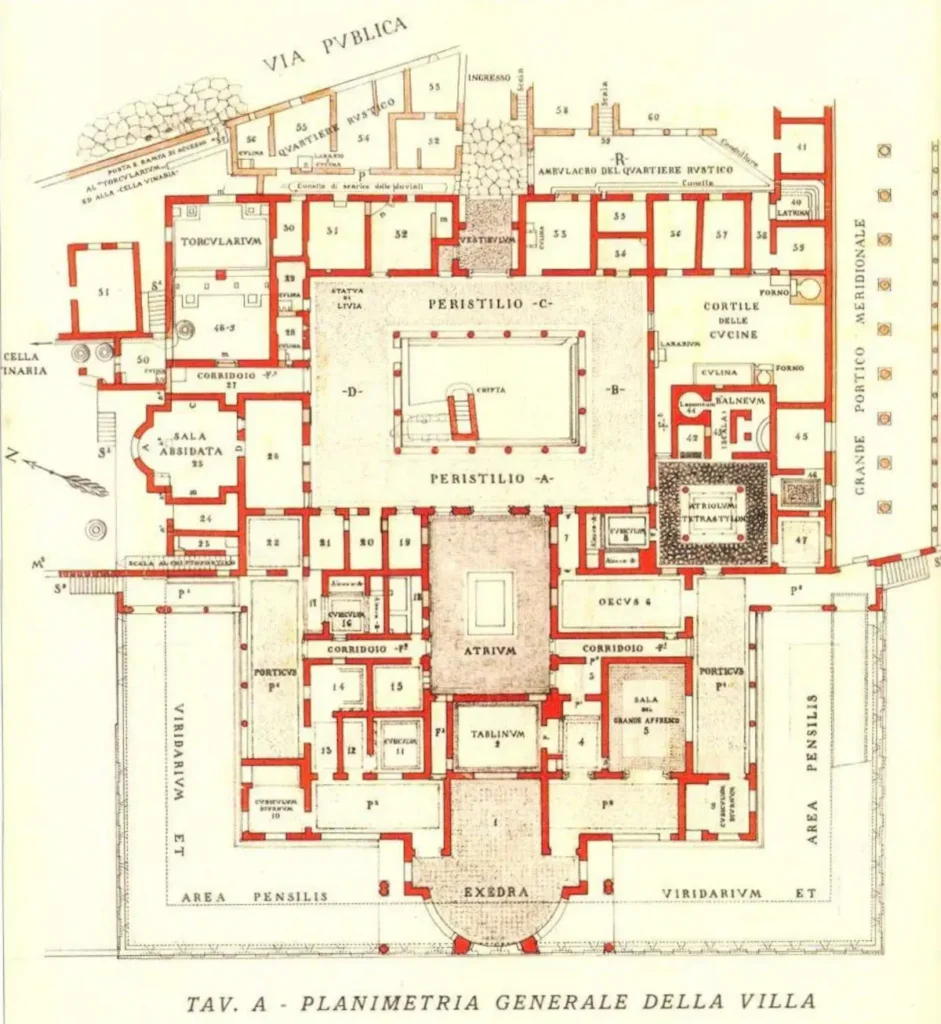
Ancient floor plan of the Villa. Credit: Ministry of Culture - Pompeii Archaeological Park.
Ancient floor plan of the Villa. Credit: Ministry of Culture – Pompeii Archaeological Park.

Excavation Reveals Layers of History

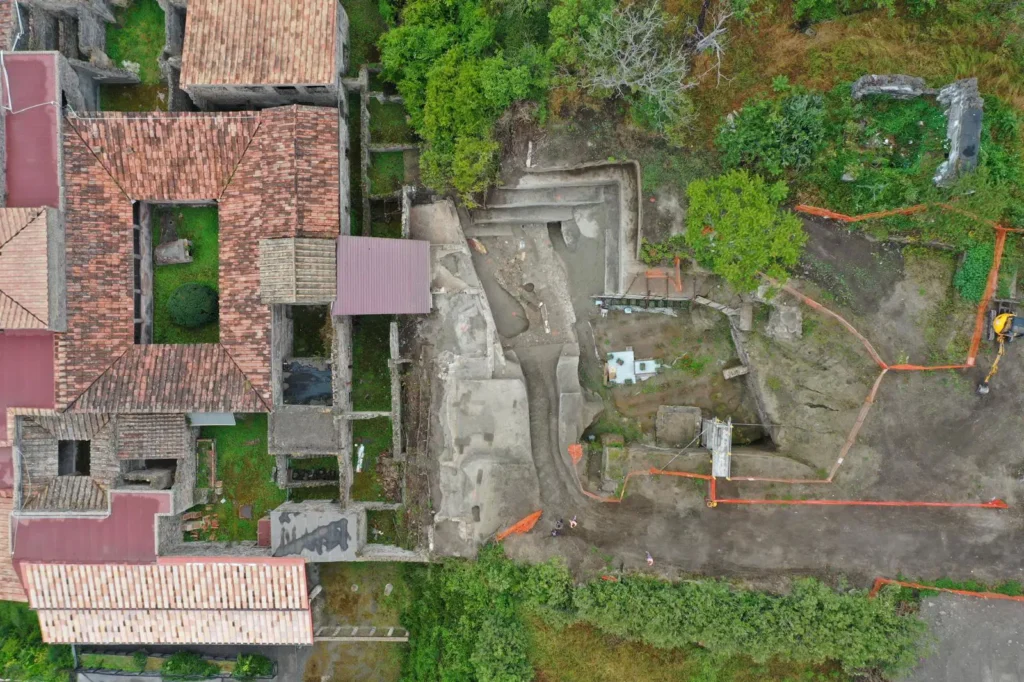
The find comes from recent archaeological investigations on the north-western front of the Villa of the Mysteries, one of the most iconic monuments of Pompeii and the entire ancient world. The project was relaunched following the demolition of illegal structures that once overshadowed the site.

Excavations exposed:

The villa’s monumental entrance along the ancient Via Superior, paved with lava stone.

Sections of the building still sealed beneath volcanic material from the eruption of AD 79.

Refined Third Style wall paintings with black and yellow backgrounds and elegant ornamental motifs.

A vaulted cistern connected to an advanced water management system.

Clear stratigraphic layers of pumice and pyroclastic flows from the eruption, offering crucial scientific evidence.

Even traces of Roman agricultural practices in the form of a paleosol prepared with “conchette,” a soil-arrangement technique for crop management.
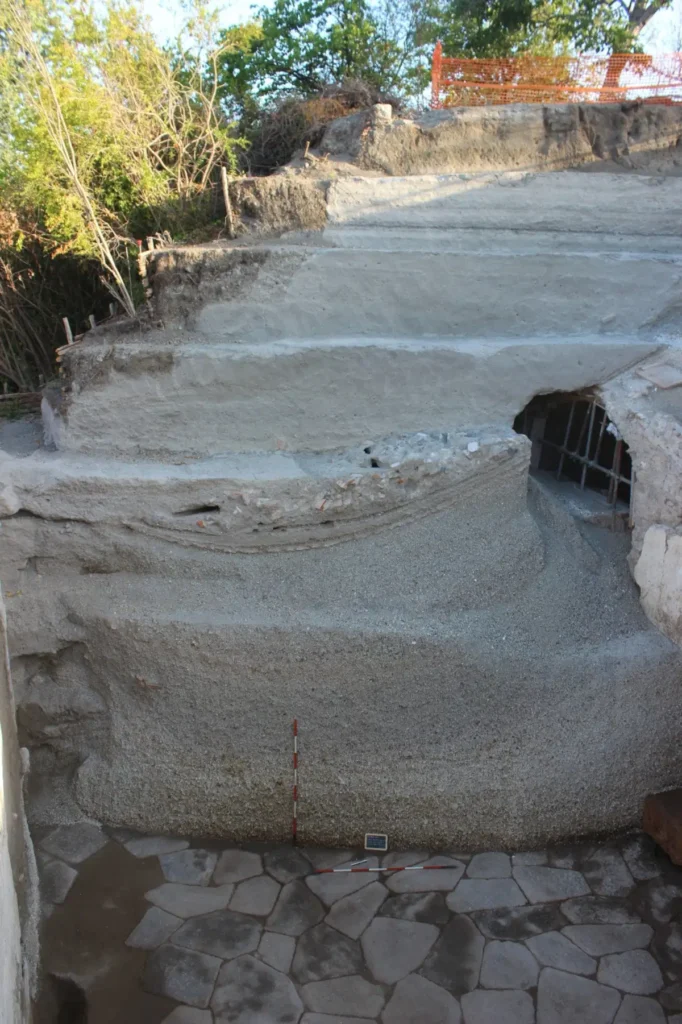
Stratigraphy. Credit: Ministry of Culture - Pompeii Archaeological Park.
Stratigraphy. Credit: Ministry of Culture – Pompeii Archaeological Park.

Social Symbolism of Waiting Benches

Benches such as this one were not unique to the Villa of the Mysteries. Similar examples are found outside other Pompeian houses, symbolizing the prestige of their owners. The more crowded the bench, the more influential the patron inside was perceived to be—much like a bustling waiting room at a modern medical office.

“The bench is a reminder that the villa was not only a private residence, but a hub of political and economic power,” noted researchers. “It reflects how strongly the estate was embedded in the community and social fabric of Pompeii.”
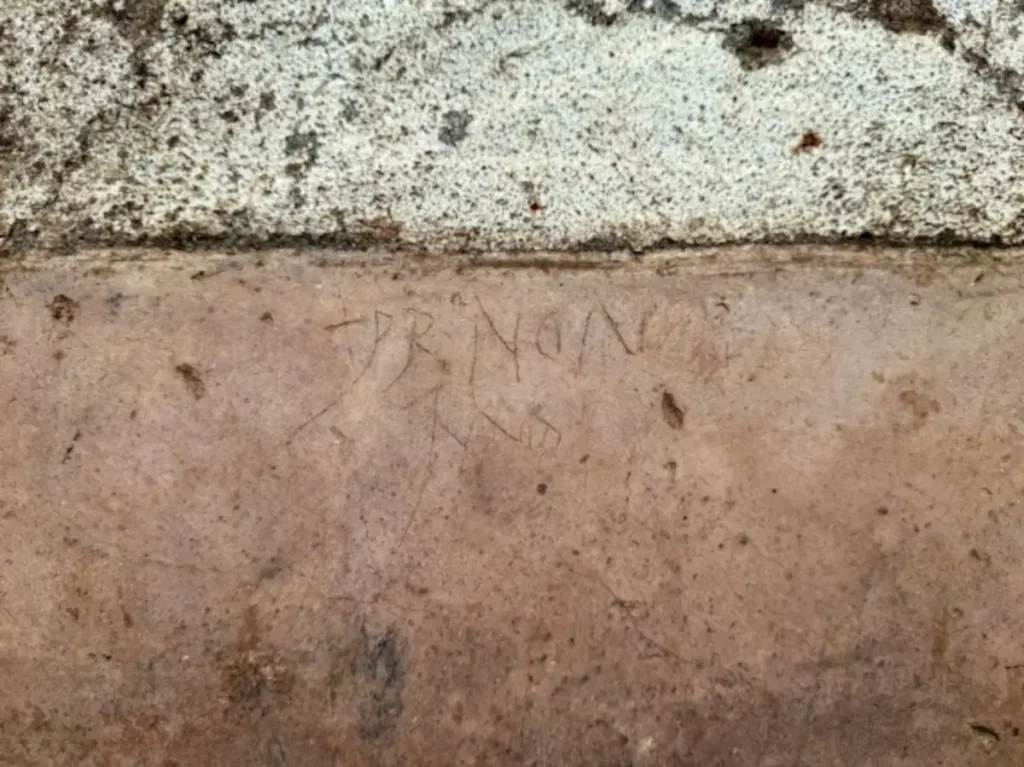
Graffiti. Credit: Ministry of Culture - Pompeii Archaeological Park.
Graffiti. Credit: Ministry of Culture – Pompeii Archaeological Park.

A Site for All, Then and Now

What was once an exclusive privilege of the elite is now accessible to millions of visitors from around the world. Today, the Villa of the Mysteries is among Pompeii’s most visited landmarks, particularly on Italy’s monthly free-admission Sundays.

The ongoing excavations aim to complete the exploration of the villa’s still-buried areas, particularly the servants’ quarters, promising new insights into daily life, social dynamics, and the management of one of antiquity’s most fascinating residences.

Archaeological Park of Pompeii

Cover Image Credit: Ministry of Culture – Pompeii Archaeological Park.

Related Articles

The newly discovered fossils are 200,000 years old in Denisova Cave

29 November 2021

29 November 2021

Scientists have discovered the earliest remains of a human lineage known as the Denisovans. Researchers have identified stone artifacts connected...

Unique ‘Good Shepherd Jesus’ Fresco Unearthed in Iznik: A One-of-a-Kind Discovery in Anatolia

10 December 2025

10 December 2025

Archaeologists in Türkiye have uncovered a remarkable Early Christian fresco depicting the ‘Good Shepherd Jesus’, a motif rarely found in...

Folded Gold Diadem discovered in Ancient Burial Urn in Southern India

12 August 2022

12 August 2022

A gold diadem, bronze, iron objects, and pottery were reportedly found in a burial urn at the archaeological site of...

Hand disease known as Viking disease may have its origins in Neanderthal genes

14 June 2023

14 June 2023

A recent study in the Oxford University Press journal Molecular Biology and Evolution demonstrates that a condition known as Dupuytren’s...

2400-year-old artifacts discovered in the Black Sea’s first scientific underwater excavation

25 March 2024

25 March 2024

Dozens of historical artifacts dating from the 4th century BC to the 12th century AD were unearthed in the first...

Flint tools found in Tunel Wielki Cave, Poland, about half a million years old

9 October 2022

9 October 2022

Flint tools discovered over 50 years ago in the Tunel Wielki Cave (Maopolskie region) are not tens of thousands of...

Medieval Underground Tunnel Discovered Inside a 6,000-Year-Old Neolithic Burial Site in Germany

1 February 2026

1 February 2026

A remarkable archaeological discovery in central Germany has revealed a rare medieval underground tunnel hidden within a much older Neolithic...

Dragon-Adorned Gilt-Bronze Armor Found in Japan’s Kofun Tombs

6 January 2026

6 January 2026

Archaeologists in Japan have announced a remarkable discovery that could reshape scholarly understanding of elite craftsmanship and power networks in...

2,000-year-old Roman pewter hoard discovered in Suffolk

4 July 2023

4 July 2023

A rare hoard of Roman pewter has been discovered in Euston, western Suffolk, in eastern England. The rare discovery includes...

An Iron Age Necropolis was discovered in the Normandy, northwestern France

11 May 2022

11 May 2022

A modest Iron Age agricultural settlement excavated at Blainville-sur-Orne in Normandy, northwest France, led to the unexpected discovery of a...

A marble slab with an inscription from the 2nd century was discovered during excavations in Bulgaria

18 October 2023

18 October 2023

Archaeologists discovered a 1,900-year-old marble slab bearing an ancient Greek inscription in the Roman Baths of Hisarya, a small resort...

South Ockendon’s Belhus Park Golf Course: A Tudor Garden Discovered

15 July 2021

15 July 2021

Under a golf course, the ruins of Tudor and Jacobean gardens were unearthed. Aerial images of Belhus Park Golf Course...

Researchers able to reconstruct the development of Barbegal’s former watermills over time with the help of carbonate deposits

7 July 2024

7 July 2024

Archaeologists are faced with a difficult task: how can information be obtained about buildings or facilities of which – if...

The identities of the occupants of the unspoiled 4th-century BCE Royal Tombs at Vergina in northern Greece have been identified

26 January 2024

26 January 2024

The identities of the occupants of the unspoiled 4th-century BCE Royal Tombs at Vergina in northern Greece have been identified....

A 11,000-Year-Old Neolithic “Amphitheater” Discovered at Karahantepe

28 November 2025

28 November 2025

Archaeologists working in the arid hills of southeastern Türkiye have uncovered one of the most intriguing architectural discoveries of the...