
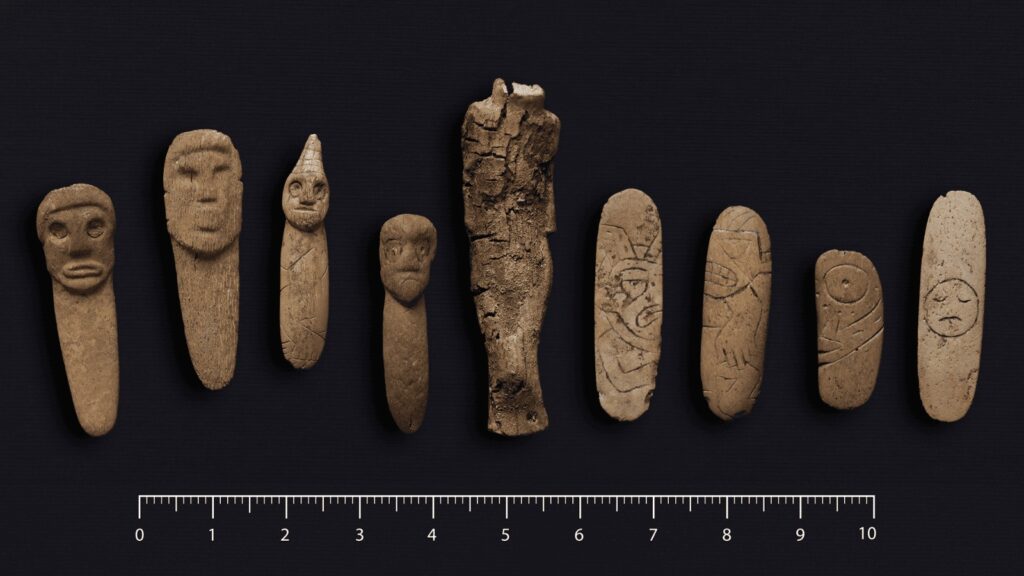
A compact ceremonial deposit containing carved wooden and bone objects, including ornaments engraved with the so-called “Eye of God” motif, offers new evidence that traditions associated with the Caral civilization continued at Peñico after the decline of its principal urban centers.
Archaeologists working at Peñico, an ancient urban center in Peru’s Huaura Province, have uncovered a ritual offering dating back approximately 3,800 years.
The deposit was found in subsection B1-B3 of Peñico’s Main Public Building. Researchers believe it was placed during a consecration ceremony connected with the construction of a new architectural platform.
The discovery was made by specialists from the Caral Archaeological Zone of Peru’s Ministry of Culture under the direction of archaeologist Ruth Shady Solís. According to Peru’s state news agency Andina, the find strengthens evidence that cultural practices developed by the Caral civilization survived and changed at Peñico after Caral’s major cities lost their influence.
Forty-three objects placed inside a tiny ritual space
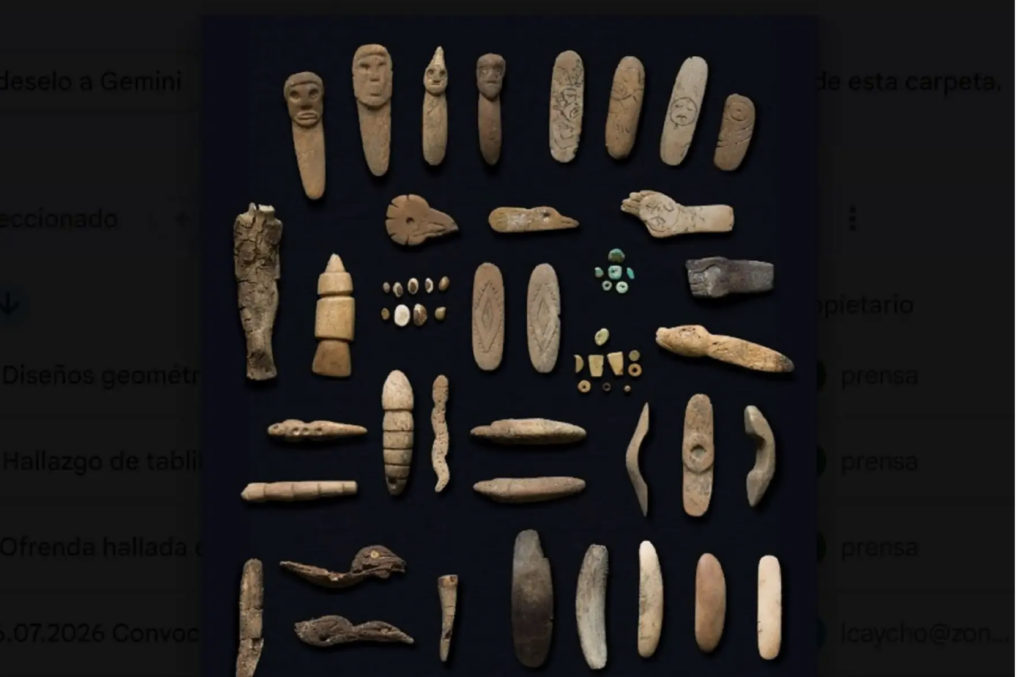
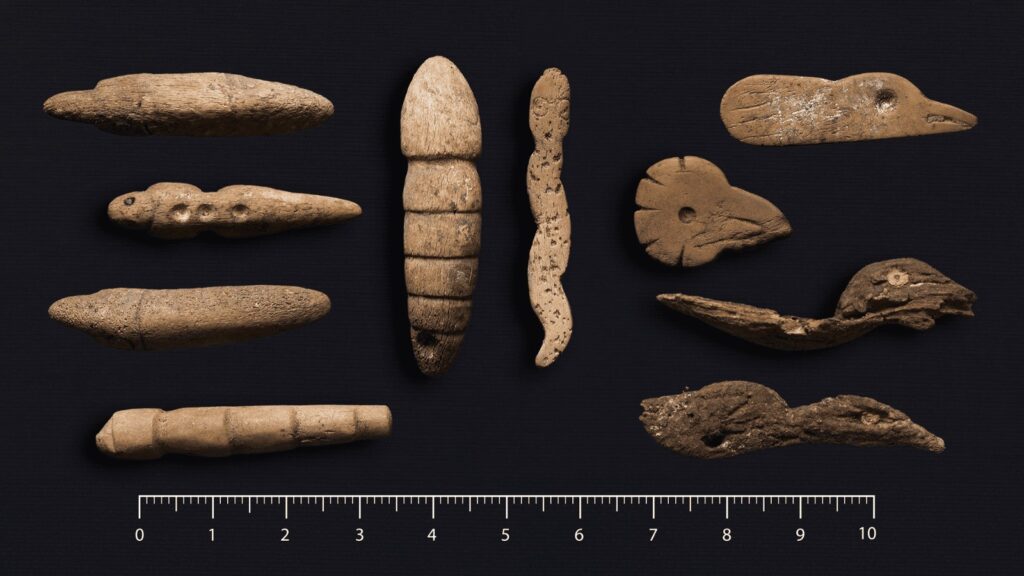
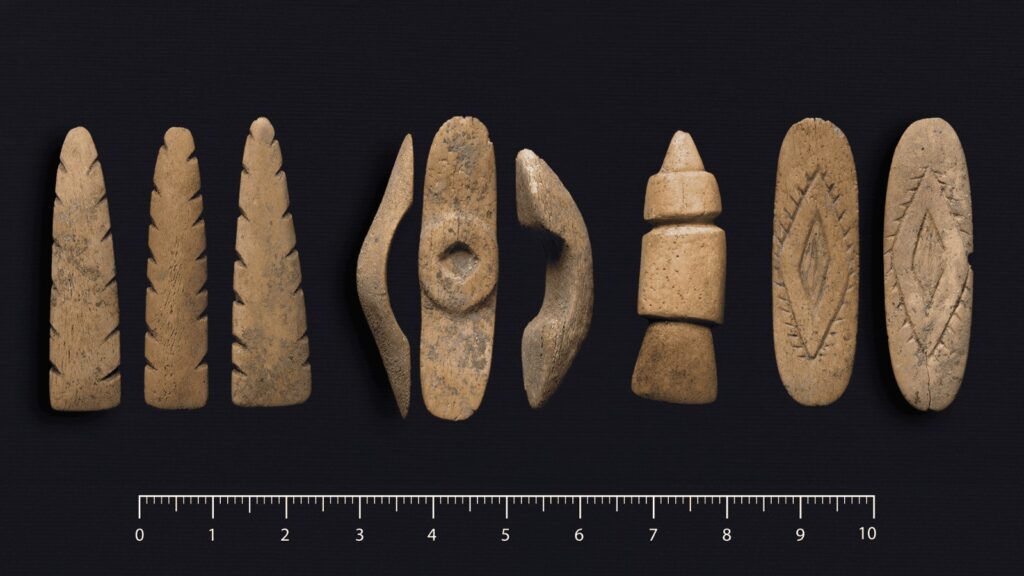
The central group consists of 43 objects made from wood and bone. Many bear incised designs, while several show signs of exposure to fire.
Among them are representations of mythical beings, birds, snakes, and tadpoles, as well as geometric and abstract forms. The anthropomorphic pieces include a female figure and other individuals interpreted by researchers as possible authority figures.
Several objects contain small cavities apparently prepared for mineral or semiprecious-stone inlays, supporting their interpretation as ceremonial pieces rather than everyday tools.
The offering also contained three beads, three fragments of chrysocolla, pieces of beads made from terrestrial gastropod shells, and nine eye-shaped elements carved from mollusc shell. Archaeologists believe the shell eyes may once have been attached to larger sculptures. Eight additional small objects remain under investigation.
Despite the number of objects, the deposit occupied a space measuring only 22 centimeters in length. River stones had been arranged around it in a semicircle before the contents were covered with soil and sealed beneath a large stone.
The careful arrangement suggests that the objects were not discarded. They were deliberately placed during a planned ritual marking an important stage in the building’s construction.
Fire traces and the “Eye of God” motif
Peñico site director Mauro Ordóñez told Andina that some ornaments carry a design known as the “Eye of God.” Similar imagery has been documented at the earlier city of Caral and in Amazonian regions.
The motif does not by itself prove direct contact with a particular community. However, when considered alongside materials recovered at Peñico, it adds to evidence that the settlement participated in exchange networks extending far beyond Peru’s central coast.
Previous discoveries at the site include feathers from parrots and macaws, depictions of monkeys and Spondylus shells originating in the warm waters of the equatorial Pacific. These materials point to connections linking the coast, the Andean highlands and areas associated with the Amazon.
Peñico carried the Caral tradition forward
Peñico was established around 1800 BCE, when the oldest urban centers of the Caral civilization were declining or being abandoned. The settlement covers approximately 19.44 hectares and contains at least 15 public buildings.
Located about 600 meters above sea level in the upper-middle Supe Valley, Peñico occupied a strategic position between coastal and highland communities. Goods from forest regions also reached the settlement, indicating that it served as an important center of social, economic, and ceremonial interaction.
Researchers have identified similarities between the newly uncovered objects and material associated with earlier Caral sites, including the choice of materials, incision techniques and recurring iconographic patterns.
The offering therefore provides evidence of continuity rather than a complete cultural break. Ritual practices, architectural traditions and symbolic knowledge survived the decline of the older cities and were adapted within a new political and social setting at Peñico.
Objects conserved and digitally reconstructed
The offering was originally discovered in December 2025. The objects subsequently underwent cleaning and conservation work.
Thirty-two pieces were presented at Peru’s Ministry of Culture in July 2026, while the remaining objects continued to receive conservation treatment. Interactive three-dimensional reconstructions were also produced, allowing visitors to enlarge the small artifacts and examine their incisions, cavities, traces of red pigment, and evidence of burning.
Ministerio de Cultura del Perú
Cover Image Credit: Ministerio de Cultura del Perú
