

A copper-alloy object barely 2.4 centimeters across has made a small Late Bronze Age hoard from eastern England unusually difficult to interpret. Found beside two socketed axes near Barton Turf in Norfolk, the roughly 3,000-year-old object has been classified as a “button,” although archaeologists cannot yet say whether it ever fastened clothing at all.
The find is rare on its own. Only 19 Bronze Age objects classified as buttons have been recorded through the Portable Antiquities Scheme, and the Barton Turf example is only the third known from Norfolk. Its form also appears to set it apart, with a conical boss rising from the center of a deep concave field surrounded by a thick outer rim.
Yet the object becomes more interesting when considered alongside the two axes buried with it. It also adds another small piece to a much wider archaeological story at Barton Turf, where a separate and far larger Late Bronze Age metal hoard had already been discovered.
An object that looks familiar, but may not be
The newly reported hoard was discovered in stages by a metal detectorist. The first socketed axe came to light in March 2021, while a second axe and the circular copper-alloy fitting were recovered from the same site in 2023.
Specialists believe all three objects were deposited together sometime between 1000 and 700 BC. The assemblage has since been declared treasure, and Norwich Castle Museum hopes to acquire the unusual button.
On its reverse, the small object carries a short rectangular loop that would have allowed it to be attached to something. What that “something” was remains unresolved, and that uncertainty makes the apparently simple label “button” more complicated than it first appears.
Modern readers naturally associate a button with clothing, but the archaeological evidence does not yet support such a precise interpretation. No comparable example from Britain has survived in a context that clearly demonstrates how it was attached or exactly what role it played.
A small number of related objects are known from Bronze Age graves elsewhere in northwestern Europe. Even those examples have not established whether such fittings fastened garments, served as personal decoration or were attached to another object, such as horse equipment.
“The exciting thing is when we see it, we call it a button, but in the UK context we have never found it showing how it was attached,” Bronze Age small finds specialist Dr Ed Caswell told the BBC. His comment points to a familiar archaeological problem: modern terminology can sometimes make an ancient object sound better understood than it really is.
Norfolk Finds Liaison Officer Dr Helen Geake raised the same uncertainty when discussing the discovery. Without finding one of these objects preserved in its original position on clothing, leather or another material, archaeologists have little basis for deciding whether Bronze Age people used it in anything resembling the way buttons are used today.
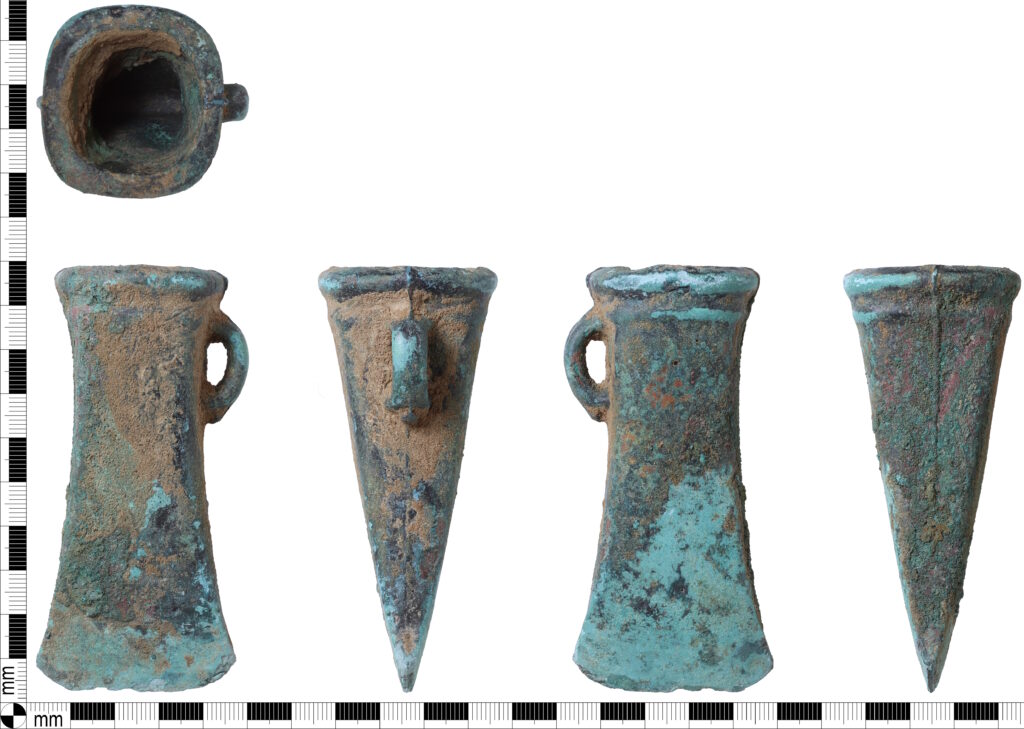
Why bury two usable axes?
The two socketed axes introduce a second question. Neither appears to have been discarded simply because it was broken or had reached the end of its useful life, which makes their presence in the ground harder to explain as ordinary rubbish.
Caswell said the condition of the axes strengthens the possibility that all three objects were deliberately deposited. “This type of button is only found in the late Bronze Age, and to find it with axe heads, when they are all perfectly usable, does suggest it was intentionally deposited in the ground,” he told the BBC.
Intentional deposition, however, does not automatically mean ritual sacrifice or religious offering. Bronze Age metal hoards have generated competing explanations for decades, ranging from stores of valuable bronze intended for later recovery to material set aside for recycling, displays of wealth and deliberate deposits with social or symbolic meanings.
Those interpretations do not necessarily exclude one another. A metal object could hold economic value and social significance at the same time, while the motives for depositing one hoard may have differed considerably from those behind another.
The Barton Turf group is therefore interesting precisely because it combines familiar and unfamiliar elements. Socketed axes are well represented in Late Bronze Age hoards, but the addition of an exceptionally rare fitting introduces an object whose original function remains uncertain.
Barton Turf has produced another major Bronze Age hoard
This is not the first significant Late Bronze Age metal deposit known from Barton Turf. A separate hoard previously found in the parish contained at least 44 objects and was assigned to the Ewart Park phase, one of the final major metalworking traditions of the British Bronze Age.
The earlier assemblage was included in archaeologist Christopher J. Griffiths’ large-scale study of Bronze Age hoarding in Britain and Northern Ireland. Published in the Proceedings of the Prehistoric Society, the research examined 385 hoards reported between 1997 and 2021 and compared their composition, chronology and geographical distribution.
The older Barton Turf hoard stood out even within that substantial dataset. Griffiths grouped hoard contents into broad categories including axes, weapons, ornaments, tools and material connected with metalworking, and the Barton Turf assemblage was one of only three Late Bronze Age mixed hoards in the study to contain material from all six categories.
That does not mean the newly reported three-object hoard and the earlier 44-object assemblage were connected. There is currently no evidence that they came from the same precise location, were deposited by the same community or reflected the same practice, and treating them as parts of one archaeological event would go beyond what the evidence can support.
Their shared geographical and chronological setting is nevertheless notable. Barton Turf has now produced more than one example of metal objects being deliberately removed from circulation during the closing centuries of the Bronze Age, even if the circumstances behind each deposit remain unknown.
A period when more metal was going into the ground
The pattern is much broader than Norfolk. Griffiths’ study identified a major increase in metal hoarding toward the end of the British Bronze Age, with the Ewart Park phase producing more hoards in the dataset than the preceding several centuries combined.
Axes were particularly prominent among the objects selected for deposition. Their repeated appearance suggests that the Barton Turf finds belong to a much wider Late Bronze Age practice in which substantial quantities of usable metal were being placed in the ground rather than simply remaining in circulation.
That wider context changes how the new discovery can be read. Two socketed axes fit comfortably within a well-established pattern, while the small object buried with them is the element that makes this particular hoard unusual.
Its modern name may eventually prove correct, but for the moment “button” is better understood as an archaeological classification than a confirmed description of its Bronze Age function. The discovery leaves archaeologists with two related questions: what was this rare object actually used for, and why was it placed in the ground beside two axes that could still have been used?
Those questions are unlikely to be answered by the three objects alone. What the Barton Turf hoard does provide is another glimpse of a period when communities across Britain were repeatedly choosing to take valuable bronze objects out of everyday circulation—and, in this case, placing an unusually rare fitting among them.
