
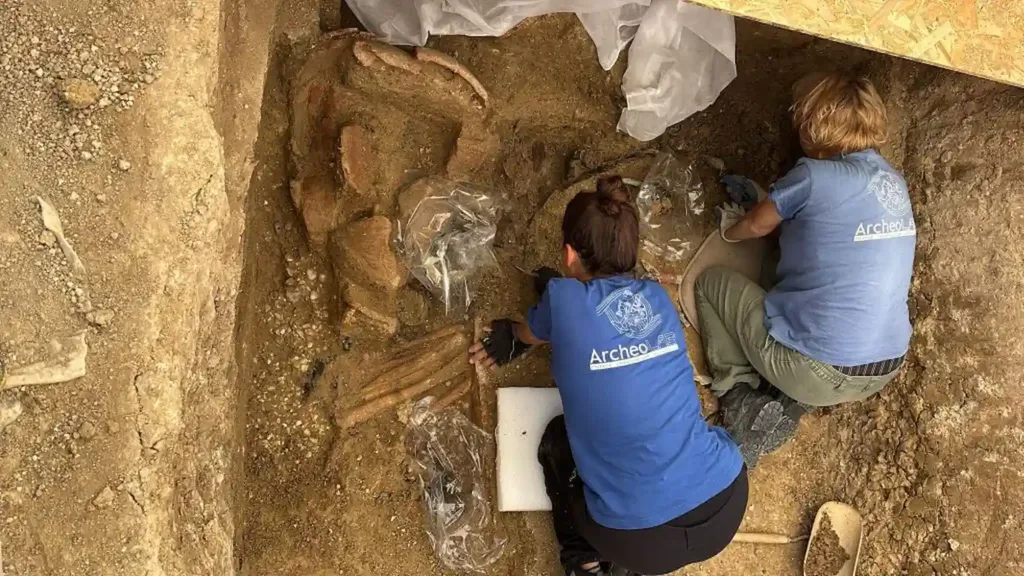
Archaeologists in central Italy have uncovered a 6th-century BC Picene funerary complex near Sirolo, in the Marche region, revealing a princely tomb with the remains of a two-wheeled chariot, weapons, and large bronze vessels still sealed with ceramic lids.
The discovery was made during preventive archaeology investigations promoted by the Superintendency of Archaeology, Fine Arts and Landscape for the provinces of Ancona and Pesaro and Urbino, carried out by ArcheoLab in collaboration with the municipality of Sirolo. The excavation was supported by extraordinary funding from the Italian Ministry of Culture.
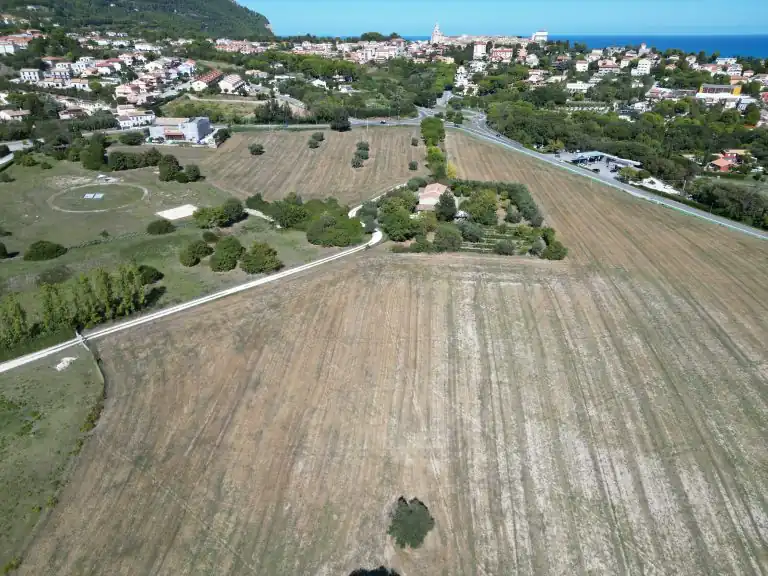
The site lies near the well-known I Pini necropolis and not far from the famous “Queen’s Tomb” of Sirolo-Numana, one of the richest Picene burials known from the Adriatic Iron Age. The new find does not stand alone. It appears to form part of a larger aristocratic cemetery, helping archaeologists place a warrior tomb discovered in 2020 on Via del Leccio within its original social and funerary setting.
A chariot burial at the center of the monument
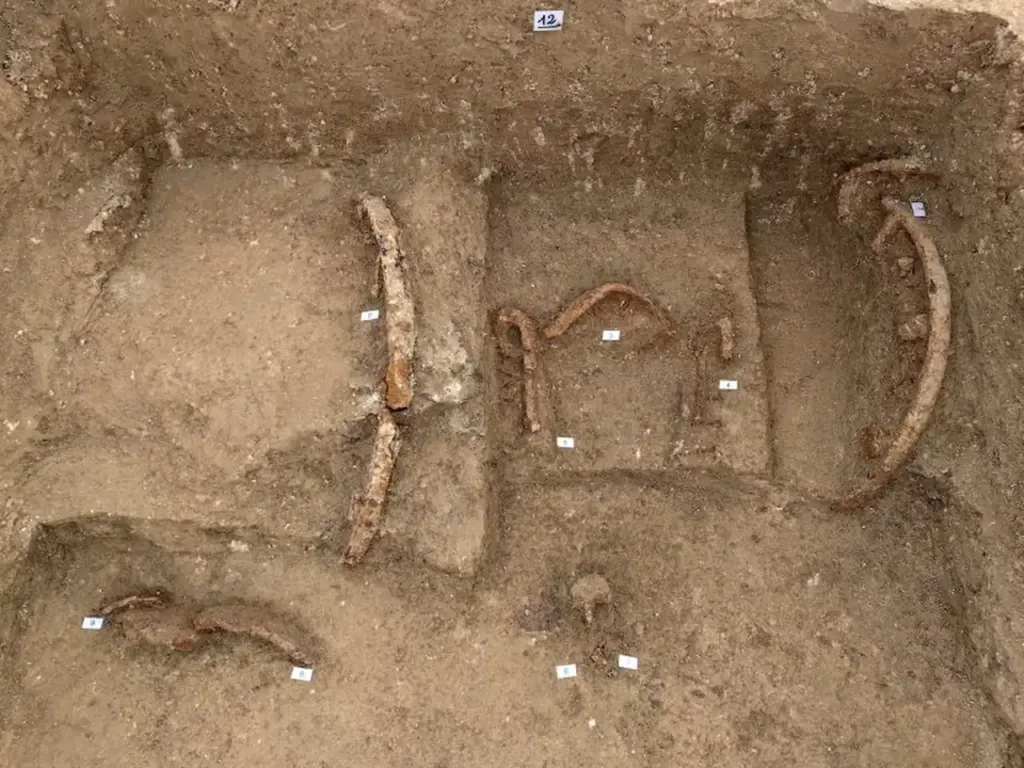
At the heart of the newly identified funerary circle, archaeologists found a large male burial containing the remains of a currus, a two-wheeled chariot probably placed intact inside the grave pit. In Picene and broader pre-Roman Italy, chariots in tombs are usually read as markers of elite rank rather than ordinary transport.
The grave goods include weaponry, among them a helmet, an axe, and other offensive weapons. Some objects are still undergoing restoration and study, but early observations suggest they may belong to forms of authority display not yet well documented in Picene archaeology.
This is important because Picene elite tombs often speak through objects: weapons, bronze vessels, imported goods, amber ornaments, and items connected to banqueting. In a society without the kind of written historical record available for Rome or Greece, these grave assemblages are among the main sources for reconstructing social hierarchy, political power, and external contacts.
Still-sealed vessels may preserve traces of a funeral banquet
One of the most striking elements of the burial is a group of large bronze sheet containers found inside the chariot tomb. They were sealed with ceramic lids and still contained organic material, ceramic fragments, and animal bone remains.
For now, the interpretation should remain cautious. These contents may preserve traces of the funeral banquet held during the burial, or food offerings placed with the deceased for the afterlife. In either case, the vessels point to the importance of commensality — eating, drinking, and display — in Picene aristocratic funerary ritual.
Such evidence is valuable because banquet equipment in elite graves was not merely practical. It helped represent status. A high-ranking individual was not only buried with weapons, but also with objects that framed him as a host, leader, and participant in wider aristocratic customs shared across central Italy.
A rare palisade instead of the usual ditch
The architecture of the monument is also unusual. Large Picene funerary circles are generally marked by ring-shaped ditches cut into the ground, often with a V-shaped section. These ditches created a visible boundary between the space of the living and the space reserved for the dead.
At Sirolo, however, the boundary was not a ditch. Archaeologists identified a ring-shaped palisade, visible through a regular sequence of post holes. At the bottom of some of these holes, they found small deposits made of selected ceramic fragments, suggesting that the construction of the enclosure itself had a ritual component.
This makes the monument more than a rich grave. It adds a new architectural form to the funerary landscape of the Piceni and may change how archaeologists understand elite burial spaces in the Conero area.
The 2020 warrior tomb now has a wider context
The new complex also helps explain the warrior tomb found in 2020 on Via del Leccio. That burial belonged to a man who lived in the second half of the 6th century BC and was buried with a high-status military kit: helmet, spear, long sword, and dagger.
His grave goods also included a bronze oinochoe of Greco-Etruscan tradition and a rare diphros, a folding stool associated with prestige and command. Until now, that tomb was known as an important but isolated find. The new excavation suggests it belonged to a broader family cemetery organized around a princely burial with a chariot.
Archaeologist Stefano Finocchi, scientific director of the excavation, said the discovery makes it possible to see not a single tomb but an aristocratic nucleus, with hierarchical and symbolic relationships among the burials. According to the published statements, the monumentality of the complex and the quality of the grave goods point to ruling groups connected with wider networks linking the central Adriatic to major centers of central Italy.
A female burial with textiles, footwear, and amber
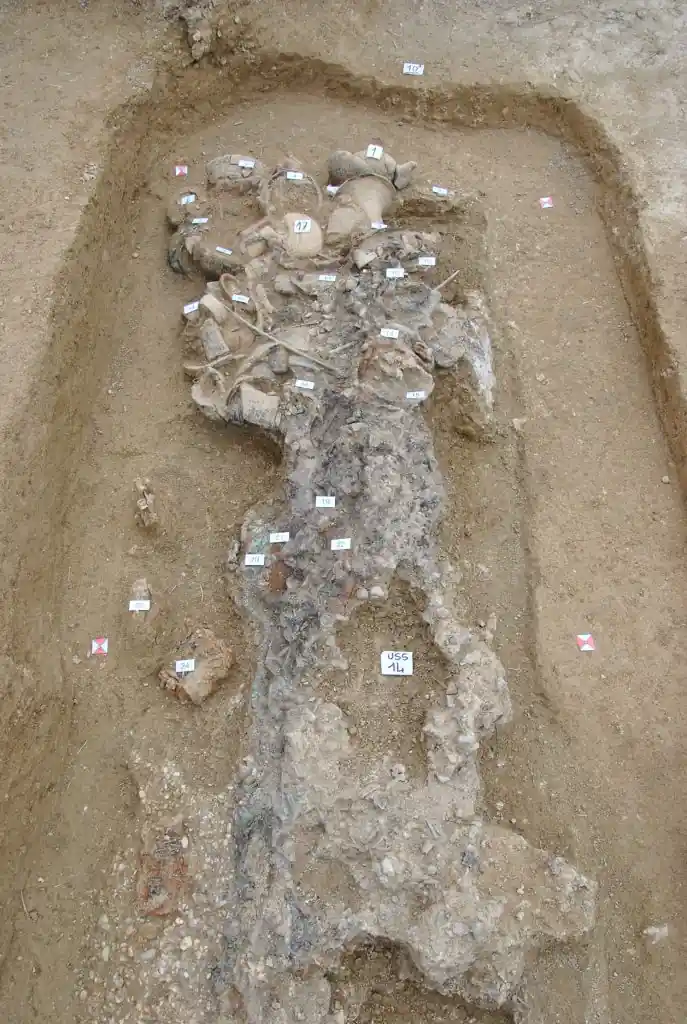
Next to the central tomb, archaeologists also found a female burial. The preservation of organic and delicate materials appears especially important: traces of textiles, ornaments, and footwear with metal elements were documented in their original positions.
Numerous fibulae — brooches used to fasten garments — were placed on the body at the chest, shoulders, pelvis, and feet, suggesting how the clothing and shroud were arranged. A large fibula with an amber core was found beyond the woman’s head and may have belonged to a headdress or hairstyle.
The burial indicates that female prestige in Picene aristocratic groups could be represented through clothing, ornament, amber, and carefully staged funerary display. This is consistent with the wider Picene world, where rich female graves often contain elaborate personal ornaments and objects that signal social rank.
Who were the Piceni?
The Piceni were an Italic people of the central Adriatic, mainly associated with today’s Marche and northern Abruzzo during the Iron Age. Numana, near Sirolo, was one of their major centers, although archaeologists note that much of what is known about ancient Numana still comes from necropoleis rather than settlements.
The region was not isolated. Its elites participated in exchange networks that connected the Adriatic coast with Etruscan, Greek, and other central Italian communities. Objects such as bronze vessels, imported ceramics, amber, weapons, and chariots show how local aristocracies expressed power through both regional traditions and wider Mediterranean contacts.
The comparison with the nearby Queen’s Tomb is unavoidable. In the I Pini archaeological area, that 6th-century BC burial of a Picene noblewoman contained more than 1,700 valuable objects and two chariots, now preserved at the Antiquarium di Numana.
The newly discovered Sirolo complex therefore strengthens an already clear picture: the Conero area was one of the major aristocratic landscapes of Picene Italy. What is new is the combination of a chariot tomb, a probable palisaded enclosure, still-sealed bronze vessels, and associated male and female elite burials within the same monumental nucleus.
Further restoration, laboratory analysis, and study of the sealed vessel contents will be needed before firmer conclusions can be drawn. For now, the discovery offers a rare view of how Picene elites used burial architecture, weapons, banquet remains, clothing, and imported or prestigious objects to project power in life and after death.
Soprintendenza Abap Ancona Pesaro Urbino
Cover Image Credit: Archaeologists excavating the chariot tomb within the newly uncovered 6th-century BC Picene funerary complex near Sirolo, central Italy. Soprintendenza ABAP Ancona Pesaro Urbino
