
17 June 2026 The Future is the Product of the Past

2,600-Year-Old Lost Temple Built of Green Tuff Stone Unearthed at Oluz Höyük, Northern Türkiye

Archaeologists have uncovered a 2,600-year-old temple in northern Türkiye, a monumental sanctuary built from striking greenish volcanic tuff. Discovered at Oluz Höyük (Oluz Mound) near the city of Amasya, the structure is unlike anything recorded in antiquity—absent even from the writings of Herodotus and Strabo—earning it the name of the “lost temple.”

The temple, dedicated to the Anatolian mother goddess Kubaba, has been revealed after nearly two decades of systematic excavation led by Prof. Dr. Şevket Dönmez of Istanbul University. Researchers describe the site as one of the most significant Iron Age cultic complexes ever discovered in the region.

“No ancient author ever mentioned the Oluz Höyük Kubaba sanctuary. Yet here we stand before a massive, enigmatic religious system on the Anatolian steppe,” Dönmez explained.

A Monument of Faith from the Iron Age

Dating to the Phrygian period (8th–6th century BCE), the sanctuary contains altars, a sacred chamber, and a symbolic cult stone representing Kubaba, a deity who later influenced the image of the Phrygian mother goddess Cybele. Its monumental layout suggests that Oluz Höyük was not merely a settlement, but also a regional religious center.

What makes this discovery exceptional is its silence in the historical record. Neither Herodotus, known as the “Father of History,” nor Strabo, the ancient geographer who was born in nearby Amasya, mentioned the existence of such a sanctuary. This absence suggests that Oluz Höyük housed a localized yet powerful cult tradition, hidden from the narratives of the Mediterranean world.


📣 Our WhatsApp channel is now LIVE! Stay up-to-date with the latest news and updates, just click here to follow us on WhatsApp and never miss a thing!!


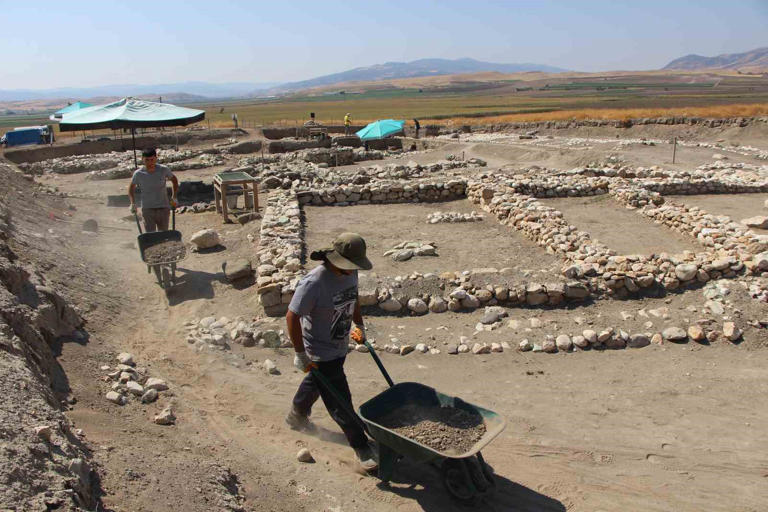
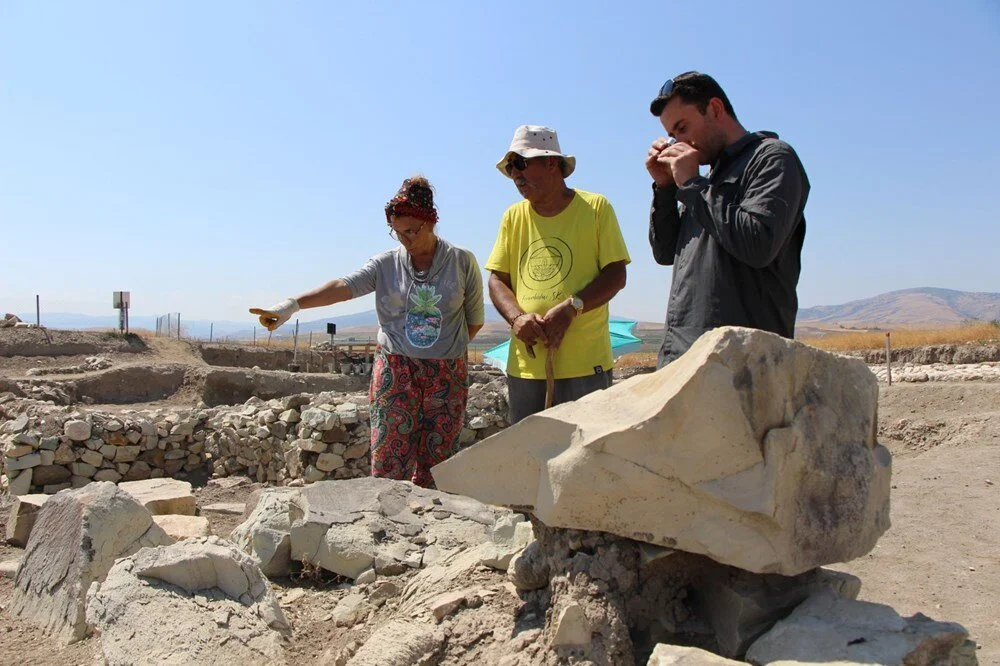
Excavations revealed the temple’s altars, its sacred chamber, and a cult stone representing the goddess Kubaba. Credit: İHA

Built from Volcanic Stone

Geoarchaeological analysis revealed that the temple was constructed from greenish tuff blocks, a fine-grained volcanic stone quarried at Doğantepe, just 10 kilometers away. According to Dr. Ersin Kaygısız, an astrogeologist involved in the study, the choice of material was deliberate:

“The petrographic patterns of the temple stones and the quarry samples are identical. These stones were chosen not only for their striking color but also because they were easier to shape and transport.”

Nearly 90% of Oluz Höyük’s monumental architecture appears to have been built from this distinctive volcanic stone, underscoring its symbolic and practical importance to the community.

A Settlement with 6,500 Years of History

While the Kubaba sanctuary dates back 2,600 years, Oluz Höyük itself has a much deeper past. Excavations reveal continuous occupation layers stretching back 6,500 years, spanning the Chalcolithic, Hittite, Phrygian, and Persian periods. Over the years, archaeologists have unearthed city walls, storage facilities, ritual spaces, and residential zones, painting a picture of a settlement that was both politically and spiritually significant.

The site’s strategic location on the Anatolian steppe made it a crossroads for cultural exchange between Central Anatolia, the Black Sea region, and Mesopotamia. This blending of traditions may explain why a local goddess like Kubaba was worshiped with monumental devotion in Oluz Höyük, even while remaining obscure in broader historical narratives.
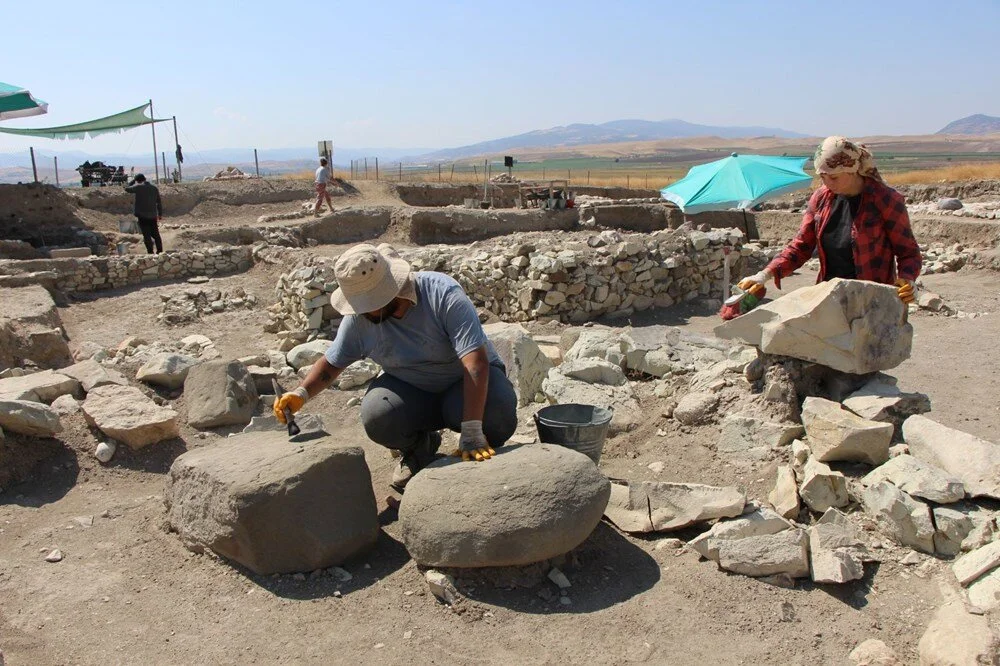
Archaeologists have uncovered a 2,600-year-old temple in northern Türkiye, a monumental sanctuary built from striking greenish volcanic tuff.
Archaeologists have uncovered a 2,600-year-old temple in northern Türkiye, a monumental sanctuary built from striking greenish volcanic tuff. Credit: İHA

Heritage for the Future

The discovery is part of Türkiye’s “Heritage for the Future” project, coordinated by the Ministry of Culture and Tourism. The program supports long-term excavations that preserve and showcase Anatolia’s layered civilizations.

For Amasya, a city already celebrated for its Ottoman architecture and ties to the ancient Kingdom of Pontus, the unveiling of the Kubaba temple offers a new cultural treasure. Archaeologists hope the site will attract both scholarly attention and heritage tourism, placing Oluz Höyük on the global archaeological map.

Why the Temple Matters

The unearthing of the Kubaba sanctuary at Oluz Höyük is more than a local discovery—it is a window into the unwritten histories of Anatolia. It challenges scholars to reconsider how religion was practiced in the Iron Age, outside the better-documented spheres of Greece and Mesopotamia.

By combining volcanic stone architecture, a forgotten cult tradition, and layers of settlement stretching back millennia, Oluz Höyük stands as a reminder of Anatolia’s role as a cradle of civilizations.

As excavations continue, archaeologists believe further secrets may lie beneath the soil. For now, the “lost temple” of Amasya has already reshaped our understanding of faith, identity, and cultural memory in ancient Türkiye.

Cover Image Credit: İHA

Related Articles

2,800-Year-Old Hallstatt Dagger Found on Baltic Coast— A True Work of Art

20 October 2025

20 October 2025

After powerful storms eroded a coastal cliff along Poland’s Baltic shoreline, nature itself unveiled a secret buried for nearly three...

The Famous Cueva de Ardales cave in Spain was used by ancient humans for over 50,000 years

8 June 2022

8 June 2022

Cueva de Ardales cave in Málaga, Spain,  famed for the extensive prehistoric art on its walls was excavated for the...

7,000-Year-Old Animal-Figured Seals Found in Arslantepe, Anatolia’s First City-State

27 August 2024

27 August 2024

Archaeologists working at the Arslantepe Mound (Turkish: Arslantepe Höyük), a UNESCO World Heritage Site in Türkiye’s eastern Malatya province and...

‘Roman numerals’ discovered on Stone of Destiny ahead of King Charles III coronation

8 April 2023

8 April 2023

New research has revealed previously unrecorded markings that appear to be Roman numerals on the Stone of Destiny, considered one...

Ancient Three Fortresses: Layered Defense on Egypt’s Eastern Border at Tell Abu Saifi

11 May 2025

11 May 2025

Archaeological excavations at the strategically significant Tell Abu Saifi site in North Sinai have unearthed compelling evidence of Egypt’s long-standing...

Ancient city site unearthed in Central China produces fortune-telling relics

8 February 2024

8 February 2024

Bone slips used for “fortune-telling activities” and “ancient sacrificial ceremonies” were unearthed during excavations at an archaeological site in Puyang,...

A 4000-Year-Old Seal Found in the prehistoric coastal site of Kalba on the Gulf of Oman

5 April 2024

5 April 2024

Archaeologists discovered a Gulf-type seal made of soft stone dating to the end of the third millennium BC at Kalba,...

The secret of the mummy in the Crystal coffin found in a garage in San Francisco

30 March 2023

30 March 2023

Mysterious mummies are a symbol of ancient lost times, which we often associate with Egypt and other ancient civilizations. Therefore,...

Archaeologists Unearth Exceptionally Preserved Roman Wicker Well in Norfolk, England

4 July 2025

4 July 2025

A team of archaeologists from Oxford Archaeology has uncovered a remarkably intact Roman-era well in Norfolk, England, revealing new insights...

New fibula types discovered at prehistoric Kopilo graves in Bosnia

26 August 2022

26 August 2022

An archaeological dig at Kopilo, a hill settlement founded around 1300 BC about 70 miles west of Sarajevo, has discovered...

Małopolskie Region Reveals Oldest Evidence of Metal Mining in Poland, Dating Back 1,000 Years Earlier Than Previously Thought

16 February 2025

16 February 2025

Researchers have uncovered the oldest confirmed evidence of metal ore mining and metallurgy in Poland through the study of lead...

Private lodges were uncovered in the colosseum of the ancient city of Pergamon

24 September 2021

24 September 2021

Private lodges built for the elite-class people to watch gladiator or wild animal fights shows have been unearthed in the...

2,200-Year-Old Zapotec Lunar Calendar Decoded at Monte Albán, Predating Maya Records by 857 Years

4 June 2026

4 June 2026

The oldest known lunar day count in Mesoamerica may have been hiding in plain sight on the carved stones of...

Unique ‘Good Shepherd Jesus’ Fresco Unearthed in Iznik: A One-of-a-Kind Discovery in Anatolia

10 December 2025

10 December 2025

Archaeologists in Türkiye have uncovered a remarkable Early Christian fresco depicting the ‘Good Shepherd Jesus’, a motif rarely found in...

Newly Uncovered Bronze Age Megasettlement in Wicklow Challenges Long-Held Beliefs About Ireland’s First Towns

2 January 2026

2 January 2026

A major archaeological discovery in County Wicklow may rewrite what historians thought they knew about the origins of urban life...