
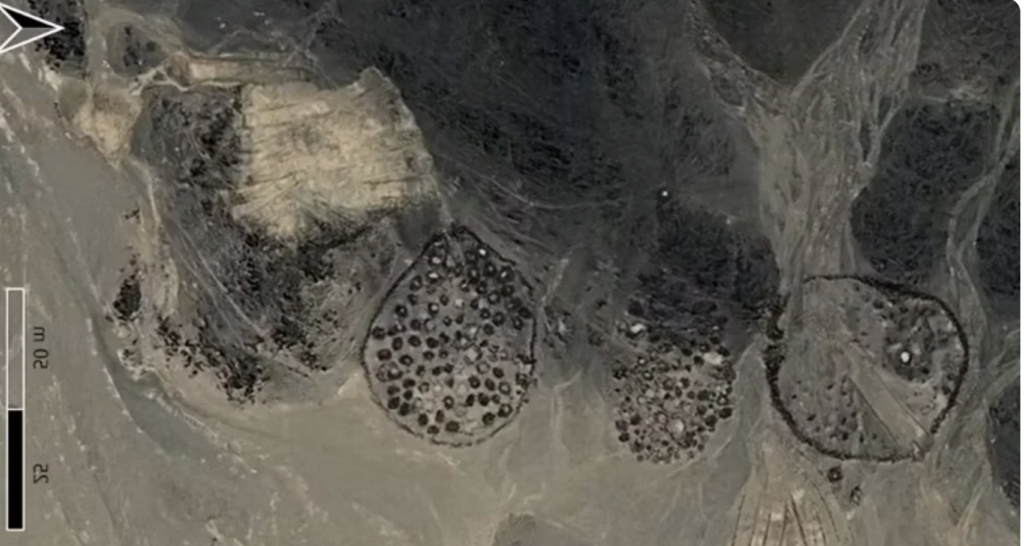
Satellite archaeology has revealed 260 previously unknown stone burial monuments in Sudan’s Atbai Desert, opening a rare window onto life in the Eastern Sahara before the rise of pharaonic Egypt.
In the dry lands between the Nile and the Red Sea, hundreds of stone circles are rewriting what archaeologists know about life in the Eastern Sahara before the rise of pharaonic Egypt.
A new archaeological study has identified 260 previously unknown monumental tombs in the Atbai Desert, a vast and still poorly explored region stretching across eastern Sudan between the Nubian Nile and the Red Sea Hills. The structures, known as Atbai Enclosure Burials, appear to belong to a mobile pastoralist culture that flourished during the fourth and third millennia BC, with some related examples reaching back even earlier.
That makes the earliest phases of this funerary tradition older than Egypt’s pyramids, built centuries later on the Nile Valley’s western edge. But these were not royal tombs of stone-cut corridors and written names. They were circular monuments in the desert, built by herding communities whose wealth moved on four legs.
A desert cemetery visible from space
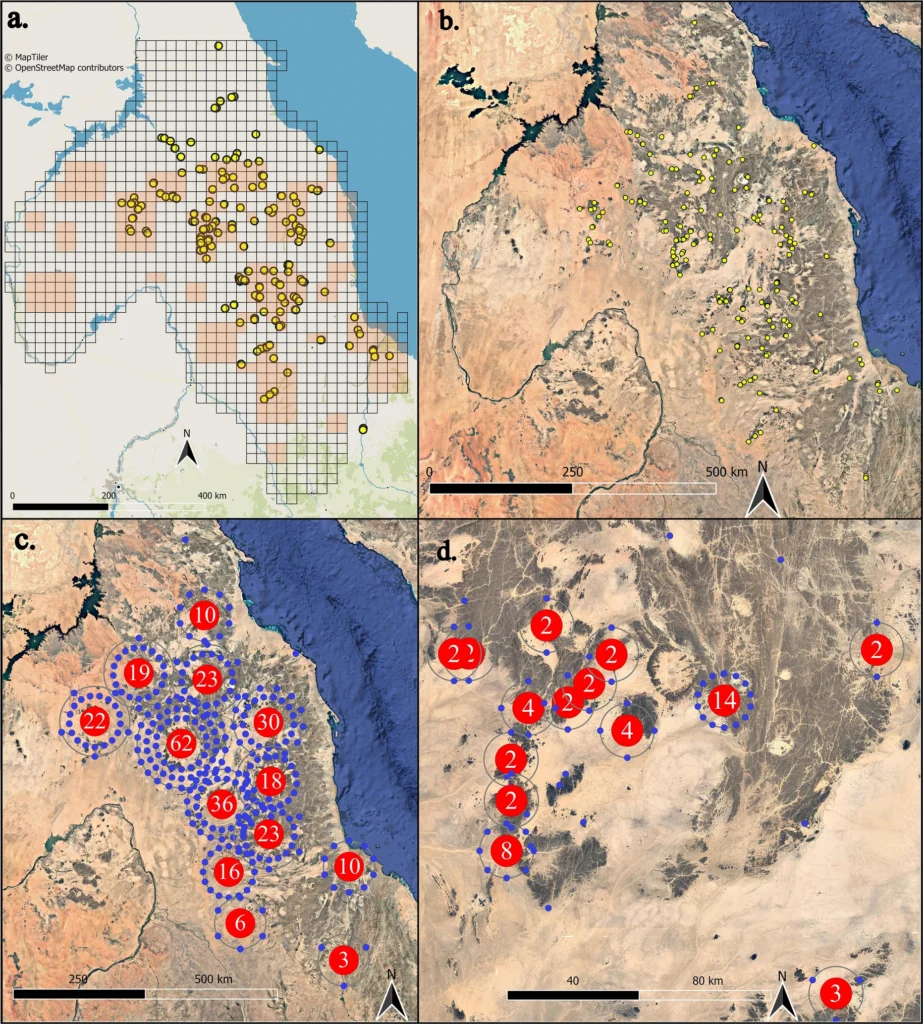
The discovery was made through systematic remote-sensing work by the Atbai Survey Project. Using satellite imagery, researchers mapped circular and oval stone monuments across an enormous desert zone from Upper Egypt toward the Eritrean borderlands.
The study recorded 280 monumental structures in total, including 20 already known from earlier surveys. The remaining 260 were newly identified through satellite analysis.
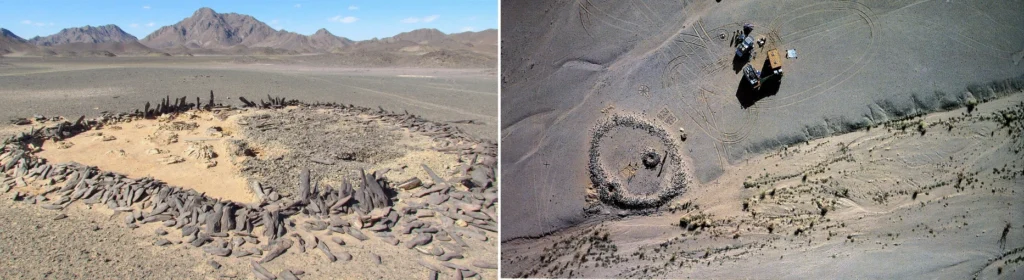
Most are large circular stone enclosures containing internal burials. Some measure only a few meters across, while the largest reach more than 80 meters in diameter. Their scale suggests that these were not ordinary graves, but central places in the social and ritual landscape of prehistoric herders.
Cattle as wealth in a drying Sahara
The most striking detail is what many of these tombs contained. Excavated examples such as Wadi Khashab, Wadi el-Ku, and Bir Asele have produced human remains together with cattle, sheep, and goats.
At Wadi Khashab, archaeologists found a central human burial surrounded by animal burials, including cattle and sheep. This arrangement points to a society in which livestock was not only food or transportable wealth, but also a symbol of rank, identity, and perhaps ancestral power.
In simple terms, cattle were capital. In a landscape where water was becoming harder to find, owning large herds would have marked status in a way that was visible to the entire community. The dead were buried not only with possessions, but with the animals that expressed their social position.
A society forming in the shadow of climate change
The tombs belong to a period when the African Humid Period was ending. The Sahara, once greener and more hospitable, was slowly drying. Monsoon rains retreated. Lakes, seasonal rivers, and grazing lands shrank.
The placement of the tombs is important. Many were built near wadis, former water sources, wells, rock pools, or areas that would have supported pasture. This suggests that the monuments were tied to places where mobile communities gathered, watered their animals, buried their dead, and reinforced group identity.
As the climate became harsher, cattle herding likely became more difficult. Later pastoralists appear to have relied more heavily on sheep, goats, and eventually camels, animals better suited to arid conditions.
A hierarchy in stone
The internal layout of some Atbai Enclosure Burials suggests emerging social inequality. In several examples, one central or focal burial appears to dominate the structure, while other human and animal burials are arranged around it.
Researchers interpret this cautiously. The central individual may have been a leader, elder, ritual specialist, ancestor, or another person of unusual importance. The evidence does not allow a simple label such as “king.” But it does show that these nomadic communities were not socially flat.
They built monuments. They organized burial space. They placed humans and animals in meaningful patterns. They returned to the same sites across generations.
That matters because archaeology has often treated early complexity as something tied mainly to cities, farming villages, and river valleys. The Atbai tombs show that mobile desert societies could also create durable monuments and complex ritual landscapes.
A world beside Egypt and Nubia
The Atbai Desert lies between two famous archaeological worlds: ancient Egypt and Nubia. Yet the desert itself has received far less attention. These newly mapped tombs suggest that the region was not an empty corridor between civilizations, but home to its own pastoralist cultural horizon.
The study does not claim that the tomb builders were Egyptians or members of a single known Nubian culture. Instead, the evidence points to a distinct desert tradition connected to wider Nubian and Saharan patterns of cattle-centered ritual life.
Similar relationships between elite burials and cattle are known from Nubian cemeteries such as Qustul and from pastoralist contexts around the Nile. The Atbai discoveries may therefore help explain how desert herders, Nile communities, and early state formation in northeast Africa interacted before and during the rise of Egypt.
A heritage now under threat
The discovery also carries an urgent warning. Many of these monuments are endangered by illegal and unregulated gold mining in Sudan’s deserts. Heavy machinery, looting, and surface disturbance are destroying archaeological landscapes that have survived for thousands of years.
This is why satellite archaeology has become essential. In areas where fieldwork is difficult or impossible, remote sensing can identify monuments before they disappear.
The Atbai Enclosure Burials are not just tombs. They are the remains of a pastoralist world that adapted to climate stress, turned cattle into symbols of wealth, and marked the desert with monuments long before the pyramids rose beside the Nile.
Cooper, J., Bourgeois, M., Crépy, M. et al. Atbai Enclosure Burials: Monumentalism, Pastoralism and Environmental Change in the Mid-Holocene East Nubian Deserts. Afr Archaeol Rev (2026). https://doi.org/10.1007/s10437-026-09654-y
Cover Image Credit: Cooper, J., et al., 2026, African Archaeological Review
