

Archaeologists excavating the Łysa Góra site in Poland have uncovered the remains of a 2,500-year-old longhouse alongside an ancient bronze coin that traveled nearly 1,500 kilometers from Thrace. Together, the discoveries are providing an unusually detailed picture of an Iron Age community in Mazovia and its contacts far beyond the region.
The site, located in the Chorzele commune of northern Mazovia, has been investigated for three consecutive seasons by researchers from the State Archaeological Museum in Warsaw. Archaeologists associate the settlement primarily with the West Baltic Barrow Culture, but the growing collection of Celtic artifacts suggests that Łysa Góra was far from isolated.
Previous excavations had already produced exceptional objects, including a Celtic bronze helmet dating to around the 4th century BC and an iron instrument interpreted as a tool used for cranial trepanation. The latest season, however, has added evidence not only for long-distance connections but also for how people actually lived at the settlement.
A Longhouse Rarely Seen in This Part of Poland
One of the most important discoveries is a building approximately 17.5 meters long and four meters wide. Archaeologists initially encountered the associated earthworks in 2025 but were uncertain about their purpose, considering possibilities such as a reinforcement structure or ritual ditch.
Further excavation changed that interpretation. The remains belong to a longhouse divided into residential sections, each providing roughly four by five meters of usable space.
Dr. Bartłomiej Kaczyński of the State Archaeological Museum described the structure as a Biskupin-type longhouse. According to the researchers, it was probably built by the local West Baltic Barrow Culture community around the 5th century BC.
Comparable construction is known farther southwest in Poland, but finding such a building in Mazovia and northeastern Poland is highly unusual. Its discovery therefore gives archaeologists a new way to reconstruct the organization of the settlement, particularly its more prosperous southern sector.
A Coin That Traveled from Ancient Thrace
The smaller discovery may have traveled much farther.
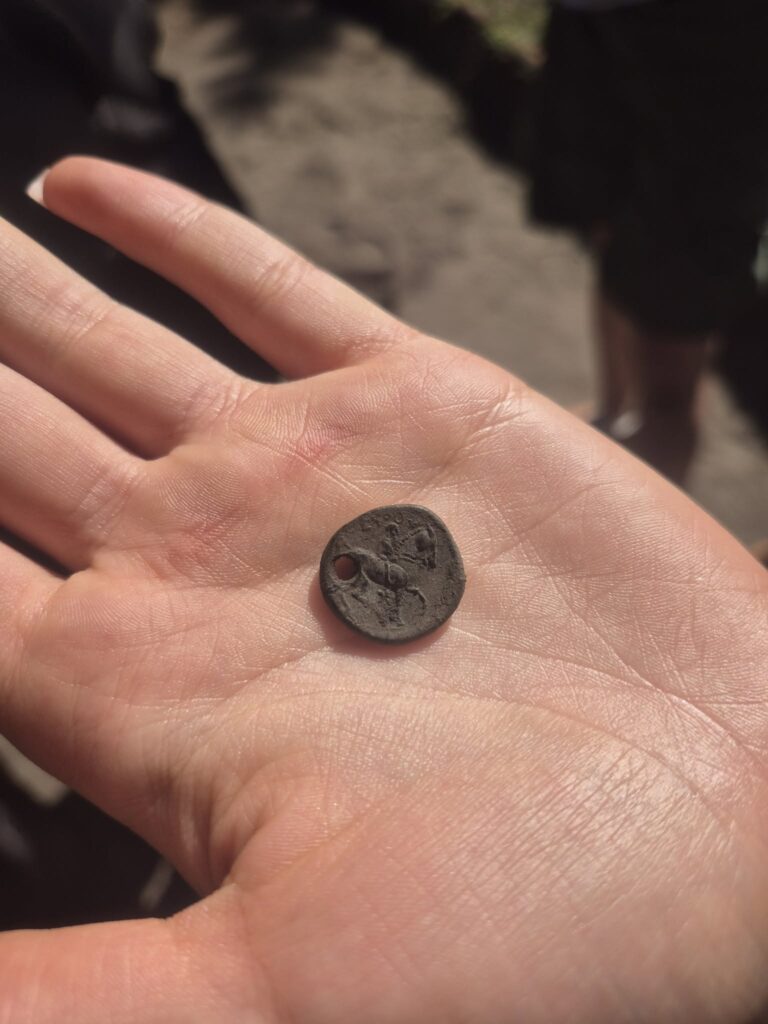
Archaeologists found a bronze coin minted during the reign of Seuthes III, ruler of the Odrysian kingdom of Thrace, between 323 and 316 BC. It was produced at Seuthopolis, near present-day Kazanlak in Bulgaria, roughly 1,500 kilometers in a straight line from Łysa Góra.
The coin bears a mounted figure and mint mark on one side, while the other depicts Zeus wearing a laurel wreath. At some point after it left the mint, someone pierced it. Wear around the hole indicates that it was probably suspended from a cord or leather thong and worn as a pendant rather than simply carried as money.
Researchers regard it as the earliest well-documented ancient coin recovered from an archaeological excavation in Poland and an important piece of evidence for contact between Mazovia and southeastern Europe during the Early Iron Age.
How exactly it reached Łysa Góra remains uncertain.
One possibility proposed by the researchers involves the Celts. Seuthopolis suffered during Celtic incursions into the Balkans in the first half of the 3rd century BC, and archaeologists suggest the coin could have moved north through Celtic networks. It may even have reached Mazovia as a keepsake or personal ornament carried by someone connected with those campaigns.
That interpretation remains a hypothesis, but two additional objects discovered at Łysa Góra could make the story even more interesting. Kaczyński said they may be Greek obols, although specialists still need to confirm their identification.
Łysa Góra Is Becoming an Exceptional Iron Age Site
Seen together, the discoveries are beginning to change the picture of Łysa Góra. The longhouse reveals a substantial and organized local settlement, while the Thracian coin, Celtic helmet and other artifacts point toward contacts extending deep into Central and southeastern Europe.
Archaeologists first investigated the site extensively during the 1970s and 1980s before returning in 2024 as part of work connected with plans for an educational trail. What began as renewed documentation has since produced a series of unusually important Iron Age discoveries.
The most significant artifacts are currently undergoing conservation. The State Archaeological Museum in Warsaw plans an exhibition devoted to Łysa Góra for its centenary in two years, where the Thracian coin, Celtic helmet and trepanation instrument are expected to rank among the centerpiece objects.
After three excavation seasons, however, researchers are not treating that list as final. At Łysa Góra, a settlement once regarded mainly as a regional Iron Age site is increasingly revealing a community connected to a much larger ancient world.
