
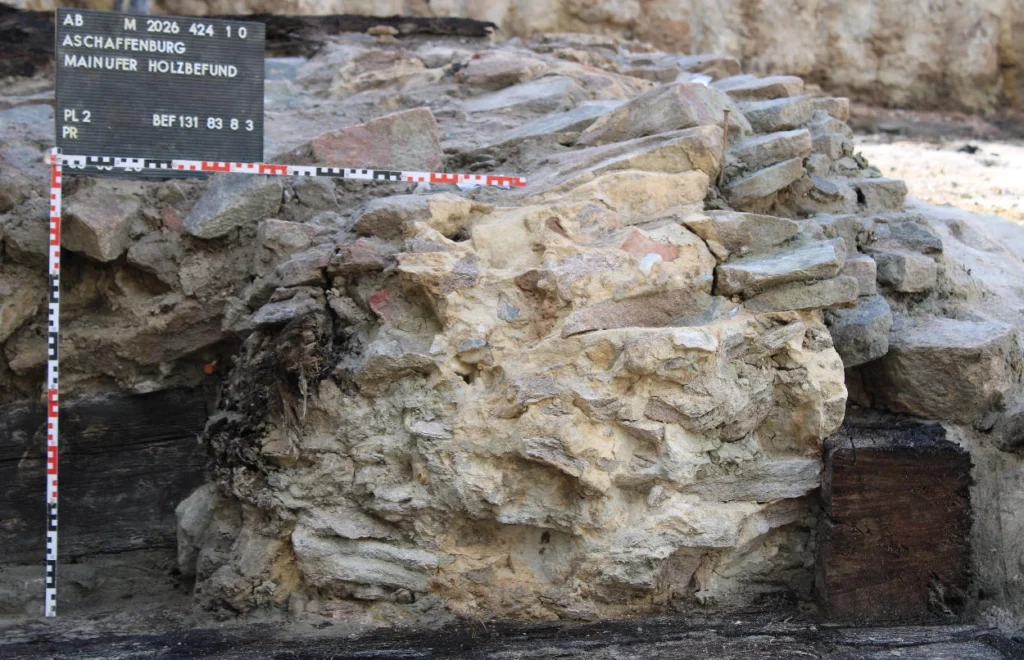
An Iron Age structure discovered beneath the Main River bank in Aschaffenburg has surprised archaeologists with its age, preservation, and unusual combination of massive oak beams and stonework.
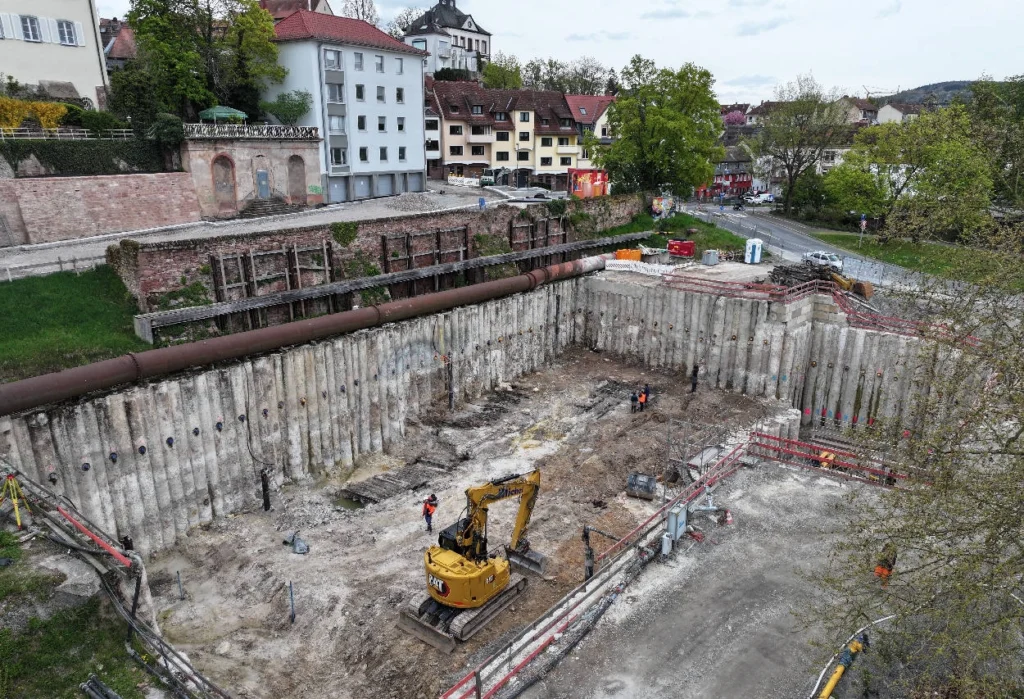
The find emerged during construction work for a rain overflow basin north of the Willigis Bridge. At first, the wooden remains appeared so well preserved that specialists assumed they belonged to the early modern or modern period. But scientific dating of oak beams has now produced a far more unexpected result: the timber was cut and used in the 4th century BC.
That places the structure in the Iron Age, around 2,400 years ago, and potentially links it to an early La Tène-period settlement already known from finds in the area of today’s old town of Aschaffenburg.
Oak beams from the 4th century BC
The discovery was reported to the Bavarian State Office for Monument Protection, known as the BLfD, in March 2026 after workers encountered wooden archaeological remains about eight meters below the surface.
Because the site had not previously been registered or suspected as an archaeological monument, the area had already been cleared for construction. Once the remains were identified, archaeologists began documenting and recovering the structure under difficult conditions inside a deep construction pit.
Samples from several oak beams were examined at the BLfD dendrochronology laboratory in Thierhaupten. By analyzing tree rings and comparing them with regional oak chronologies, researchers were able to determine that the wood came from trees felled and built into the structure during the 4th century BC.
For archaeologists, that result changed the meaning of the find completely. What first looked like a much younger riverside construction is now understood as part of a rare Iron Age architectural complex.
A rare wood-and-stone construction on the Main River
The structure is unusual not only because of its age. According to the BLfD, the remains include a large number of massive oak beams arranged in what appears to have been a technically sophisticated construction. Toward the Main River, the installation ended in a dry-stone wall.
That detail matters. Stone architecture is rarely documented for the Iron Age in this region. When stone structures from this period are found, they are usually connected to fortified sites, including post-slot walls.
Dr. Stefanie Berg, head of archaeological monument preservation at the BLfD, described the discovery as exceptional because of its riverside location, outstanding preservation, singular wood-and-stone construction, and Iron Age date.
The combination suggests that the structure may not have been a simple utilitarian feature. Researchers believe it could have belonged to a large and possibly representative building. Its exact function, however, remains unknown.
A possible clue to an Iron Age center in Aschaffenburg
The discovery is especially important because Aschaffenburg has long shown signs of Iron Age activity.
Archaeological finds from the area of the modern old town include remains of early La Tène-period settlement activity, a gold finger ring, and a fibula decorated with an animal head. These finds have led researchers to suspect that an important Iron Age central place may once have existed in what is now Aschaffenburg.
Until now, however, the evidence has been limited. Individual finds pointed to settlement and status, but they did not fully reveal how large the community was, how it was organized, or what role it played along the Main River.
The newly discovered riverside structure may help answer some of those questions. Its scale, construction quality, and location suggest that Iron Age Aschaffenburg may have been more complex than previously documented.
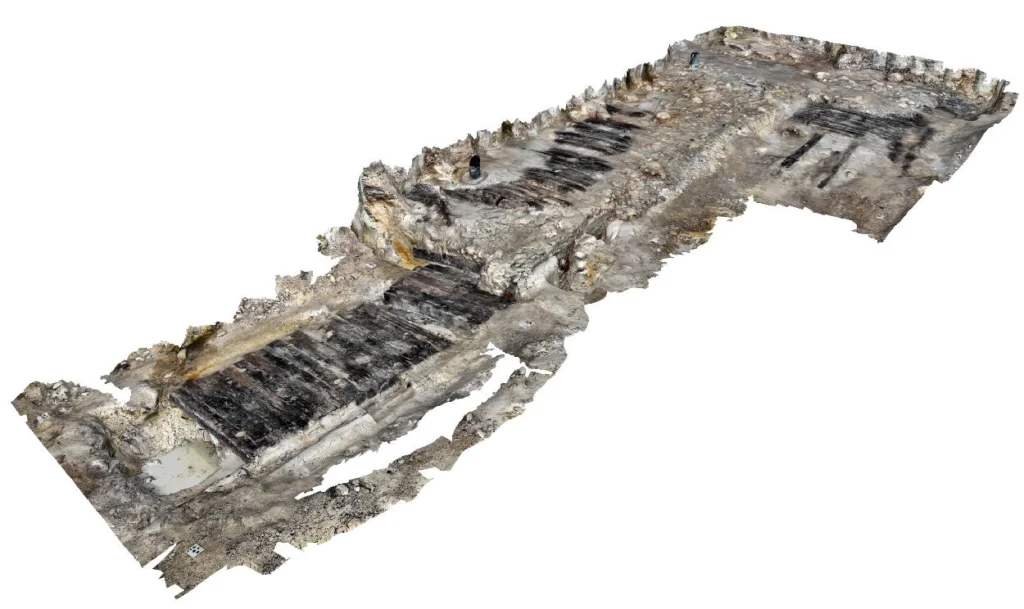
3D model showing the full extent of the Iron Age structure discovered in Aschaffenburg. Credit: Bayerisches Landesamt für Denkmalpflege (BLfD)
Excavations continue under difficult conditions
The archaeological work is being carried out in close coordination with the City of Aschaffenburg. The excavation conditions are unusually demanding because the remains lie inside a construction pit about eight to ten meters deep. Every step must be coordinated with technical, structural, and safety requirements.
Researchers now hope further excavation, documentation, and analysis will clarify the structure’s purpose. Was it part of a riverside installation, a fortified element, a representative building, or something else entirely?
For now, the find has already changed the archaeological picture of Aschaffenburg. Beneath the modern city, close to the Main River, a rare survival from the Iron Age has appeared with enough preserved wood and stone to raise new questions about power, architecture, and settlement life in the 4th century BC.
Bayerisches Landesamt für Denkmalpflege (BLfD)
Cover Image Credit: Bayerisches Landesamt für Denkmalpflege (BLfD)
