
10 March 2026 The Future is the Product of the Past

2,500-Year-Old Pre-Roman Iron Age Settlement Discovered in Hüllhorst, Germany During Fire Station Construction

A remarkable archaeological discovery has been made in Hüllhorst (Minden-Lübbecke district), where construction work for a new fire station has uncovered a settlement dating back more than 2,500 years to the pre-Roman Iron Age. The excavation was supervised by the Landschaftsverband Westfalen-Lippe (LWL), whose experts describe the find as a rare and significant breakthrough for archaeology in East Westphalia.

Rare Iron Age House Structures in East Westphalia

According to the LWL-Archäologie für Westfalen, house floor plans from this early Iron Age period (800–600 BC) have previously been identified in the region only in Werther and Minden. Both sites were discovered only in recent years, making the Hüllhorst settlement an exceptional addition to the archaeological record of Ostwestfalen-Lippe.

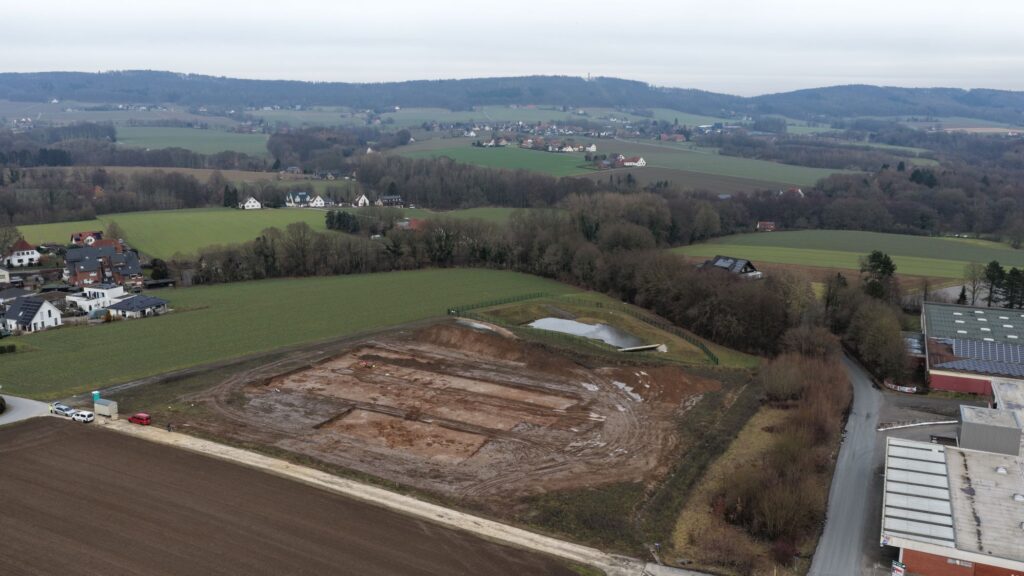
The excavation took place along Lohagenweg, where the municipality is currently building a new fire station. Before construction could begin, archaeologists investigated the area due to its highly favorable settlement location near the edge of the Wöhrsiek — a spring that remains active to this day. Experts note that prehistoric settlements are frequently found near water sources, which provided reliable access to fresh water for early communities.
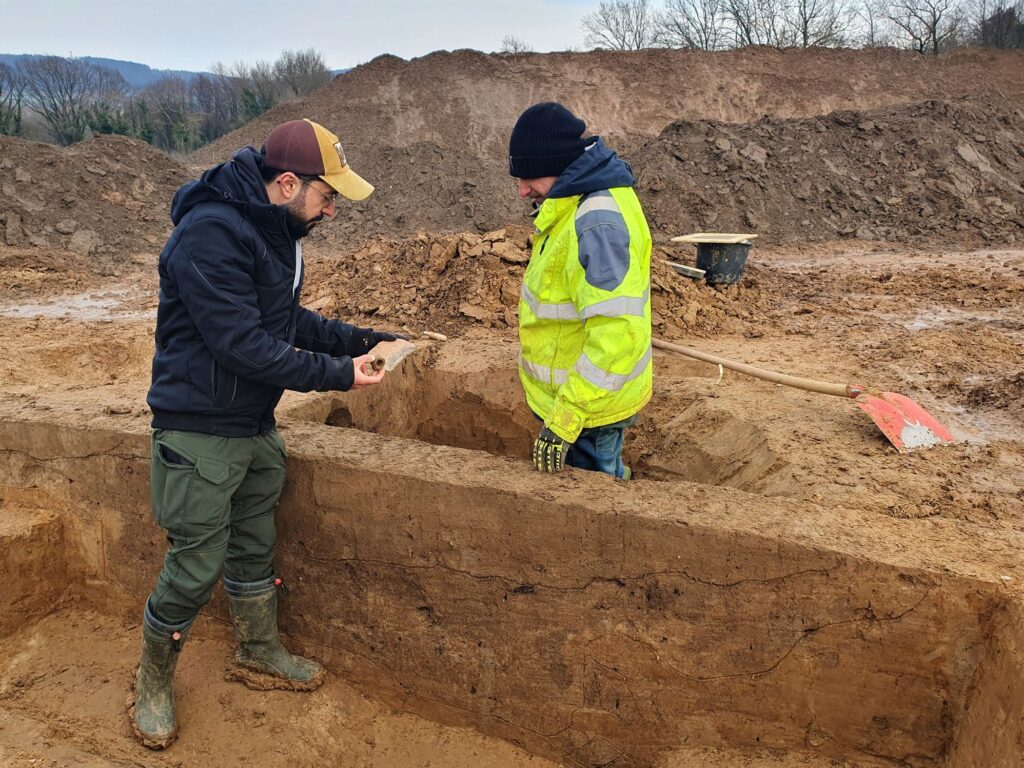
Excavation director Hisham Nabo (left) and excavation team member Ristam Abdo (right) stand inside a unearthed settlement pit, examining pottery fragments discovered within it. The soil discolorations are carefully sectioned to document their structure and recover the archaeological finds. Credit: LWL-AfW / S. Düvel

Evidence of a Planned Early Iron Age Settlement

In summer 2025, archaeologists initially removed the topsoil in four narrow strips to survey the site. It quickly became clear that the area had once been inhabited more than two millennia ago.

Most of the remains consist of soil discolorations indicating former storage and refuse pits. Particularly significant, however, are small posthole stains in the ground that reveal the former positions of wooden support posts. With careful analysis, these features allow archaeologists to reconstruct entire building layouts.


📣 Our WhatsApp channel is now LIVE! Stay up-to-date with the latest news and updates, just click here to follow us on WhatsApp and never miss a thing!!


“We discovered the remains of a large residential building alongside two smaller structures,” explained excavation director Hisham Nabo. The orientation of the main house demonstrates deliberate planning: it was aligned northeast to southwest, positioning its narrow sides toward the prevailing wind direction to reduce wind exposure. This detail highlights the architectural knowledge and environmental awareness of early Iron Age builders.

Pottery Finds Help Date the Site

Artifacts recovered from pit fillings have been crucial in dating the settlement. Fragments of handled cups known as terrines, as well as coarse-walled pottery vessels with distinctive finger-impressed rim decorations, clearly point to an early phase of the pre-Roman Iron Age between 800 and 600 BC.

To refine the dating further, researchers plan to apply radiocarbon analysis to charcoal fragments recovered from the postholes. Such testing is essential because archaeological sites often contain traces from multiple historical periods.

Sebastian Düvel, a scientific advisor specializing in Iron Age sites in East Westphalia, described the discovery as a “stroke of luck for archaeology.” He emphasized that the find offers valuable new opportunities to better understand daily life in the region more than 2,500 years ago.
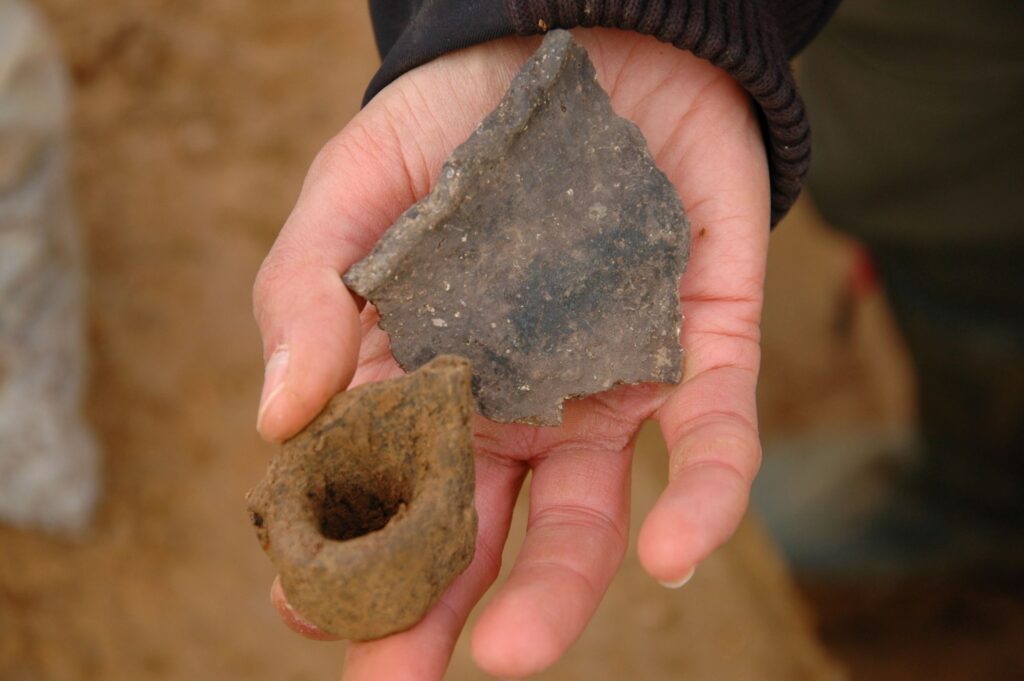
Typical pottery fragments from the early Iron Age: a vessel rim decorated with finger impressions and a sherd featuring a wide rim-mounted handle. Credit: LWL-AfW / S. Düvel

Fire Station Construction to Proceed as Planned

Despite the significance of the discovery, construction of the new fire station in Hüllhorst will continue as scheduled. Archaeologists have carefully documented and excavated only the areas directly affected by the building project. Initial findings suggest that the settlement may extend further north, but this poses no obstacle to the current development.

Close coordination between the municipality of Hüllhorst, the excavation company, and LWL ensured that archaeological investigations were completed before the official start of construction. This collaborative approach allowed heritage preservation and modern infrastructure development to proceed hand in hand.

The discovery not only enriches the archaeological map of North Rhine-Westphalia but also sheds new light on settlement patterns during the pre-Roman Iron Age in northwestern Germany. For researchers and residents alike, the unexpected find beneath a future fire station underscores how traces of ancient history can still lie hidden beneath everyday construction projects — waiting to be uncovered.

Landschaftsverband Westfalen-Lippe (LWL)

Cover Image Credit: Aerial view of the excavation area for the new fire station building on Lohagenweg in Hüllhorst, Germany. LWL-AfW / A. Koch

Related Articles

Mythical Viking stronghold Jomsborg could be on Hangman’s Hill near Wolin, archaeologist say

14 July 2023

14 July 2023

A new hypothesis about the location of the mythical Viking stronghold on Hangman’s Hill near Wolin (West Pomerania) has been...

New research reveals the true function of Bronze Age daggers

30 April 2022

30 April 2022

A new study led by Newcastle University has revealed that the analysis of Bronze Age daggers has shown that they...

An inscription with the name of the ancient city was found at the excavation site in Gordion, the capital of the Phrygians

8 August 2022

8 August 2022

An inscription bearing the name of the ancient city was found at the excavation site in Gordion, the capital of...

45,000 years ago, Neanderthals in the Swabian Jura used complex tool-making techniques

13 September 2021

13 September 2021

Findings that will change our perception of Neanderthals’ sophistication A team from the University of Tübingen have proved that Middle...

Wildfire Uncovers Lost Biblical Village of Bethsaida on the Sea of Galilee

16 August 2025

16 August 2025

In a surprising twist of fate, a wildfire that swept through Israel’s Betiha Nature Reserve in late July has unveiled...

Turkey’s Urartian Altıntepe Castle transforms into open museum

25 May 2022

25 May 2022

Altıntepe Castle, one of the most important centers of the Urartians and the Eastern Roman Empire, is now set to...

9th-Century Slave-Built Large-Scale Agricultural System Discovered in Southern Iraq

3 June 2025

3 June 2025

A recent archaeological study has unveiled compelling evidence of a vast agricultural infrastructure in southern Iraq, believed to have been...

A monumental Etruscan tomb discovered in the necropolis of San Giuliano, north of Rome

25 February 2024

25 February 2024

After years of work, archaeologists discovered an impressive Etruscan tomb partially hidden underground in the rock-cut necropolis of San Giuliano...

Discovery Shedding Light on Ancient Maritime Trade: 1,500-Year-Old Trade Shipwreck Found off Türkiye’s Ayvalık

21 December 2024

21 December 2024

‘Turkish Sunken-Ships Project: Blue Heritage’, a 1500-year-old trade shipwreck was found off the coast of Ayvalık district of Balıkesir. Under...

Unique ‘Good Shepherd Jesus’ Fresco Unearthed in Iznik: A One-of-a-Kind Discovery in Anatolia

10 December 2025

10 December 2025

Archaeologists in Türkiye have uncovered a remarkable Early Christian fresco depicting the ‘Good Shepherd Jesus’, a motif rarely found in...

483 Celtic gold coins worth several million euros stolen from German museum

23 November 2022

23 November 2022

A huge horde of ancient gold coins dating back to 100 BC was stolen from the Celtic and Roman Museum...

High school student discovered a 1500-year-old ancient Magical Mirror

9 August 2023

9 August 2023

 A High school student discovered an ancient “magical mirror” meant to ward off the evil eye in an archaeological excavation...

A cave in Argentina houses the oldest known pigment-based rock art in South America

15 February 2024

15 February 2024

An astounding collection of almost 900 rock paintings, dating back approximately 8,200 years, has been discovered in northwestern Argentina. The...

‘Proof of biblical kings’, Israel deciphers 8th century BC Hezekiah inscription after a decade of research

17 December 2022

17 December 2022

Israeli archeologists have deciphered an 8th-century BC inscription discovered on a palm-sized stone tablet after a decade of research.  The...

Mystery ax discovered off the coast of Arendal of Norway

26 July 2021

26 July 2021

Researchers have discovered a find that could be a first for Norwegian archeology. A hollow ax, which researchers believe dates...

Comments
Leave a Reply

Your email address will not be published. Required fields are marked *