
10 December 2025 The Future is the Product of the Past

2,000-Year-Old Roman Stele Decorated with an Eagle and Greek Inscriptions Found in Manbij, Syria

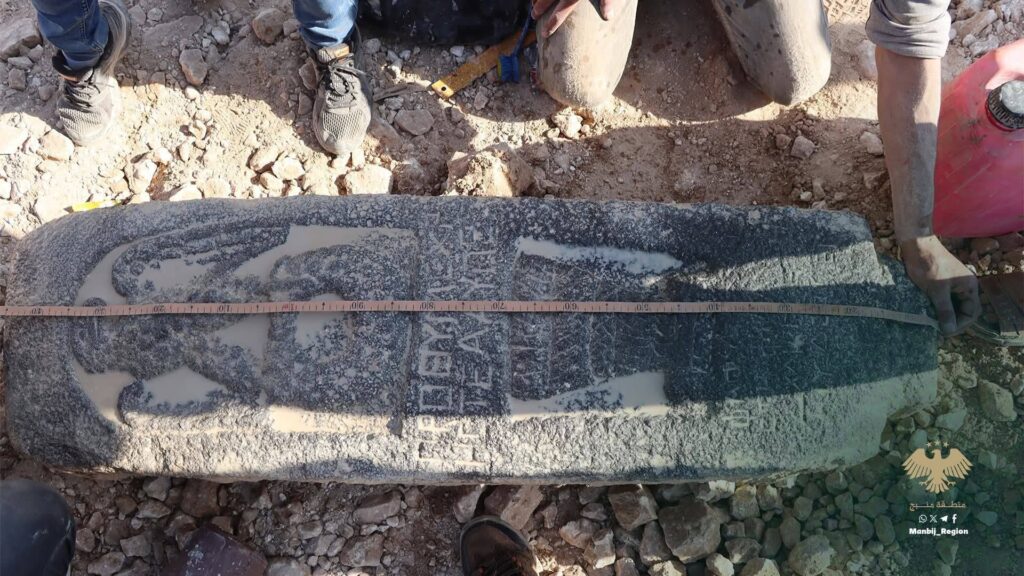
A striking Roman-era stele carved from black basalt, featuring a detailed eagle clutching a wreath and adorned with Greek inscriptions, has been found in Manbij, a historic town east of Aleppo, Syria. Believed to be approximately 2,000 years old, the funerary monument provides rare insight into the region’s ancient past and the symbolism of Roman imperial art.

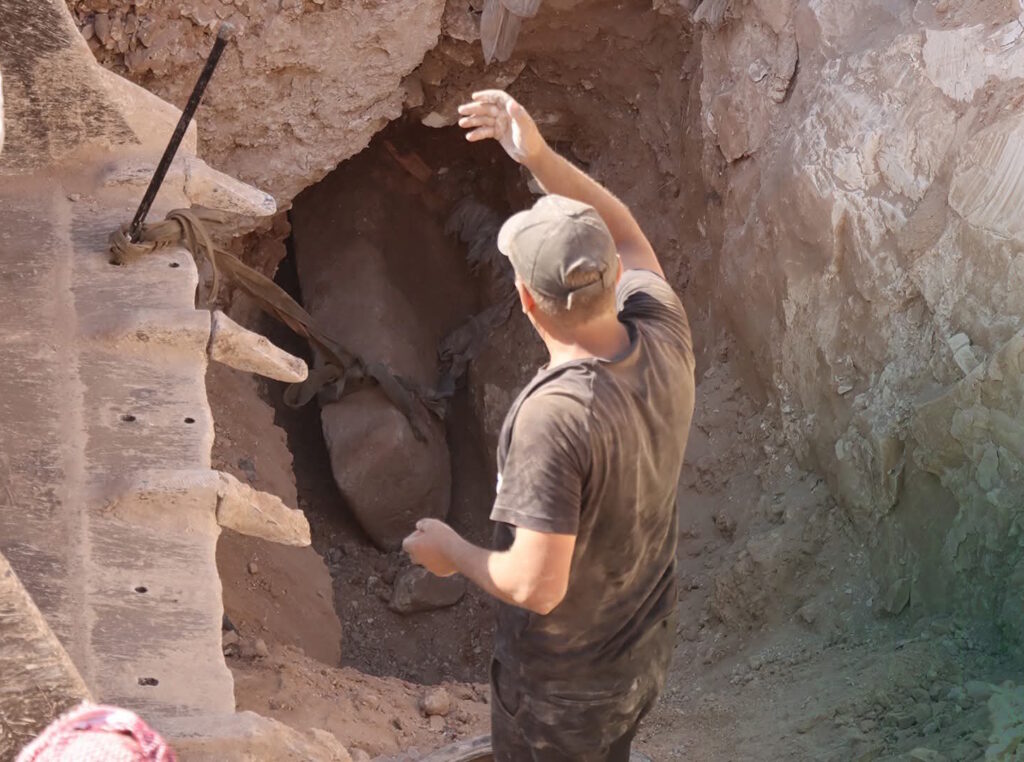
The stele was first spotted by a local resident behind the Cardamom wholesale market, who alerted the Directorate of Museums and Antiquities. Archaeologists promptly recovered the artifact and transferred it to the old bathhouse site in Manbij for secure storage, pending its eventual relocation to Aleppo for further study.

The Eagle in Roman Culture

In Roman iconography, the eagle was a powerful symbol of strength, authority, and divine protection. Frequently associated with Jupiter, the king of the Roman gods, the eagle often appeared on military standards, coins, and funerary monuments.

Its depiction on this stele, with outstretched wings and a wreath in its talons, may have been intended to signify the deceased’s valor, eternal life, or allegiance to Roman ideals. Funerary steles like this were commonly used to honor prominent citizens or soldiers, reflecting both personal achievements and broader imperial ideology.
Credit: Mambij Region

Greek Inscriptions: A Window into the Past

The Greek inscriptions carved on the stele suggest a fusion of Roman and Hellenistic influences in northern Syria. Greek was widely used in the eastern Roman provinces, especially in administrative and funerary contexts. These inscriptions may reveal the name, rank, or lineage of the deceased, offering a tangible connection to the personal lives of Manbij’s ancient inhabitants.


📣 Our WhatsApp channel is now LIVE! Stay up-to-date with the latest news and updates, just click here to follow us on WhatsApp and never miss a thing!!


Manbij: A Historical Crossroads

Manbij, historically known as Hierapolis Bambyce, has been an important cultural and commercial hub since antiquity. Under Roman rule, the city was a provincial center with significant trade connections, hosting temples, public buildings, and tombs. The discovery of the eagle stele adds to evidence of Roman influence in northern Syria and illustrates the city’s role as a regional crossroads where Roman, Hellenistic, and local traditions merged.

The city’s long history has also made it a target for looting, particularly during recent conflicts. Between 2011 and 2019, roughly one million artifacts were looted in Syria, and over 700 archaeological sites suffered heavy damage. Manbij itself became a focal point of illicit excavation during the civil war. Under ISIS control, residents were allowed to dig for antiquities on their land, provided they reported figural artifacts for destruction. Following the Syrian Democratic Forces’ takeover in 2016, local elites often oversaw excavations, turning the city into a hub for artifact smuggling to neighboring countries and beyond.

Protecting Syria’s Cultural Heritage

Despite these challenges, community cooperation has proven crucial. The resident who reported the eagle stele exemplifies how local vigilance can help safeguard Syria’s invaluable cultural heritage. Once fully analyzed, the stele will contribute not only to the understanding of Roman funerary practices but also to the broader narrative of Manbij’s historical significance.

This discovery underscores the enduring legacy of Roman influence in Syria and the symbolic power of the eagle motif. As archaeologists continue their work, the stele promises to illuminate the lives and beliefs of ancient communities that once thrived in Manbij, bridging millennia of history and connecting modern observers to the grandeur of the Roman world.

Mambij Region

Cover Image Credit: Mambij Region

Related Articles

A sanctuary for Cult God Mithras discovered in Germany

13 April 2023

13 April 2023

A place of worship for the Roman god of light, Mithras, was discovered during archaeological excavations in Trier, in southwestern...

The ‘extraordinary’ Roman mosaic depicting scenes from Homer’s Iliad unearthed in a Rutland farmer’s field is the first of its kind in England

25 November 2021

25 November 2021

The 1,500-year-old mosaic discovered by a farmer was considered Britain’s “most exciting” Roman find. The artwork was discovered on private...

10,000-year-old Sculptures and Figurines holding Phallus of the Taş Tepeler in the southeast Turkey

17 June 2022

17 June 2022

One of the common features of male depictions with similar features found in the region called Taş Tepeler (Stone Hills),...

Romania’s 1.95 Million-Year-Old Hominin Evidence Pushes Back the Timeline of Human Presence in Europe

25 January 2025

25 January 2025

A recent study revealed evidence of “hominin activity” in Romania that dates back at least 1.95 million years, making it...

Megalithic structure found in Kazakhstan was probably a place of worship for miners in the Bronze Age

2 September 2024

2 September 2024

Archaeologists investigating a megalithic monument in the Burabay district of the Akmola region of Kazakhstan have revealed that the monument...

In Parion, one of the most important cities of the Troas region, 2,000-year-old mother-child graves were unearthed

1 November 2022

1 November 2022

Archaeological excavations in the ancient city of Parion, the most important harbor city in the Hellenistic era, have uncovered  2,000-year-old...

Archaeologists have unearthed two early Aksumite Churches in Africa

11 December 2022

11 December 2022

New discoveries in the port city of Adulis on Eritrea’s Red Sea coast show that two ancient churches discovered more...

Flint tools found in Tunel Wielki Cave, Poland, about half a million years old

9 October 2022

9 October 2022

Flint tools discovered over 50 years ago in the Tunel Wielki Cave (Maopolskie region) are not tens of thousands of...

1,600-Year-Old Tomb of First Maya King Discovered in Caracol, Belize

11 July 2025

11 July 2025

Archaeologists have unearthed the 1,600-Year-Old Tomb of First Maya King at Caracol, Belize, marking one of the most significant Maya...

Archaeologists say 12,000-year-old flutes discovered in northern Israel may have been used to lure falcons

9 June 2023

9 June 2023

New research reveals that about 12,000 years ago, in northern Israel, humans turned the bones of small birds into instruments...

Isotopic Evidence reveals surprising dietary practices of pre-agricultural human groups in Morocco

30 April 2024

30 April 2024

It has long been accepted wisdom that hunter-gatherer societies lived primarily off of meat. But fresh data from an innovative...

The Secret of the Shipwrecks at Theodosius Harbor: 1,600 Years Old Women’s Sandals and Comb

11 April 2023

11 April 2023

The 1,600-year-old sandals and comb unearthed during the excavations of Theodosius Harbor (Portus Theodosiacus), the second-biggest harbor built on the...

The Celts’ Astronomical Secrets: The Chão de Lamas Lunula and the Coligny Calendar Connection

2 March 2025

2 March 2025

A groundbreaking study published in the journal Palaeohispanica has shed light on the ancient timekeeping practices of the Celts, centering...

Marmore, the Highest and Oldest Artificial Waterfall in Europe, Created by the Romans

4 March 2024

4 March 2024

Approximately eight kilometers away from the town of Terni in Umbria, Italy, there is a waterfall that is one of...

New studies confirm that there was indeed a shipyard at Lothal, the commercial center of the Harappan civilization and world’s oldest port

6 September 2024

6 September 2024

Since the discovery of Harappan sites at Lothal, located about 30 kilometers inland from the coast of the Gulf of...