
15 February 2026 The Future is the Product of the Past

2,000-Year-Old Multicolored Roman Enamelled Fibula Discovered

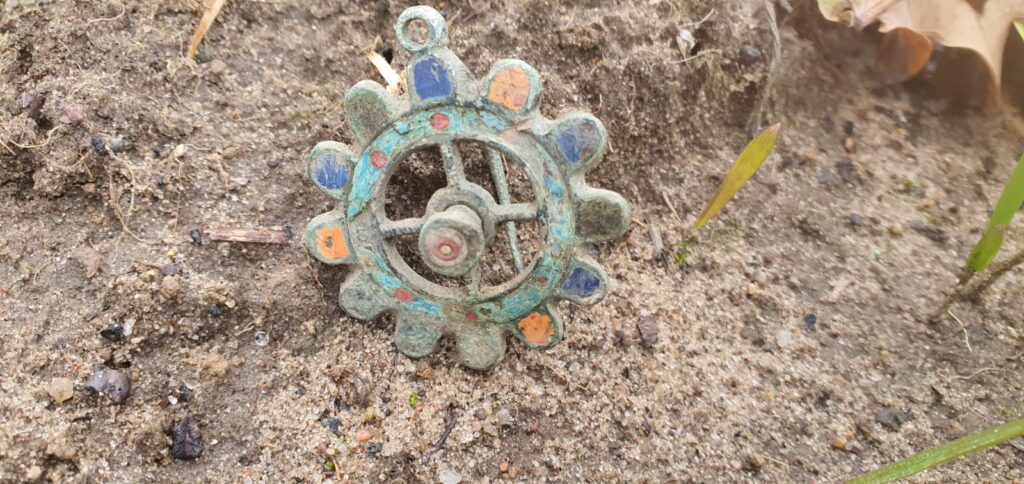
A remarkable archaeological discovery near the Polish city of Grudziądz is offering new insight into the cultural diversity and trade connections of northern Europe nearly 2,000 years ago. Members of the Grudziądz Fortress Association uncovered a rare, enamelled Roman-era fibula (brooch) during a routine metal-detector survey — only the second artifact of its kind ever found in Poland.

Archaeologists believe the finely crafted brooch may be linked to the Wielbark Culture, a community associated with Gothic migrations from Scandinavia during the first centuries CE. The find also strengthens evidence that the area once formed part of a multicultural settlement along the Amber Road, the ancient trade route that connected the Baltic coast with the Roman world.

A Unique Artifact With Exceptional Craftsmanship

According to the search team, the brooch immediately stood out due to its unusual ornamentation and vivid enamel. The circular piece features a central boss surrounded by alternating white and blue enamel rings, while red enamel decorates the inner zone around the raised center. Unlike a similar artifact discovered earlier in northern Poland, this newly found example features twelve decorative protrusions instead of eight, making it unique on a national scale.

Although the exact function and origin of the piece are still under investigation, experts note that enamelled brooches of this type were produced across several Roman provinces — particularly in Gaul, Raetia and regions along the Danube and Rhine — between the late 1st and mid-2nd centuries CE. Such colorful items were often worn by young girls as decorative dress fasteners, and in some cases may have served as amulets or cherished personal objects.
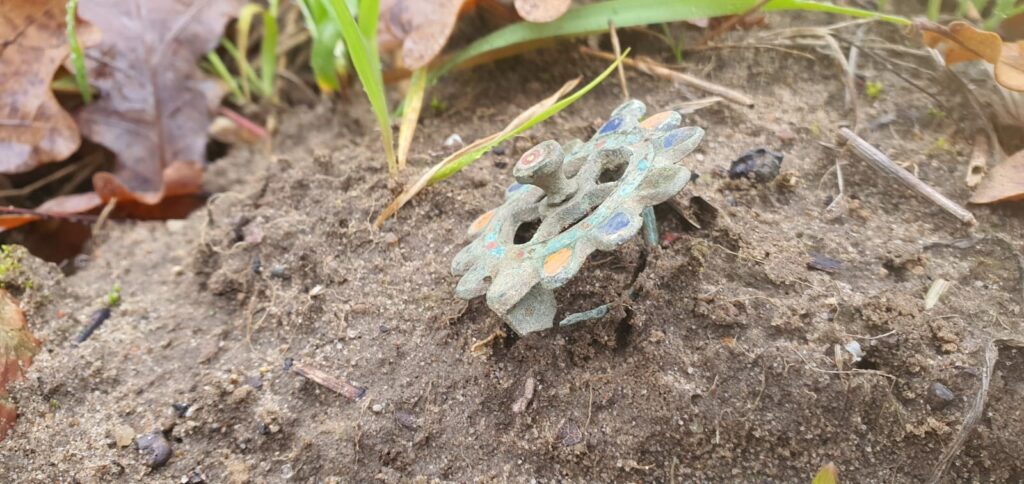
Members of the Grudziądz Fortress Association uncovered a rare, enamelled Roman-era fibula (brooch) during a routine metal-detector survey — only the second artifact of its kind ever found in Poland. Credit: Grudziądz Fortress Association

Evidence of a Multicultural Settlement Near the Amber Road

The discovery site has long attracted archaeological interest. Previous fieldwork in the area revealed a rich mix of artifacts, including Roman ceramics, other fibulae, hair ornaments, belt fittings, a Scythian arrowhead, medieval coins and metal spurs. The diversity of finds suggests that the location may once have been both a settlement and a nearby burial ground, influenced by different cultural traditions over time.


📣 Our WhatsApp channel is now LIVE! Stay up-to-date with the latest news and updates, just click here to follow us on WhatsApp and never miss a thing!!


Researchers believe that the region’s proximity to the Amber Road — a major trade corridor transporting Baltic amber to Roman markets — made it an attractive and strategically important zone. The presence of foreign-style objects, including the Scythian arrowhead, may even hint at episodes of conflict or contact with distant groups drawn to the area’s economic potential.

Possible Links to a Child’s Grave in Babi Dół-Borcz

To better understand the brooch’s origins, specialists are comparing it with a closely related artifact excavated at the Babi Dół-Borcz burial site in the Kashubian region of Poland. That earlier brooch was discovered in the grave of a young girl, alongside glass and amber beads, bronze jewelry and textile tools — a context strongly associated with the Wielbark Culture of the early Roman period.

While researchers stress that firm conclusions cannot be drawn without further field studies, stylistic similarities suggest that both objects may belong to the same broad cultural and chronological horizon. Ongoing analyses — including material studies and landscape research — aim to clarify whether the Grudziądz brooch reflects local production influenced by Roman fashions or whether it arrived through long-distance exchange networks.
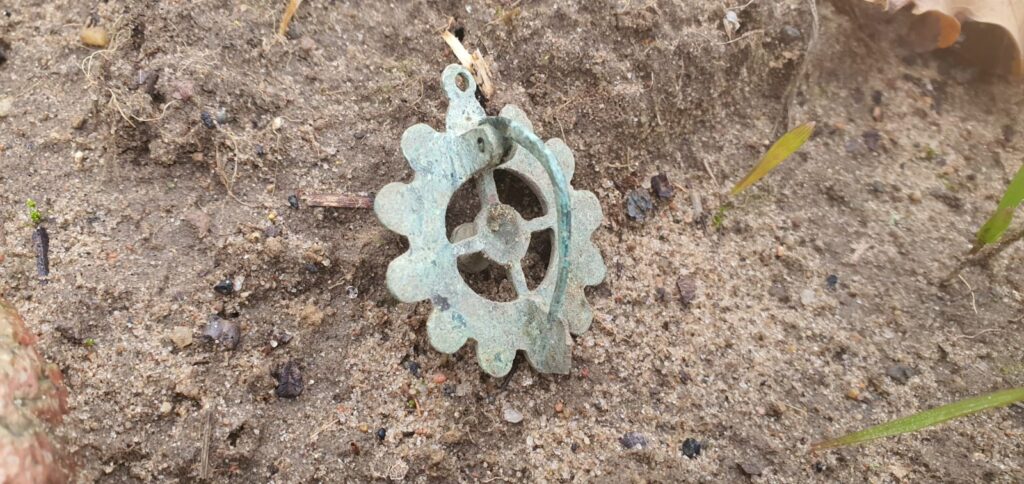
Archaeologists believe the finely crafted brooch may be linked to the Wielbark Culture, a community associated with Gothic migrations from Scandinavia during the first centuries CE. Credit: Grudziądz Fortress Association

Preserved for Study and Future Exhibition

Following established procedures, the artifact and associated finds were secured and reported to heritage authorities. After conservation and documentation, the newly discovered brooch is expected to go on public display at the Museum in Bydgoszcz, where visitors will be able to view the rare object and learn more about the communities that once lived along Poland’s ancient trade routes.

Archaeological teams also plan to conduct additional excavations in the surrounding area, hoping to uncover settlement remains or burial structures that may reveal more about the site’s role within regional networks of exchange, migration and cultural interaction.

A Window Into Life on the Edge of the Roman World

Although small in size, the enamelled fibula represents an important window into everyday life nearly two millennia ago. Objects like this one highlight how fashion, craftsmanship and symbolic meaning traveled across vast distances — from Roman workshops to communities beyond the Empire’s formal borders.

For historians and archaeologists, the find reinforces the view that northern Poland during the Roman period was not an isolated frontier, but rather a dynamic crossroads of peoples, goods and traditions. As future research unfolds, the Grudziądz brooch may help deepen our understanding of how children, families and travelers experienced life along one of Europe’s most significant ancient trade corridors.

Grudziądzkie Stowarzyszenie Twierdza

Cover Image Credit: Grudziądz Fortress Association

Related Articles

Archaeologists discover rare Caanite inscription on ancient ivory comb

12 November 2022

12 November 2022

Israeli archaeologists discovered a rare inscription on an ivory comb that sheds new light on the Canaanite language’s use some...

3,000-year-old skeletons of nine children were discovered in Qazvin province, Iran

29 April 2023

29 April 2023

Archaeologists from the University of Tehran have discovered the remains of children dating back 3,000 years during excavations in an...

2,700-Year-Old Rare Bronze Knives from the Early Saka Period Unearthed in Kazakhstan

17 July 2025

17 July 2025

In a remarkable archaeological breakthrough, researchers and students from Margulan University have unearthed two rare bronze knives dating back over...

Oldest Fortresses in the World Discovered in Siberia

8 December 2023

8 December 2023

Archaeologists from Freie Universität Berlin together with an international team have uncovered fortified prehistoric settlements in a remote region of...

The historic Egyptian Palace is being demolished, it may hold a surprise underneath

27 August 2021

27 August 2021

The cause for the evacuation and demolition of the ancient Tawfiq Pasha Andraos Palace, located in the precincts of the...

Mysterious 1,600-Year-Old Roman-Era Burial Unearthed in Delbrück-Bentfeld, Germany

15 June 2025

15 June 2025

Archaeologists have uncovered a rare and mysterious Roman-era burial in Delbrück-Bentfeld, Germany, revealing a unique glimpse into the region’s ancient...

Ceremonial cave site from Postclassic Maya period discovered in Yucatán Peninsula

21 December 2021

21 December 2021

Archaeologists have discovered a ceremonial cave site in Chemuyil on the Yucatán Peninsula, Mexico, that dates from the Postclassic Maya...

The Mysterious Stone Structure Overlooking Ani: A Hidden Monument Raising New Questions

14 November 2025

14 November 2025

A lone stone structure standing silently on a windswept hill near Kars has begun to draw growing curiosity. Rising from...

Key Silla Kingdom Palace Site Found in South Korea After Decade-Long Probe

11 February 2025

11 February 2025

A decade-long investigation conducted by the Korea Heritage Service has uncovered a crucial palace site of the Silla Kingdom (57...

1900-year-old Child’s Nightgown with intriguing knots found in the Cave of Letters in the Judean Desert

5 October 2023

5 October 2023

The Cave of Letters in Israel is one such site that has yielded a large number of papyrus letters and...

Archaeologists unearthed a pot of copper coins in first major discovery at Mohenjo Daro in Pakistan, in 93 years

18 November 2023

18 November 2023

A pot full of copper coins was discovered from a stupa (a dome-shaped building erected as a Buddhist shrine) at...

The Lady of the Inverted Diadem (7th Century BC): A Fallen Aristocrat Unearthed in Boeotia, Greece

29 November 2025

29 November 2025

An archaeological discovery in Boeotia uncovers the 7th-century BC Lady of the Inverted Diadem, revealing elite burials, rare artifacts, and...

Maya Archaeological site for sale on Facebook has stirred controversy in Yucatán and across Mexico

31 March 2023

31 March 2023

Over 249 hectares of land for sale on Facebook Marketplace has sparked controversy in Yucatan and across Mexico. The property,...

3600-year-old lead weights were unearthed in the Kumluca Bronze Age Shipwreck, one of the oldest shipwrecks in the world

27 November 2022

27 November 2022

Underwater archaeological work continues in the Bronze Age shipwreck off Antalya Kumluca, one of the oldest shipwrecks in the world....

1,600-year-old fragment Of Enigmatic Roman Artifact Discovered In Belgium

17 February 2023

17 February 2023

A metal detectorist in Belgium discovered a piece of a mysterious bronze artifact known as a Roman dodecahedron, which is...