
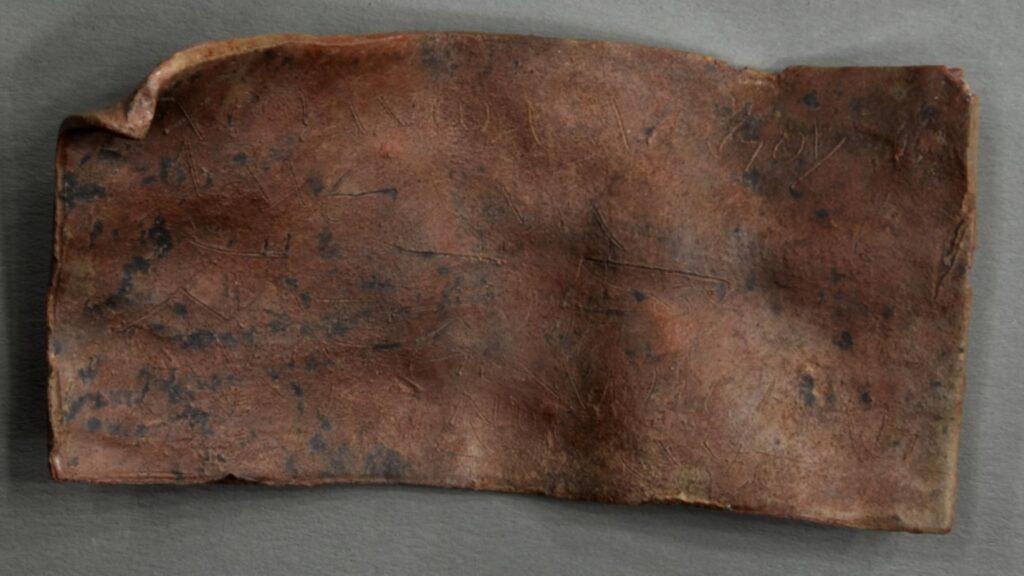
A small lead tablet found beneath a modern town square in the Netherlands has opened an unexpected window onto the shadowy world of ancient magic on Rome’s northern frontier.
Researchers at Heidelberg University have deciphered the inscription on the 1,800-year-old object, identifying it as a rare curse tablet from the Roman province of Lower Germania. Unlike most curse tablets found in northern Europe, this one was not written in Latin. Its text was composed in ancient Greek and follows an Egyptian-style magical formula, a detail that makes the find unusually important for understanding how ritual practices moved across the Roman Empire.
A curse tablet from Roman Coriovallum
The tablet was discovered during excavations in Heerlen, a Dutch municipality that occupies the site of the former Roman military settlement of Coriovallum. Archaeologists found the lead object in a pit beneath the town’s Rathausplatz, or town hall square.
Measuring only 9.3 by 4.8 centimeters, the artifact is modest in size, but its inscription carries a complex ritual message. According to Dr. Rodney Ast, Academic Director at Heidelberg University’s Institute of Papyrology, the tablet was used to invoke gods and demons in order to harm, restrain, or “bind” an opponent.
Such tablets were known in Latin as defixiones and in Greek as katadesmoi. They were usually made of lead, a cold, heavy, and easily worked material that ancient practitioners associated with binding power. In the Roman world, these objects were often buried after being inscribed with spells aimed at legal rivals, athletic competitors, business enemies, or romantic opponents.
Greek words on Rome’s northern edge
What sets the Heerlen tablet apart is its language and style. Curse tablets from northern Europe are usually written in Latin. This object, however, contains an invocation in ancient Greek shaped by Egyptian magical traditions.
The inscription was examined at Heidelberg University’s Institute of Papyrology using Reflectance Transformation Imaging, or RTI. The technique photographs an object under changing light conditions and then combines the images into a digital model. Researchers can adjust the virtual light source on screen, making shallow scratches and worn surface details easier to read.
That analysis revealed three different groups of signs on the tablet. One section contains the Greek invocation. Another includes three magical symbols known as characteres. Ast suggests that these signs probably served as a way to transmit the message to supernatural powers.
The tablet then names two men and two women, all described as fellow slaves. “The tablet served either as a curse against these four slaves or as a curse in their name against an unnamed person,” Ast said.
Four slaves and a possible link to Roman Egypt
The group named on the tablet is also unusual. The two men have Latin names, while the two women have Greek names. For Dr. Julia Lougovaya, a researcher at Heidelberg University’s Institute of Papyrology, that combination raises an intriguing possibility.
She notes that one of the women may have been the author of the inscription, perhaps bringing with her knowledge of such ritual practices from Roman Egypt. The suggestion cannot be proven, but it fits the cultural complexity of the Roman Empire, where enslaved people, soldiers, merchants, and officials moved across vast distances, carrying languages, beliefs, and private rituals with them.
The Egyptian connection is especially significant. According to Prof. Dr. Joachim Quack, Director of Heidelberg University’s Institute of Egyptology, magic played an important role in the civilization of the Nile. Some practices, especially those connected with protection and healing, were accepted parts of religious life. Others, particularly rituals intended to damage another person for personal gain, were more likely performed discreetly.
Quack emphasizes that in the early centuries CE, Near Eastern, Egyptian, Jewish, and sometimes even Christian traditions increasingly blended and spread throughout the Roman world. The Heerlen tablet, found far from Egypt in the northern provinces, offers a striking example of that cultural circulation.
A private act preserved in lead
Curse tablets rarely speak in the public language of monuments, emperors, or official religion. They preserve private fear, anger, rivalry, and desperation. The Heerlen find is valuable because it captures that hidden side of Roman life in a frontier settlement where different languages and identities met.
The tablet is expected to be displayed in the Heerlen Museum. Heidelberg researchers will also publish the deciphered inscription in a scientific study, making the object available for further research into ancient magic, slavery, mobility, and religious exchange across the Roman Empire.
Cover Image Credit: Elke Fuchs, Institute of Papyrology, Heidelberg University.
