
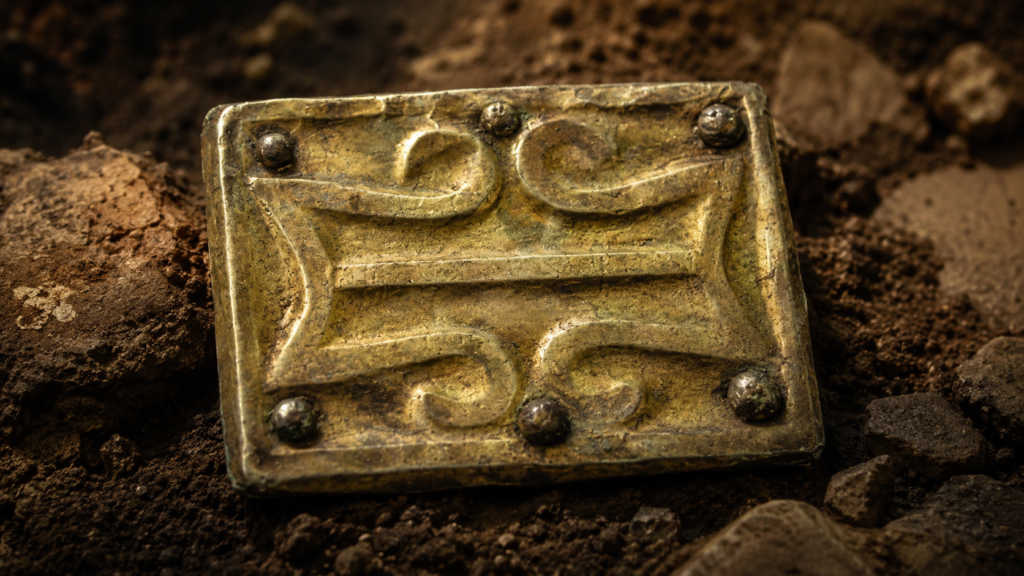
A gold-and-silver horse harness plaque found in the North Caucasus is giving archaeologists a rare look at the early Alans, a mobile warrior society whose identity was shaped by horses, burial rites, metalwork and contact with older Sarmatian traditions.
The artifact was discovered at the Levopodkumsky 1 kurgan cemetery in the Malokarachayevsky District of the Karachay-Cherkess Republic, during fieldwork by specialists from the Institute of Archaeology of the Russian Academy of Sciences and the State Historical Museum. Researchers date the plaque to the middle or second half of the 3rd century AD, a period when the cultural map of the Central North Caucasus was still being redrawn.
At first glance, the find is small. Its meaning is not. The plaque was part of a horse harness set, the kind of elite object that could mark status, mobility, and cultural belonging. It came from a catacomb burial that had already been robbed in antiquity, yet enough of the grave survived to reveal a complex funerary scene. The lost mound was reconstructed through geophysical survey and traces of a square ditch.
The grave structure helped identify the cultural setting. According to the researchers, the burial was a type IV catacomb, with the entrance pit and chamber arranged on parallel axes. This form is characteristic of the Podkumok-Khumara cultural group, a local population of the Kislovodsk basin that existed before the full arrival of Alan groups in the microregion.
The most striking element of the rite was the horse. In the entrance pit lay the disturbed skeleton of an adult stallion, about eight or nine years old. Osteological analysis showed that the animal had been heavily used, probably for riding and possibly for traction. The human burial was also accompanied by weapons, including an iron socketed spearhead, fragments of an iron sword or dagger with remains of a scabbard, knife fragments and other objects. Together, the grave goods suggest a world in which mounted life, weaponry and display were tightly linked.
The harness plaque survived because it had been placed in a deliberately made hiding place. Similar caches are known from some of the richest early Alan graves, even when those burials were later looted. Researchers connect the practice with Middle Sarmatian traditions, arguing that it points to an older cultural current that influenced the formation of Alan culture in the Central North Caucasus.
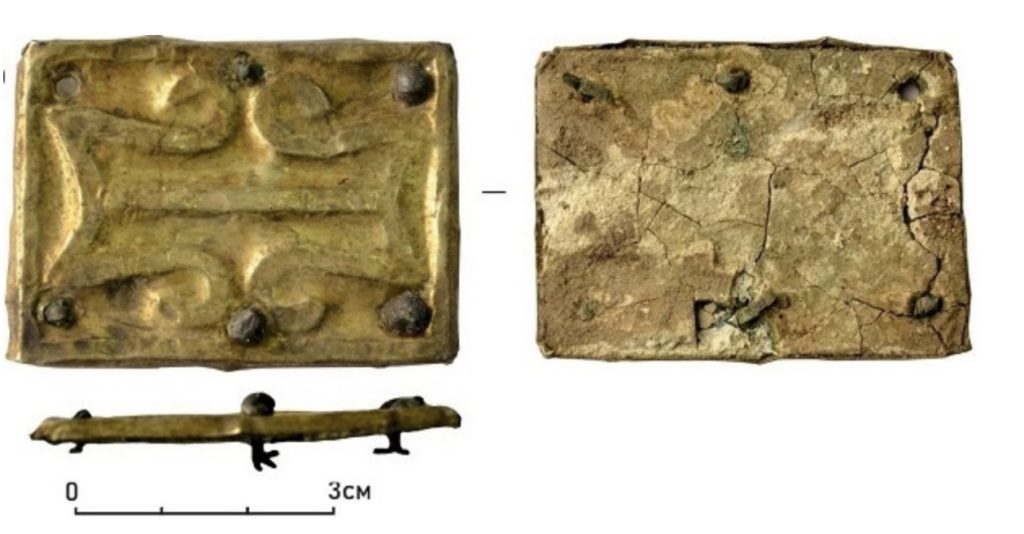
Scientific analysis made the object more revealing. X-ray fluorescence spectroscopy showed that the front plate was made from a gold and silver alloy in a ratio of about two to one by weight. The fastening pins were also composite. Their decorative heads were made of silver, while their shafts were copper. The inner plate was made from a copper-based alloy, and the outer surface carried precious metal plating.
The white mastic inside the plaque opened another line of evidence. It was composed mainly of calcium carbonate, with a significant amount of wax that likely served as the main binder. Researchers also detected clay minerals and organic compounds, including proteins and lipids. Such details show that the object was not simply hammered metal. It was a carefully engineered item, assembled from metals, fillers, organic binders and leather.
The manufacturing sequence reconstructed by the team points to advanced craftsmanship. A metal matrix with the image was first created. A thin copper plate was then embossed, followed by the embossing of gold-silver foil. The plates were assembled, holes were punched, small pins with decorative heads were made and installed, the inner cavity was filled with mastic, and the finished piece was attached to leather.
For archaeologists, the plaque is important not only because it is beautiful, but because it helps date cultural influence. The combination of a kurgan mound, a square ditch and a precious-plated harness ornament with tamga-like decoration led the researchers to conclude that Alan influence had already reached the inhabitants of the Kislovodsk basin by the middle of the 3rd century AD, roughly half a century before Alan groups are thought to have appeared directly in this microregion.
That finding refines the story of the early Alans in the North Caucasus. The Alans were an Iranian-speaking nomadic people known in ancient sources from the first centuries AD and closely connected with the Sarmatian world of the Eurasian steppe. At Levopodkumsky 1, however, the evidence does not show a simple replacement of one group by another. It points instead to a slower process of contact, adoption and elite signaling.
The gold-and-silver harness plaque is therefore more than a luxury object from a robbed grave. It is a small survivor of a much larger historical transition. In its metals, hidden cavity, horse burial, and technical construction, archaeologists can see how prestige, movement, and cultural memory shaped the North Caucasus during the age of the early Alans.
The article was published in the latest issue of the journal Russian Archaeology (No. 1, 2026). Its authors are Dmitry Korobov, head of the Department of Theory and Methodology at the Institute of Archaeology of the Russian Academy of Sciences and professor of the Russian Academy of Sciences, together with Evgenia Belkevich and Nikolai Mamonov of the State Historical Museum.
Cover Image Credit: Illustration created by the author.
