
A 16th-century shipwreck in Cádiz Bay has been identified as the Genoese vessel San Giorgio e Sant’Elmo Buonaventura, sunk during Francis Drake’s 1587 raid. The wreck reveals cannon, American cochineal dye, food remains and human evidence from the age of the Spanish Armada.
A ship trapped between commerce and war
A 16th-century shipwreck in Cádiz Bay has been identified as the Genoese vessel San Giorgio e Sant’Elmo Buonaventura, a merchant ship sunk during Francis Drake’s attack on Cádiz in 1587. More than four centuries after it disappeared beneath the waters of southern Spain, the wreck is now offering an unusually vivid picture of war, Atlantic trade, food supplies, luxury goods, and the human cost of one of Europe’s most consequential naval confrontations.
The wreck, known to archaeologists as Delta II, was discovered in 2012 during archaeological work linked to the construction of a new container terminal at the Port of Cádiz. At first, it was one of three wrecks documented in the area, labeled Delta I, Delta II and Delta III. But a multidisciplinary study by researchers from the Andalusian Historical Heritage Institute, including specialists from its Centre for Underwater Archaeology and Paleobiology Laboratory, has now confirmed the vessel’s identity.
A Genoese ship in the service of Philip II
The San Giorgio e Sant’Elmo Buonaventura was not an ordinary merchant vessel caught in the wrong place at the wrong time. According to the research, it was a Mediterranean-built Genoese ship owned by Pietro Paolo Vassallo and captained by Clemente Vassallo. It had arrived in Cádiz as part of a state mission ordered by King Philip II of Spain, carrying military supplies and bronze cannon intended for the Spanish Armada then being prepared in Lisbon.
That detail changes the meaning of the wreck. Delta II is not only a submerged cargo ship. It is a fragment of the tense months before the Armada campaign of 1588, when Spain and England were moving toward open confrontation. Cádiz was one of the key ports in this military system, linking Mediterranean shipowners, Atlantic routes, Iberian logistics and the flow of colonial goods from the Americas.
Francis Drake’s raid on Cádiz, carried out between April 29 and May 1, 1587, was later remembered in English tradition as the “singeing of the King of Spain’s beard.” The attack aimed to disrupt Spain’s naval preparations before the planned invasion of England. Britannica notes that Drake’s forces destroyed dozens of Spanish ships and damaged the logistical system behind the Armada, including materials needed for barrels and supplies.
Cargo from a connected world
What makes Delta II exceptional is the survival of fragile organic material. The wreck had been sealed beneath a thick layer of compact mud, creating conditions that helped preserve wood, food remains, textiles and other delicate finds that normally vanish in marine environments.
Among the most remarkable discoveries was cochineal, a precious red dye from the Americas. Researchers identified it as Dactylopius coccus, the insect that produces carminic acid. In the early modern period, cochineal became one of the most valuable products exported from the Americas to Europe, prized for producing an intense red color used in textiles and luxury goods. The Junta de Andalucía statement describes it as the third most expensive American product after gold and silver.
The dye was found preserved in cloth sacks placed inside wooden barrels. Dendrochronological analysis of the barrel staves identified the wood as Baltic oak, with a date compatible with the ship’s sinking in 1587. This small detail opens a wide commercial map: American dye, Baltic timber, Genoese ownership, Spanish royal military needs, and Cádiz as the meeting point of multiple maritime worlds.
The cargo also included ceramic jars containing olives in brine, remains of guaiac wood, boxes of ginger from the Americas and other materials that illuminate the commercial life of 16th-century Cádiz. These were not abstract trade goods. They were objects moving through a port where war and commerce were inseparable.
A human trace of violence
The wreck also preserved evidence of the people caught in Drake’s attack. Among the human remains recovered from Delta II was the skull of a young woman, estimated to have been between 25 and 35 years old. Anthropological study identified a perimortem injury on the right side of the forehead, compatible with the impact of a projectile or a triangular-section object.
That finding gives the wreck a human dimension often missing from naval history. Drake’s raid is usually told through strategy, ships and imperial rivalry. Delta II adds something quieter and more immediate: the violence experienced by individuals aboard a vessel anchored off Cádiz as English forces struck the port.
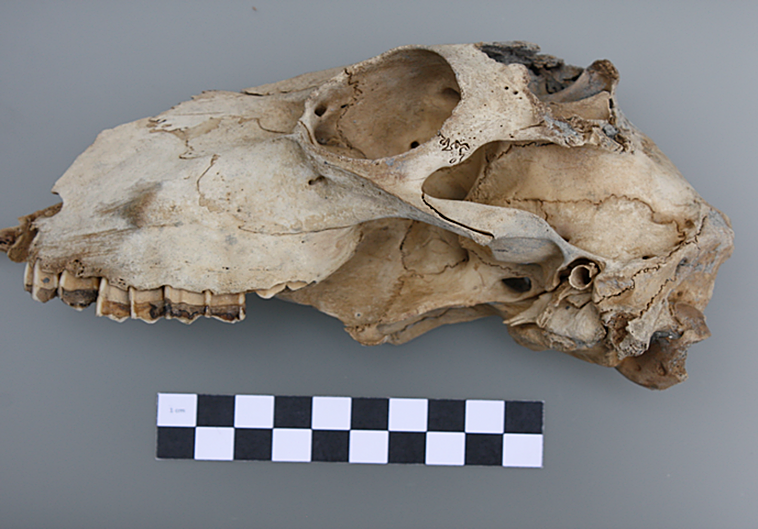
Paleobiological studies also identified animal bones from cattle, pigs, caprines and poultry. These remains help reconstruct the ship’s provisioning and diet, showing what kinds of meat and food supplies were available aboard a 16th-century vessel operating within the military and commercial networks of the Spanish monarchy.
A Shipwreck That Reconnects Cádiz with the Armada Age
The importance of Delta II lies in the way it connects different scales of history. At one level, it is the story of a single Genoese ship sunk in Cádiz Bay. At another, it is a window into the global systems that shaped the late 16th century: the Spanish Armada, English privateering, Mediterranean finance, American colonial products, military logistics and the economic power of ports.
The study also shows why underwater archaeology depends on collaboration across disciplines. Archaeology, archival research, dendrochronology, paleobiology, physicochemical analysis, microbiology and ancient DNA have together transformed a shipwreck into a detailed historical archive.
More than 400 years after Drake’s fleet entered Cádiz, the San Giorgio e Sant’Elmo Buonaventura has resurfaced not as a legend, but as evidence. Its bronze cannon speak of war. Its cochineal tells of American trade. Its food remains reveal shipboard life. And one injured skull reminds us that the great events of maritime history were lived, and sometimes ended, by real people.
Junta de Andalucía Consejería de Cultura y Deporte
Cover Image Credit: Sheep skull found inside the ship. Junta de Andalucía Consejería de Cultura y Deporte
