

15 February 2026 The Future is the Product of the Past

1,600-Year-Old Elderly Care Home Discovered in Ancient City of Hippos

Archaeologists working in northern Israel have uncovered what may be the world’s earliest known home for the elderly, shedding new light on social welfare systems in the ancient world. The discovery was made at Hippos National Park, near the Sea of Galilee, and dates back nearly 1,600 years to the Byzantine period. The findings were announced by the University of Haifa and reported by The Israel Times.

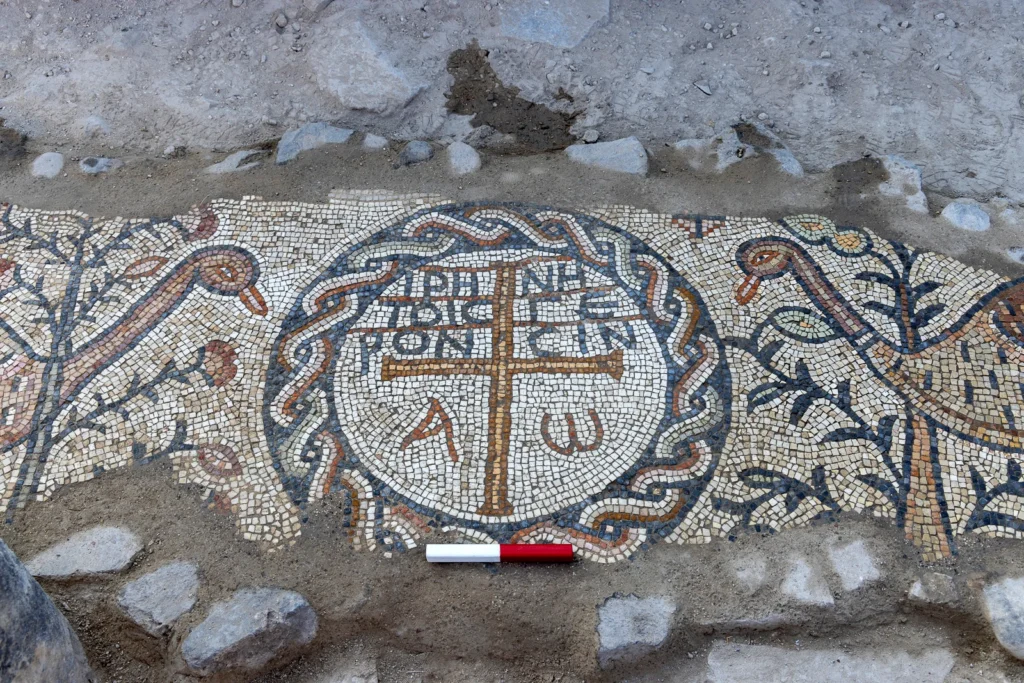
At the center of the discovery is an ornate mosaic medallion bearing a Greek inscription that reads, “Peace be with the elders.” Researchers date the mosaic to the late fourth or early fifth century CE. The inscription was found in a prominent location within a residential quarter of the ancient city of Hippos, suggesting that the building it marked served a specific communal function related to elderly care.

According to archaeologists, this inscription provides the earliest physical evidence of an organized institution dedicated to the care of older people. While historical texts from the fifth and sixth centuries mention facilities for the elderly, no archaeological proof had previously been identified. This makes the Hippos find a groundbreaking contribution to the study of ancient social institutions.

Dr. Michael Eisenberg of the University of Haifa’s Zinman Institute of Archaeology, who co-directed the excavation, emphasized the broader significance of the discovery. He explained that the find demonstrates how concern for the elderly was embedded in society long before modern welfare systems emerged. “This discovery proves that care for older members of society was already an established social value around 1,600 years ago,” Eisenberg said, as cited by The Israel Times.

The research team included Dr. Arleta Kowalewska and Professor Gregor Staab from the University of Cologne. Their study, published in the academic journal Zeitschrift für Papyrologie und Epigraphik, argues that the medallion’s wording and location strongly indicate the presence of a formal nursing home. The inscription specifically addresses elders as a group, a rare and direct reference in archaeological contexts.


📣 Our WhatsApp channel is now LIVE! Stay up-to-date with the latest news and updates, just click here to follow us on WhatsApp and never miss a thing!!


A close-up of an inscribed medallion saying "Peace be with the elders" flanked by Egyptian geese, found at the Hippos site in northern Israel. Credit: Dr. Michael Eisenberg
A close-up of an inscribed medallion saying “Peace be with the elders” flanked by Egyptian geese, found at the Hippos site in northern Israel. Credit: Dr. Michael Eisenberg

The site of Hippos, also known as Sussita, was a major Byzantine Christian city overlooking the Sea of Galilee. It served as an episcopal center and featured impressive public architecture, including churches, a basilica, a temple, a theater, and wide colonnaded streets. The newly identified elderly care institution was located near the intersection of two main roads, highlighting its integration into everyday urban life.

Excavations during the 2023 and 2024 seasons allowed researchers to fully uncover and analyze the mosaic and its surrounding iconography. The team concluded that the medallion was likely positioned at the entrance of the building, signaling both a spiritual blessing and a welcoming message to its residents.

Scholars believe the institution reflects early Christian values that encouraged communal responsibility and care beyond traditional family structures. According to the researchers, this development may be linked to broader social changes in Late Antiquity, including monastic life and new forms of communal living promoted by the Christian church.

The medallion may also represent one of the earliest material examples in the Holy Land of the Christian community assuming social responsibilities once managed solely by family networks. Researchers see this as a key moment in the evolution of organized social care.

This remarkable discovery not only deepens understanding of Byzantine society but also highlights the long history of compassion and institutional care for the elderly—an issue that remains highly relevant today.

Cover Image Credit: Dr. Michael Eisenberg

Related Articles

“Urartian Royal garbage dump” was found during excavations at Ayanis Castle

3 September 2022

3 September 2022

During the excavations carried out in the Ayanis Castle, which was built by the Urartian King Rusa II on the...

According to new research, medieval warhorses were shockingly diminutive in height

12 January 2022

12 January 2022

Medieval warhorses are often depicted as massive and powerful beasts, but in reality, many were no more than pony-sized by...

Collapsed 18th-Century Tomb Uncovers Hidden Crypt Beneath Historic Churchyard

12 November 2025

12 November 2025

A mysterious underground crypt has been revealed after the sudden collapse of an 18th-century tomb in a centuries-old English churchyard....

A 2000-year-old wooden figure was unearthed in a Buckinghamshire ditch

13 January 2022

13 January 2022

An extremely rare, carved wooden figure from the early Roman era has been discovered in a waterlogged ditch during work...

Archaeologists Uncover Little-Known Rare Knife Collection Spanning from the Xiongnu Era to the Middle Ages

21 January 2026

21 January 2026

Archaeologists have uncovered a little-known knife collection revealing that Xiongnu-era blacksmithing traditions survived along the Yenisei River for more than...

Gladiators’ ancient hygiene tools on exhibit in Izmir

22 July 2021

22 July 2021

Turkey’s Izmir Archaeological Museum is hosting a different exhibition this month. A bronze strigil is the museum’s guest this month...

2000-year-old dagger reveals the site of a long-forgotten battle between the Roman Empire and tribal warriors

16 December 2023

16 December 2023

In Switzerland, a volunteer archaeologist and dental student Lucas Schmid discovered in 2019 a 2000-year-old silver and brass dagger. It...

483 Celtic gold coins worth several million euros stolen from German museum

23 November 2022

23 November 2022

A huge horde of ancient gold coins dating back to 100 BC was stolen from the Celtic and Roman Museum...

Luxurious Feather Beds of Iron Age Warriors

27 March 2021

27 March 2021

According to a new study, two warriors from the 7th century in Sweden were buried in graves where they were...

A shipboard 14th-century cannon found off the Swedish coast may be the oldest in Europe

14 September 2023

14 September 2023

An international research team led by maritime archaeologist Staffan von Arbin of the University of Gothenburg has confirmed that a...

11,000-Year-Old Settlement Unearthed: Saudi Arabia Reveals Oldest Human Settlement in Arabian Peninsula

27 September 2025

27 September 2025

The Saudi Heritage Commission has announced, in partnership with Japanese scholars from Kanazawa University, the discovery of the oldest known...

3000-year-old clay figurine discovered in Germany may be a prehistoric water goddess

14 July 2022

14 July 2022

Archaeologists have discovered a rare clay figurine thought to represent a prehistoric water goddess in the Schweinfurt region of Germany....

Outstanding Bronze Age artifacts discovered in the Auvergne-Rhône-Alpes region of France

23 August 2021

23 August 2021

Hundreds of bronze objects have been discovered buried in pottery in the Auvergne-Rhône-Alpes region of France. The research team, led...

Roman ‘ritual center’ discovered in England

12 January 2023

12 January 2023

Archaeologists from have discovered a Roman ritual centre during excavations near Northampton, England. The find was made by the Museum...

2,000-year-old stone faces and engravings emerge amid severe drought in Amazon

24 October 2023

24 October 2023

As a result of record-low water levels brought on by the region’s worst drought in over a century, faces carved...