
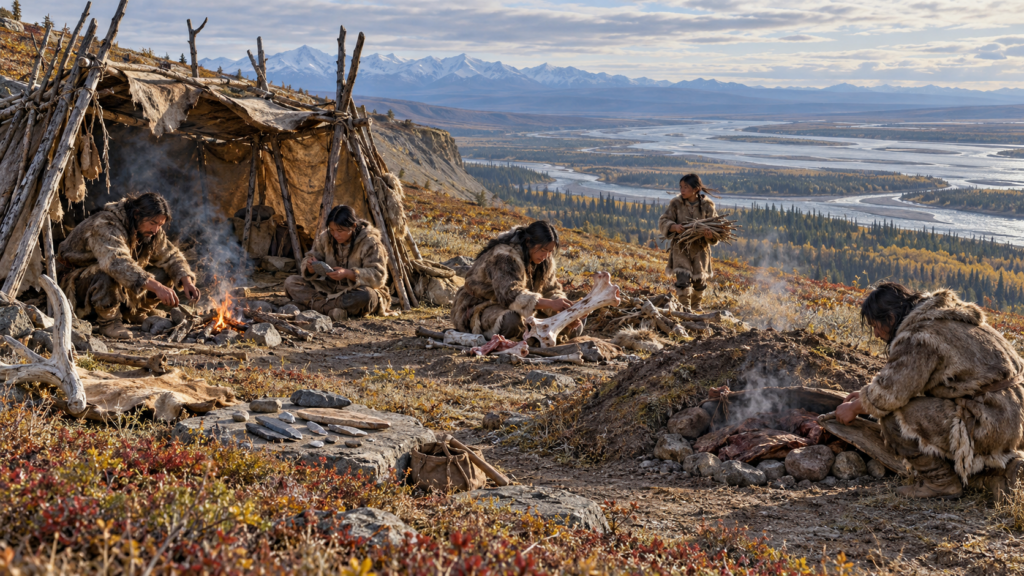
A new archaeological study has identified striking similarities between 13,800-year-old stone tools found in Alaska and artifacts from northeastern Siberia.
The research focuses on Shég’ Xdaltth’í’ (meaning “They were there” in an Alaska Native Athabaskan language), an Ice Age campsite overlooking the Tanana River in central Alaska. Excavations have uncovered tens of thousands of archaeological remains, allowing researchers to reconstruct how early communities organized their settlements, prepared food, and adapted to life in the region.
Published in Science Advances on October 14, 2026, the study also raises a broader question about the peopling of the Americas. The differences between early stone-tool traditions in Alaska may reflect separate movements of people from northeastern Asia, although researchers emphasize that genetic evidence is still needed to test this hypothesis.
Stone Tools Connect Alaska to Ancient Siberia
The strongest evidence of a cultural connection comes from a collection of distinctive, diamond-shaped stone implements recovered from the site’s earliest archaeological layer.
Unlike the triangular or teardrop-shaped points typically associated with Alaska’s early Nenana archaeological tradition, these artifacts taper toward both ends. Several have carefully ground edges near their bases, suggesting that people attached them to handles or shafts.
Researchers have not yet determined whether the implements served as hunting weapons, knives, or both. Nevertheless, their unusual shape provides an important clue to the technological traditions of the people who made them.
Comparable tools have been documented at Nikita Lake and Berelekh in northeastern Siberia, in archaeological contexts thought to date to approximately the same period. These sites also share another significant characteristic with Shég’ Xdaltth’í’: the absence of clear evidence for microblade technology, which appears at some other early sites in Beringia.
The similarities strengthen the archaeological connection between Siberia‘s Late Pleistocene communities and the Nenana Complex of central Alaska. They do not, however, establish that the same individuals traveled between these locations.
The camp’s inhabitants also had access to stone from considerable distances. Chemical analysis traced 25 obsidian artifacts to the Batza Téna source in west-central Alaska, approximately 370 kilometers northwest of Shég’ Xdaltth’í’.
Although researchers cannot determine whether people obtained this volcanic glass directly or through exchanges, its presence demonstrates access to resources far beyond the immediate campsite.
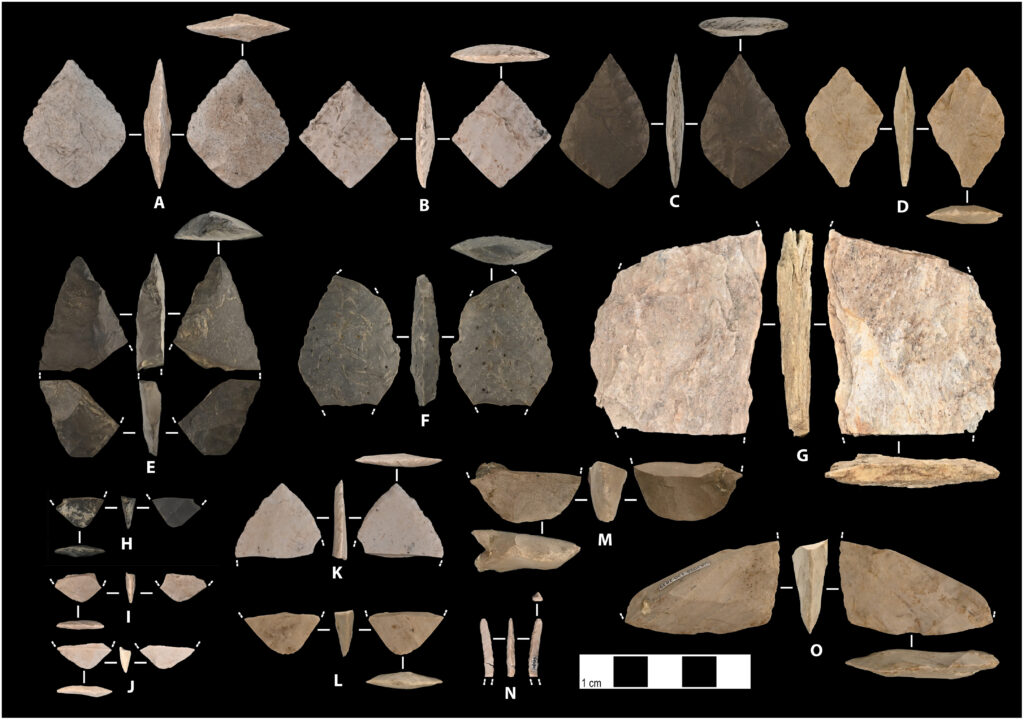
Bifacial stone tools from Context 1 at Shég’ Xdaltth’í’, including diamond-shaped bifaces, finished biface fragments, preforms, and a burin spall. Some of the diamond-shaped tools resemble artifacts from northeastern Siberia. Photo: B. Potter / University of Kansas. Credit: Graf et al., Science Advances (2026).
A Possible Ice Age Shelter
One of the most intriguing discoveries lies within the site’s earliest occupation layer, where archaeologists identified an oval concentration of charcoal-rich sediment measuring at least three meters across.
The feature contains a hearth, a shallow pit, numerous artifacts, and evidence of a possible posthole. Their spatial arrangement suggests that the inhabitants may have constructed a partially covered shelter, possibly a lean-to that opened toward the south.
The hearth occupied an area approximately 70 centimeters in diameter, while the nearby pit contained discarded bones, stone fragments, and charcoal. These remains help researchers reconstruct how people organized activities within the possible living space.
The discovery may represent the earliest known evidence of a human shelter in North America, dating back approximately 13,800 years. Its location and the remains found inside suggest that people used the space for everyday activities, including cooking and food preparation.
Archaeologists identified the possible shelter through the arrangement of its hearth, shallow pit, artifacts, and a potential posthole rather than surviving walls or roofing materials.
Cooking and Survival in Ice Age Alaska
A short distance from the possible shelter, archaeologists uncovered a large concentration of charcoal, animal bones, and fire-affected stones. The arrangement suggests that people constructed an earth oven, potentially using heated rocks and soil to cook meat slowly.
Such a method could have tenderized tougher cuts of meat while helping people obtain valuable dietary fat. Researchers suggest that the cooking feature may have served a relatively large family group and could have been reused during successive occupations.
These discoveries suggest that people broke animal bones to extract marrow or processed them to obtain grease. Both activities would have helped maximize the nutritional value of hunted animals in a demanding northern environment.
The evidence provides a rare opportunity to examine food preparation and resource use among people living in Alaska near the end of the last Ice Age.
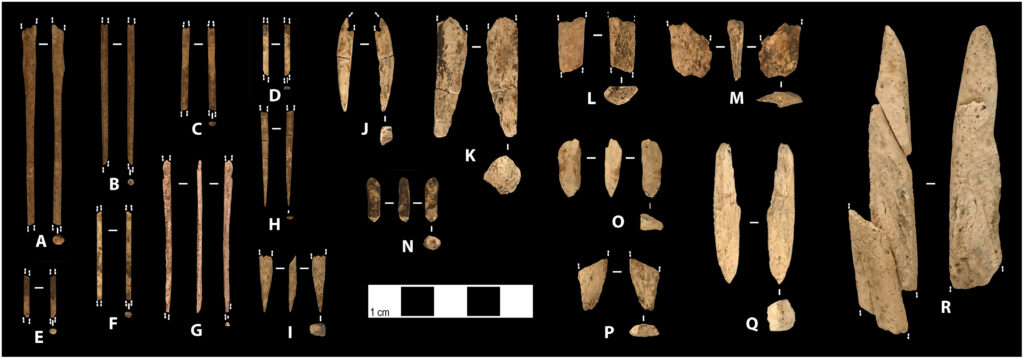
Bone and antler artifacts discovered at the 13,800-year-old Shég’ Xdaltth’í’ campsite in Alaska. The collection includes eight sewing needle fragments (A–H), an awl tip (I), a pendant with a drilled hole (J), several pointed tool fragments (K–M and O–R), and an unidentified object (N). Photo: B. Potter / University of Kansas. Credit: Graf et al., Science Advances (2026)
Bone Needles, Personal Ornaments, and Wildlife
The campsite yielded 18 worked artifacts made from bone, antler, or ivory, including eight needle fragments, an awl tip, pointed implements, and a small pendant.
Several needles retain portions of their eyes, indicating that the inhabitants possessed tools suitable for sewing animal hides. Such equipment could have supported the production and repair of clothing, bags, and other essential objects.
The pendant, approximately 2.9 centimeters long, preserves part of a drilled suspension hole and has carefully worked surfaces. Although its precise significance remains unknown, it provides evidence of personal adornment alongside the camp’s practical activities.
Animal bones add further detail to this picture of everyday life. Researchers recovered nearly 6,900 bone specimens from the earliest archaeological layer. Identified species include bison, mammoth, horse, caribou, musk ox, arctic hare, wolves, foxes, and numerous birds, including waterfowl and cranes.
The diversity suggests that the inhabitants exploited different environments and may have visited the location during more than one season. Researchers are continuing their analyses to establish the timing and nature of these activities.
Importantly, the presence of a species does not necessarily prove that people hunted it. Some remains could reflect other processes, and further zooarchaeological work will help clarify their origins.
Different Migration Traditions Across Beringia?
The similarities between Alaskan and Siberian stone tools raise a larger question about the movement of early human populations into North America.
During the Late Pleistocene, lower sea levels exposed Beringia, a vast landscape connecting present-day Siberia and Alaska. This region played a central role in human dispersal from Asia into the Americas, but its archaeological record preserves evidence of more than one technological tradition.
At Swan Point in Alaska, researchers have identified microblade technology resembling traditions known from northeastern Asia. Shég’ Xdaltth’í’, by contrast, contains distinctive hafted stone implements but lacks unequivocal evidence of microblade production.
Kelly E. Graf of the University of Kansas and her colleagues propose that these technological differences could reflect separate population movements rather than simply different activities performed by related communities.
Under this hypothesis, one tradition may have spread from the Lena River region of northeastern Asia, while the cultural connections between Berelekh, Nikita Lake, and the Nenana Complex could represent another movement from Arctic northeastern Asia.
The researchers also identified an unusual wolf jaw at Shég’ Xdaltth’í’. Its shape differs from those of the ancient and modern wolves included in their comparative analysis, raising the possibility of another connection with northeastern Asian animal populations.
They further consider whether the inhabitants might have kept early dogs, although the remains do not establish domestication. Additional genetic studies will be needed to investigate the animal’s ancestry.
The proposed human migration histories also remain hypotheses. Similar stone tools cannot establish whether their makers belonged to genetically distinct populations, and the researchers emphasize that ancient human DNA will be essential for testing these relationships.
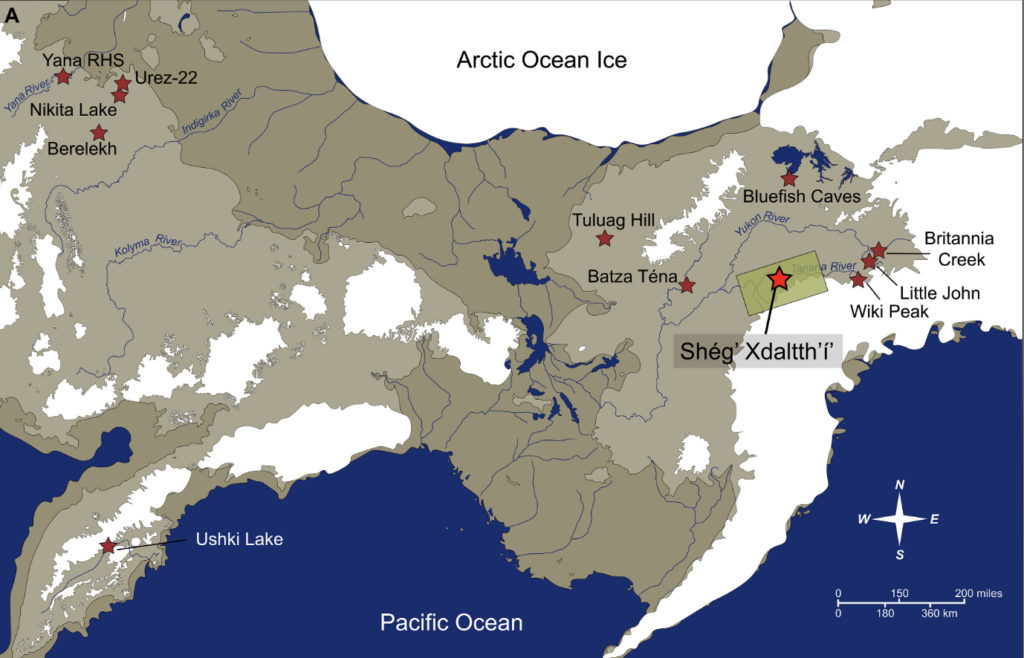
Map of Beringia during the last Ice Age, approximately 18,000 years ago, showing the land bridge that connected Siberia and Alaska and the extent of surrounding ice sheets. Credit: Graf et al., Science Advances (2026),
A Base Camp Used Across Generations
Shég’ Xdaltth’í’ lies approximately 55 kilometers south-southeast of Fairbanks, on traditional lands of the Mendas Cha’ag and Nenana communities of Tanana Athabaskan Indigenous peoples. Its name means “They were there” in an Alaska Native Athabaskan language.
Archaeologists first identified the site in 2010, and researchers began expanding excavations in 2016. Investigations have since established that archaeological remains extend across an area of at least 4,800 square meters.
The earliest occupation has produced more than 80,000 archaeological specimens, including stone-working debris, animal remains, charcoal, and artifacts. The density of material is particularly remarkable within the 25-square-meter excavation block that forms the focus of the study.
A series of 66 radiocarbon dates helped researchers distinguish several periods of human activity. The earliest major occupation dates to approximately 13,800 years ago, while later occupations occurred around 13,000 and 12,700 years ago.
The dating results indicate that people may have returned to the location periodically over approximately two centuries during its earliest phase. Researchers therefore interpret the site as a repeatedly used base camp rather than a permanent village or a single temporary hunting station.
Its position would have offered important advantages. An elevated terrace provided extensive views across the Tanana River valley, while nearby terrain offered protection from northwesterly winds.
The discoveries indicate that by 13,800 years ago, people in central Alaska had developed substantial knowledge of their environment and maintained cultural traditions with close parallels in northeastern Siberia.
Whether those similarities reflect distinct migrations across Beringia remains unresolved. The archaeological record at Shég’ Xdaltth’í’ now provides researchers with a more detailed foundation for investigating that question.
Kelly E. Graf et al., Highlights from an early base camp in Beringia 13,800 years ago: Shég’ Xdaltth’í’ and the Late Pleistocene peopling of Alaska.Sci. Adv.12,eaeh0802(2026).DOI:10.1126/sciadv.aeh0802
