
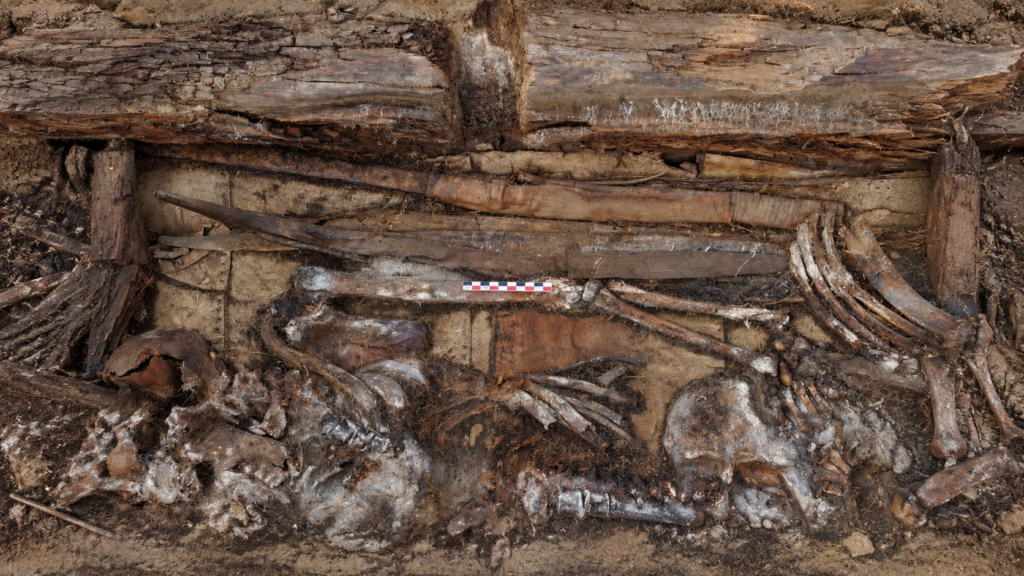
Archaeologists in Russia’s Sakha Republic have uncovered a centuries-old warrior’s grave containing an unusual bladed weapon, a bow and arrows, and the equipment of a horseman. Dating tentatively to the 15th–17th centuries, the burial offers a glimpse into the lives of the Sakha people before and during the early period of Russian expansion into northeastern Siberia.
The most intriguing discovery is a weapon that does not fit neatly into established categories of traditional Yakut arms. Its distinctive blade and unusually short handle suggest that it may represent a form between a traditional fighting polearm and a long sword.
A Warrior Buried with His Weapons and Riding Equipment
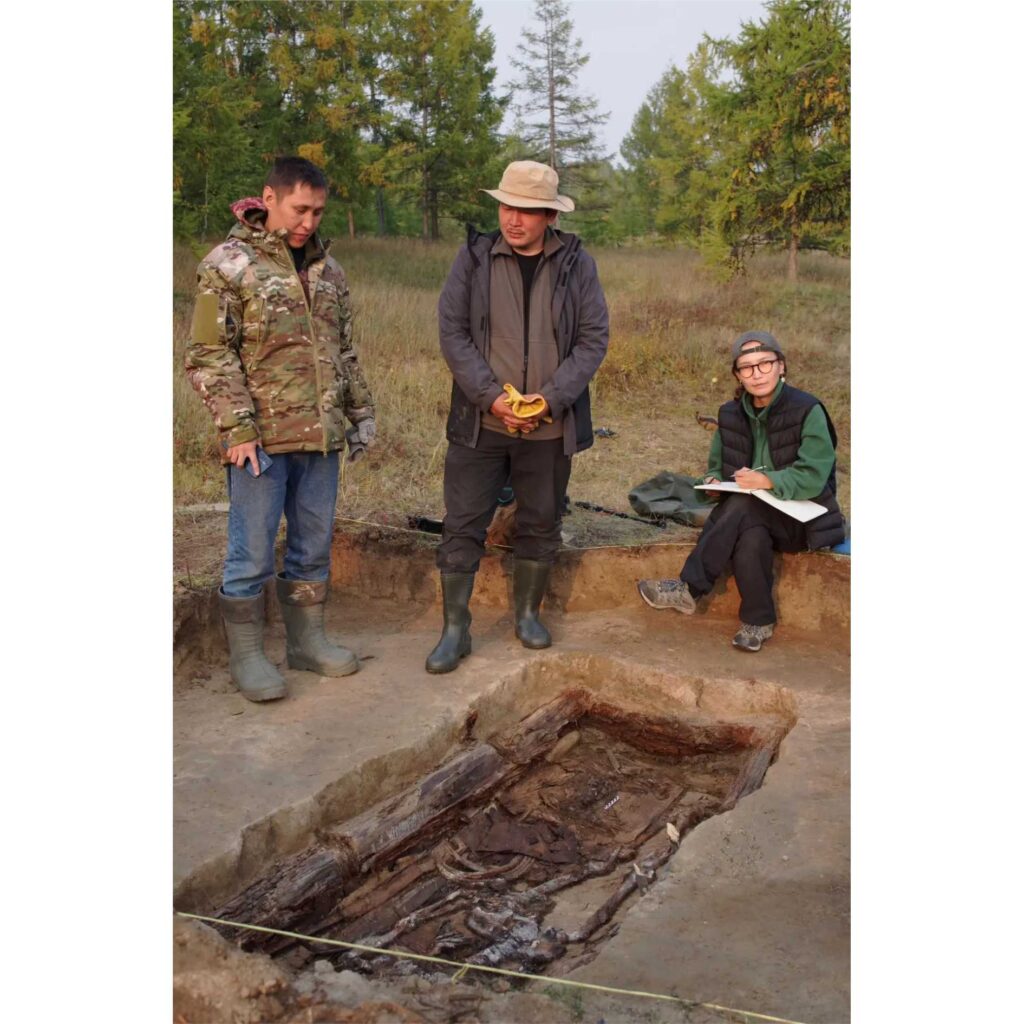
The burial was discovered near the village of Kyy in the Tatta District of Yakutia, in a locality known as Kukhaayy. The excavation was conducted by a team from the Institute for Humanities Research and Indigenous Studies of the North, part of the Siberian Branch of the Russian Academy of Sciences.
Researchers Denis Petrov and L. F. Ivanova, laboratory assistant A. I. Mikhailova, and volunteers took part in the 2026 fieldwork. The grave contained the remains of a man accompanied by objects associated with warfare, horse riding, and funerary practices.
Among the finds were a bow and arrows, a bladed weapon, a knife in its sheath, a whip, a saddle, wooden stirrups, and an iron cauldron. Remains of funerary food were also recorded.
The combination of weapons and riding equipment suggests that the deceased was buried with objects reflecting his identity as a horseman and possibly a warrior. However, the precise circumstances of his life, including whether he participated in warfare, remain unknown.
The burial has been provisionally dated to the 15th–17th centuries based on its archaeological characteristics. Further laboratory analysis will be needed to refine its chronology.
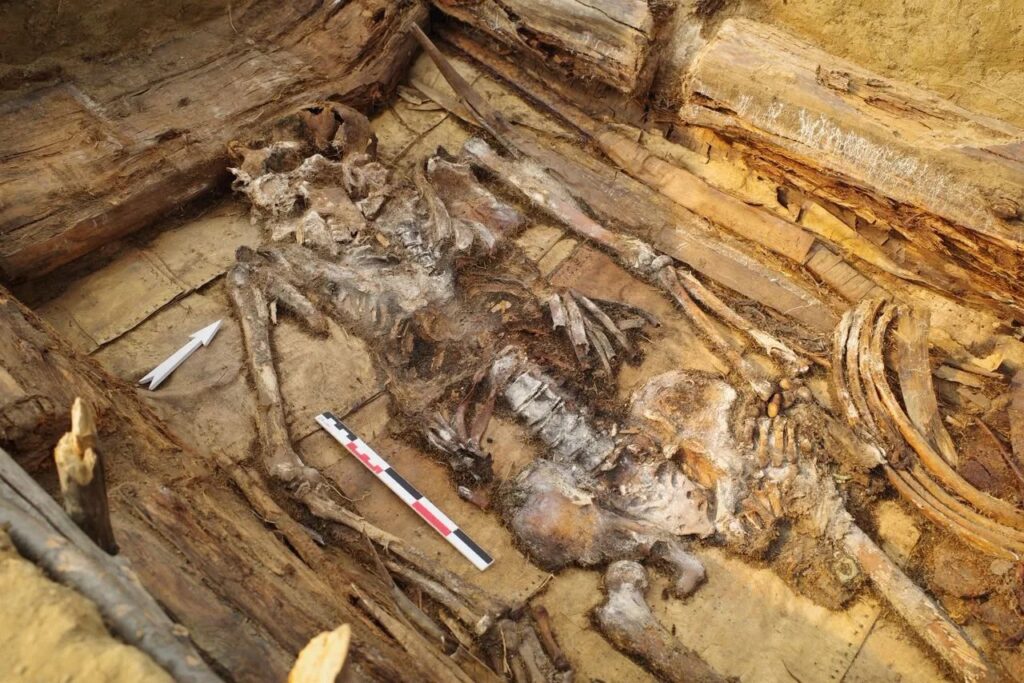
A Strange Blade That Falls Between Two Traditional Weapons
The most distinctive object recovered from the grave is an iron weapon with a blade measuring more than 40 centimeters long and slightly over three centimeters wide.
According to the research institute, its shape appears particularly suited to delivering concentrated thrusting blows, suggesting a combat function. Yet it differs from the traditional Yakut batas and batyya, both associated with the region’s historical bladed weapons.
Its handle measures approximately 45 centimeters, considerably shorter than those of traditional Yakut polearms. The end widens slightly and retains an additional wrapping of birch bark, apparently positioned where the weapon could have been gripped with one hand.
These details have led researchers to propose that the weapon may occupy an intermediate position between the fighting batas, a type of bladed polearm, and the longer kylys sword.
The interpretation is preliminary. Rather than identifying the object as an entirely new type of weapon, the researchers are examining how its unusual proportions and construction relate to known Yakut weapon forms.
To investigate the design further, the archaeological team plans to work with blacksmiths to produce a reconstruction. The process could help clarify how the weapon was held, balanced, and used.
Horsemen of the Siberian North
The discovery also belongs to a broader chapter of Sakha history.
The Sakha, also known as the Yakuts, are a Turkic-speaking people whose ancestors developed distinctive horse- and cattle-herding traditions in the Lena River basin. Archaeological research into early Sakha burials has documented the importance of livestock keeping and the development of their culture across northeastern Siberia.
A study published in Anthropology & Archeology of Eurasia describes the Kulun-Atakh archaeological culture through burials dating from the 14th to the 16th centuries, before the arrival of Russian Cossacks. These graves provide important evidence for understanding the formation of early Sakha society.
Horse-related objects were particularly significant in this cultural landscape. Saddles and other riding equipment found in burials can offer clues about the deceased’s activities, social identity, and the traditions observed at death.
Funerary customs also varied. In some graves, birch bark was used to line or cover burial structures. A separate 15th–17th-century burial at Uchugei-Yuryakh, for example, contained birch-bark sheets arranged inside the grave.
The Kyy discovery adds another example to this archaeological record, although its unusual weapon makes it particularly relevant to the study of regional military equipment.
What Will the Grave Reveal Next?
The initial stage of excavation has been completed, and the man’s remains and associated artifacts have been transferred to the research institute’s laboratory for further study.
Among the outstanding questions are the precise date of the burial, the construction and function of the unusual blade, and the significance of the accompanying objects.
The iron cauldron and funerary food may also offer information about burial practices, while the preserved wooden and birch-bark components provide an opportunity to examine how the equipment was manufactured.
For now, the identity of the man remains unknown. Yet the objects buried alongside him preserve a remarkably detailed picture of a horseman’s equipment in early Sakha society, including a weapon whose place in the history of Siberian arms has yet to be fully understood.
Historical context source: Bravina, R. I., D’iakonov, V. M., Bagashev, A. N., Razhev, D. I., Poshekhonova, O. E., Slepchenko, S. M., … Hodgins, G. W. L. (2016). Early Yakut Burials of the Fourteenth–Seventeenth Centuries: New Data on the Origin of the Yakuts (Sakha). Anthropology & Archeology of Eurasia, 55(3–4), 232–268. https://doi.org/10.1080/10611959.2016.1317534
