

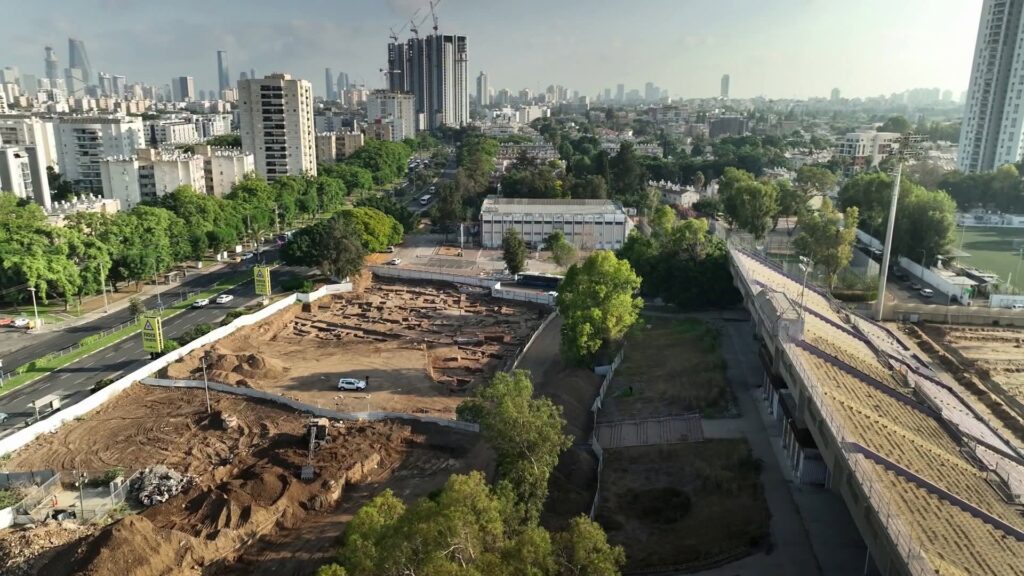
Archaeologists excavating near Ramat Gan’s Winter Stadium have uncovered a remarkably well-organized 1,300-year-old commercial and industrial complex, complete with straight intersecting streets, shops or warehouses, pottery kilns and production installations.
The discovery, made during excavations by the Israel Antiquities Authority (IAA), offers an unexpected glimpse of urban planning and economic activity in the region during the early Islamic period. The archaeological work was carried out ahead of the construction of a large bus terminal by Netivei Ayalon.
Although earlier archaeological remains were already known from the area, excavation directors Dr. Yoav Arbel and Lior Rauchberger said the scale and organization of the newly exposed complex exceeded expectations.
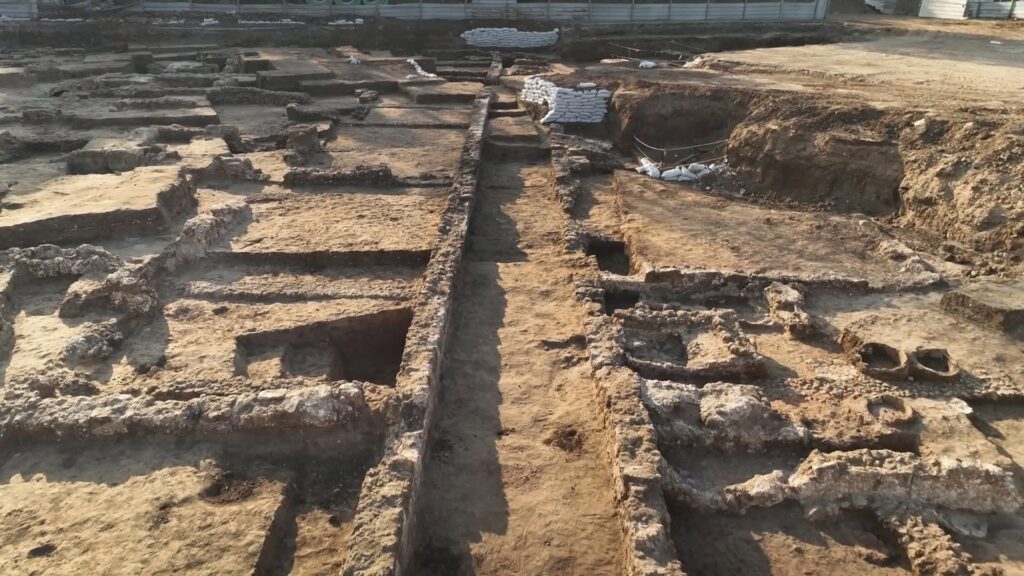
At the center of the discovery is a deliberately planned network of straight streets intersecting one another. Rows of rooms lined the streets, apparently functioning as shops, storage spaces or workshops. Archaeologists also uncovered plastered industrial installations and pottery kilns, suggesting that production and trade were central to the site’s function.
According to the excavation team, the regular layout indicates that the complex was not the result of gradual, informal growth. Instead, its principal phase appears to have been designed in advance, most likely with professional planning and the involvement of regional authorities.
A Trading Station on an Important Route?
The location may provide an important clue to why such a substantial complex developed here.
During the 7th and 8th centuries CE, the site stood close to the main road linking Jaffa with Ramla and Jerusalem. Ramla, founded during the Umayyad period, became the administrative capital of the region and developed into a major economic center.
Archaeologists believe the newly discovered complex may have stood along a secondary road branching from this important route. Fertile agricultural land and accessible water sources would have further increased the area’s economic value.
One possibility is that the site functioned as a large commercial and industrial station serving travelers and regional trade. Another is that it formed part of a larger settlement that has yet to be discovered.
The principal complex was established during the Umayyad or Abbasid periods, around the 7th or 8th century CE, and remained active for approximately 150 years. Why it was eventually abandoned is still unknown.
Settlement Returned Centuries Later
The story of the site did not end with the abandonment of the original complex.
People returned during the 10th century CE, when new residential buildings and production installations were constructed over the earlier remains. Archaeologists also discovered numerous tabuns, traditional clay ovens used for cooking and baking.
This later settlement belongs to the Fatimid period and continued until the late 11th century. Shortly before the Crusader conquest of the region, the settlement was abandoned once again. This time, according to the archaeological evidence uncovered so far, the site was never permanently resettled.
The two occupation phases therefore provide archaeologists with a rare opportunity to examine changes in settlement, industry and everyday life across several centuries.
Pottery, Oil Lamps and Tools Reveal Everyday Life
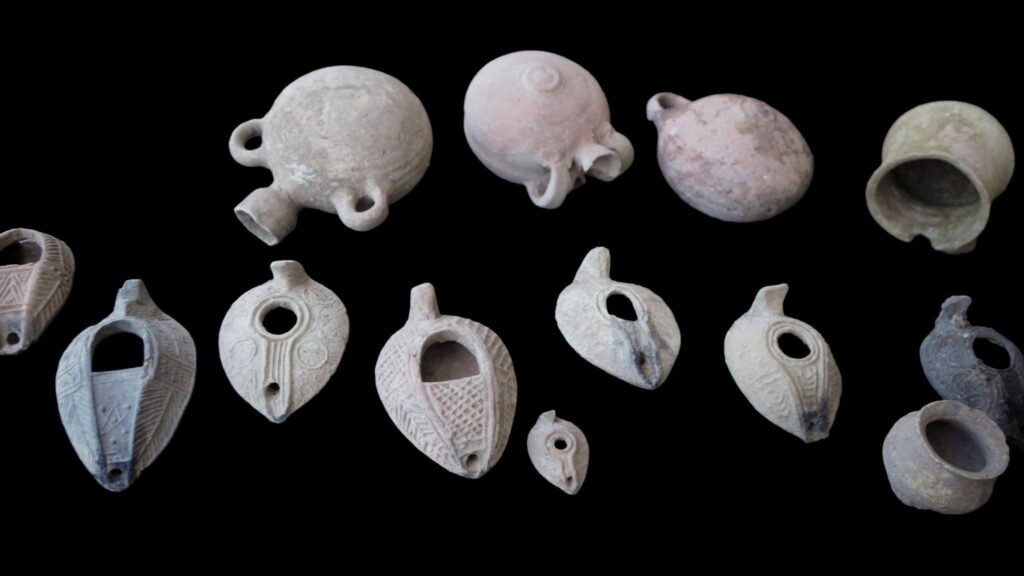
Beyond the streets and buildings, excavators recovered a substantial collection of artifacts that helps reconstruct the lives of the people who worked and lived at the site.
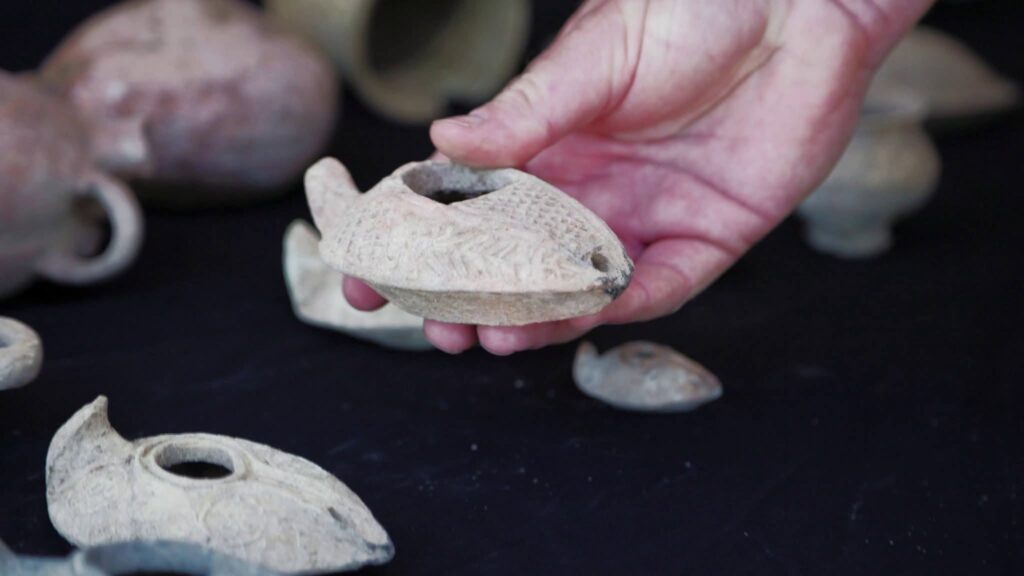
Dozens of pottery vessels and complete oil lamps were discovered alongside bronze tableware and cosmetic implements. Iron objects included pickaxe heads, a sickle and numerous nails, while dozens of coins were also recovered.
Large quantities of locally manufactured and imported pottery and glass fragments indicate that the site was connected to wider commercial networks rather than serving only a small agricultural community.
Together with the kilns, storage spaces and industrial installations, these finds strengthen the interpretation of the complex as an important center of production and exchange.
The population of the region during the Umayyad, Abbasid and Fatimid periods was highly diverse, including Muslim, Christian, Jewish and Samaritan communities. Ramla had a substantial Muslim population, while historical and archaeological evidence suggests that Samaritan communities remained particularly important in the Yarkon region after having flourished there during the Byzantine period.
However, archaeologists emphasize that none of the discoveries made so far can securely identify the religious or ethnic community that occupied the Ramat Gan complex.
An Ancient Street Grid Beneath Modern Ramat Gan
The discovery is especially striking because of its location beneath a heavily developed part of the modern city. The straight streets, commercial rooms, and industrial installations show that organized economic activity was taking place here more than a millennium before Ramat Gan emerged as a modern urban center.
The Israel Antiquities Authority will open the excavation to the public on Wednesday, August 19, allowing visitors to see the remains before they are covered for preservation. Archaeologists and planners are also examining whether some of the discoveries could eventually be displayed to the public.
For now, the excavation has revealed an unexpected early chapter in the history of the area: a carefully planned network of streets, workshops and commercial spaces that once stood beside one of the region’s major transportation corridors.
