

Luxury bowls found in one of northeastern Sudan’s harshest desert landscapes have preserved a secret invisible to the human eye for roughly a thousand years: their golden shimmer was created by metallic particles measuring only a few nanometers across.
Scientists studying lustre-painted ceramics from Deraheib, the site associated with the medieval city of al-Allaqi, found silver and copper embedded in the glaze. The silver nanoparticles had a median size of just 8 nanometers. Chemical analysis of the glaze then produced an even more surprising clue—the vessels were most likely made not in nearby Egypt, but in Basra, in present-day Iraq.
The discovery turns a handful of broken bowls into evidence for a much larger story. Expensive tableware had crossed long-distance trade networks before settling deep in Sudan’s Eastern Desert. Found near a fortified complex and decorated with blessings, animals and courtly imagery, the fragments also raise an intriguing question: who was dining from such luxurious vessels in the desert a millennium ago?
The study, published in Minerals, examined 20 ceramic fragments dating broadly to the 9th–12th centuries. Most were recovered during excavations near Deraheib’s Northern Fortress in 2022. The wider ceramic assemblage includes imports from Palestine and China, showing that the settlement was connected to exchange networks extending far beyond northeastern Africa.
Luxury at a Desert Crossroads
Today, the upper Wadi al-Allaqi is an arid landscape of rock and sand. During the medieval period, however, al-Allaqi occupied an important position on routes connecting the Nile Valley with the Red Sea. Caravan traffic crossed the region, while Wadi al-Allaqi itself was renowned for its gold resources.
That setting helps explain how luxury objects could reach what might otherwise appear to be an isolated desert settlement.
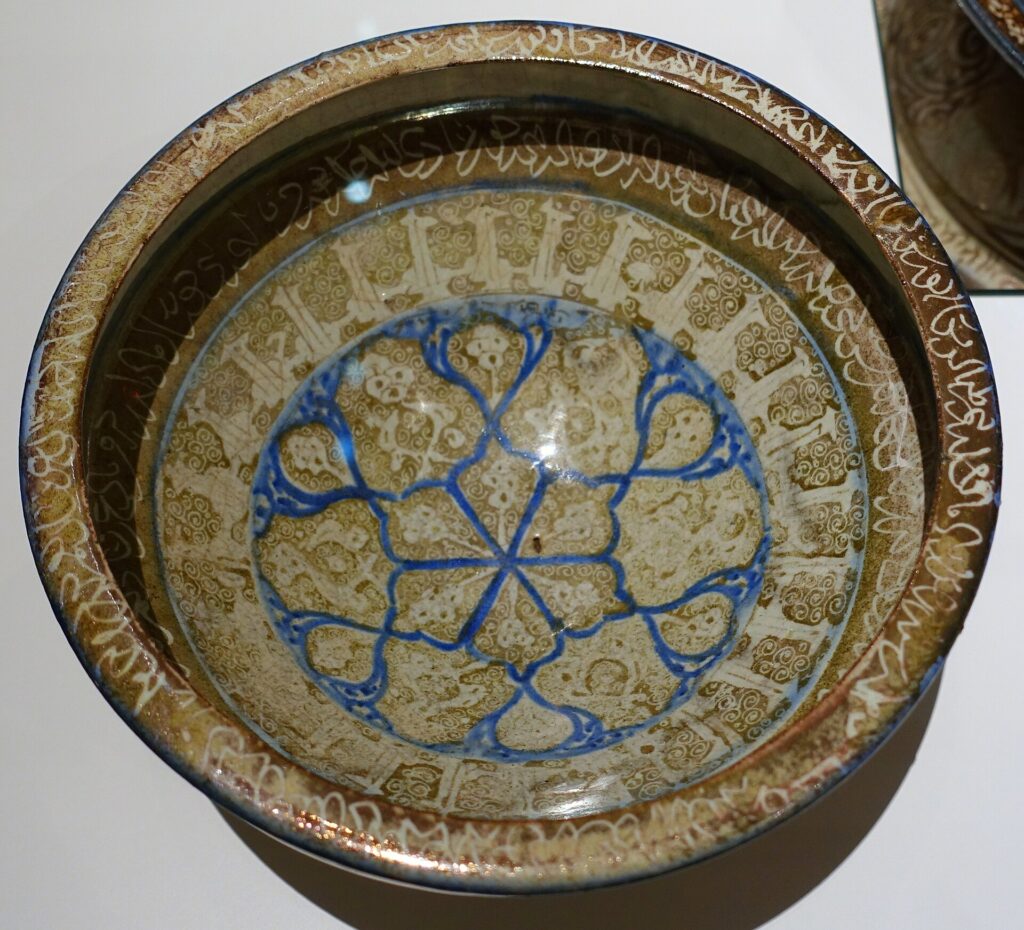
The lustre ceramics were particularly prestigious. Rather than cooking vessels or ordinary household pottery, the fragments belonged to elegant small bowls decorated with figurative and floral designs.
One preserves a hare, another a rosette, while several carry Arabic inscriptions or decorative writing imitating Arabic script. Some medallions contained blessings intended for the person drinking from the vessel.
One fragment is even more suggestive. It preserves part of a foot that researchers, using comparisons with complete museum examples, believe may have belonged to an image of a musician playing a lute. The study associates such imagery with the decorative world of “palace pleasures,” placing the vessels within a visual language of entertainment, hospitality and elite display.
The 8-Nanometer Secret Behind the Golden Shine
Lustre was one of the most technically sophisticated ceramic decoration techniques of the medieval Islamic world.
It first appeared in the Middle East during the 8th–9th centuries. Craftspeople applied compounds containing silver and copper to an already glazed vessel and fired it again at a relatively low temperature under reducing conditions.
The process left an extremely thin layer of metallic nanoparticles within the surface of the glaze. When light interacted with these particles, it produced the characteristic metallic, golden or iridescent appearance—even though the vessel contained no gold.
Researchers first examined the Deraheib ceramics using micro-X-ray fluorescence mapping, allowing them to map chemical elements without cutting, grinding or polishing the artifacts. The amber-colored decoration showed concentrations of silver and copper, confirming that the pieces were genuine lustre ware.
A microscopic fragment from a single selected sample was then examined using transmission electron microscopy. More than 200 measurements showed that the nanoparticles had a median diameter of 8 nanometers, while 90 percent fell between 5 and 12 nanometers.
High-resolution observations also showed that the silver had remained metallic after roughly a millennium.
A Chemical Fingerprint Points to Basra
Confirming how the bowls were made was only half of the investigation. Archaeologists also wanted to know where they had been produced.
Their decoration and pinkish-cream ceramic fabric had previously suggested a Mesopotamian origin. Basra was an important center of early Islamic lustre production, but similar ceramics were also manufactured in Fustat, the major Egyptian production center in the area of present-day Cairo.
Visual examination alone could not settle the question.
Researchers therefore turned to the chemical composition of the glaze, particularly concentrations of lead, tin and magnesium, which can help distinguish different production traditions.
The Deraheib samples proved much closer to comparative Iraqi material than to Egyptian ceramics. Their magnesium and lead levels corresponded more closely with Basra examples, while a proportional relationship between lead oxide and tin oxide also resembled the Iraqi material.
That pattern may reflect a controlled recipe using fixed proportions of ingredients, or a natural raw material in which the metals already occurred together. The Egyptian comparative material did not show the same relationship.
The chemical evidence therefore strongly favors Basra as the source of the Deraheib lustre ceramics and makes Fustat considerably less likely.
There is an important qualification. The researchers describe the micro-XRF measurements as semi-quantitative, and some comparative data from Basra and Fustat were obtained using different analytical methods. Basra should therefore be described as the most likely production center rather than an absolutely proven origin.
Color measurements provided additional evidence that the fragments belonged to a coherent technological tradition. Their lustre ranged from yellow through amber to dark brown, but statistical analysis revealed only minor differences in production technique.
Who Was Feasting in the Sudanese Desert?
This is where the chemistry begins to illuminate the people behind the objects.
Most of the analyzed fragments came from near the Northern Fortress, a prominent fortified complex within medieval al-Allaqi. The vessels themselves were not ordinary tableware. They carried blessings for drinkers, carefully executed decoration and imagery associated with music, leisure and elite culture.
The evidence cannot identify the individual who owned them, but their quality and context make an association with local elites and high-status dining plausible.
If so, a meal in medieval al-Allaqi could have been served in bowls manufactured in Iraq, surrounded by other imported objects arriving through trading systems that also carried ceramics from Palestine and China.
That transforms the image of the site. Al-Allaqi was not simply a remote settlement stranded in an empty desert. It participated in commercial networks connecting northeastern Africa with Egypt, the Red Sea and the wider Islamic world.
The Basra bowls provide unusually tangible evidence for those connections because researchers can now move beyond describing them simply as “imports.” Their glaze preserves a measurable technological signature pointing toward a specific major production center.
And that may be the most striking result of the study: an 8-nanometer layer hidden inside thousand-year-old ceramics has helped trace luxury tableware from Basra to a desert settlement in Sudan, revealing both the reach of medieval trade and the elite lives sustained along those routes.
The analytical method may also prove valuable far beyond Deraheib. By first mapping artifacts non-destructively and then taking a microscopic sample only from the most informative location, researchers were able to investigate production technology and probable provenance while sacrificing very little archaeological material. The authors suggest that the same approach could be used for museum collections where destructive analysis must be kept to an absolute minimum.
Cover Image Credit: Lomonosov Moscow State University
Statkus, M., Tolmacheva, E., Krol, A., Abdrashitova, I., Egorov, A., Reshetnikova, E., Korobkova, V., & Prasad, S. (2026). A New Two-Step Approach to Studying Early Medieval Lustre Ceramics from Sudan: Minimizing Destructiveness by Preliminary Micro-X-Ray Fluorescence Analysis. Minerals, 16(7), 713. https://doi.org/10.3390/min16070713
