3 December 2025 The Future is the Product of the Past

1-meter tall bronze statue found in China’s Sanxingdui Ruins-Video

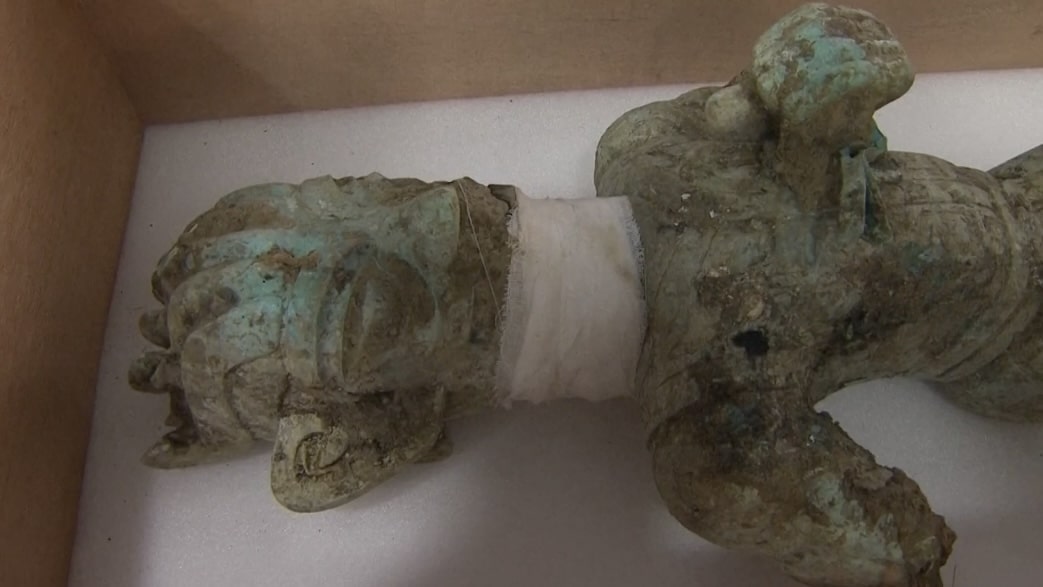
Chinese archaeologists have discovered a 1-meter tall bronze statue at the site of ancient Sanxingdui ruins site in southwest China’s Sichuan Province.

The Sichuan Provincial Cultural Relics and Archaeology Research Institute held a press conference at the Sanxingdui Museum on Monday to announce the results of archaeological excavation at the Sanxingdui site, a major project of “Archaeological China.”

The sacrificial area of the ruins is basically confirmed. The Shang Dynasty(1600 BC-1046 BC) relics distributed in the sacrificial area are all related to sacrificial activities, covering an area of nearly 13,000 square meters.

The sacrificial area includes the No. 1 pit, the No. 2 pit excavated in 1986, and the six pits newly discovered between 2020 and 2022. The eight pits are surrounded by rectangular trenches, small circular, and rectangular sacrificial pits, as well as trenches in the south and buildings in the northwest.

A large bronze figurine was unearthed from the Sanxingdui Ruins, along with other relics, as archaeologists continue excavations on the No. 7 and No. 8 sacrificial pits at the site revered as one of the greatest archaeological finds of the 20th century.


📣 Our WhatsApp channel is now LIVE! Stay up-to-date with the latest news and updates, just click here to follow us on WhatsApp and never miss a thing!!


So far, around 13,000 items buried for more than 3,000 years have been unearthed from the six pits.

Archaeologists are currently at a crucial stage of excavation with pits 7 and 8. The bronze figure is the only large intact human figurine retrieved from No. 8, which has unveiled more buried treasures.

The standing bronze figure is about one meter tall, physically strong in arms and legs, and dresses in ancient traditional attire. The figure appears to be holding thin bronze ware and carries a lei  (an ancient wine vessel), an ancient wine container, and ceremonial ware.

A bronze altar was discovered in a sacrificial pit last weekend. According to CGTN‘s news, the Bronze altar is about a meter high and is decorated with mythical creatures. There are also important finds in another pit where large amounts of bronze fragments and jade items were found.
Related Articles

The Artificial Intelligence Revolution: The Dark Age of Ancient Scrolls Ends

2 May 2025

2 May 2025

Artificial intelligence, often envisioned for future applications, is now playing a pivotal role in unraveling the mysteries of the past....

Archaeologists found a 2,000-year-old Roman road in Cluj-Napoca in northwest Romania

23 January 2023

23 January 2023

Archaeologists from the National Museum of the History of Transylvania have discovered a well-preserved 2,000-year-old Roman road in the city...

Archaeologists have found a previously unknown Roman city with buildings of monumental proportions in Spain’s Aragon Region

17 July 2022

17 July 2022

Archaeologists from the University of Zaragoza in Spain have discovered a previously unknown Roman city with buildings of monumental proportions....

Hellenistic cremation tomb found in Istanbul’s Haydarpasa excavations

11 April 2022

11 April 2022

A brick tomb belonging to the Hellenistic period (330 BC – 30 BC) was found during the Haydarpaşa excavations, which...

Artificial Intelligence Project That Will Revolutionize Archaeology

5 April 2021

5 April 2021

Polish Scientists to opening a new era in archeology They plan to use artificial intelligence to detect prehistoric cemeteries, castles,...

A Unique Discovery in Europe: Ancient Stone Circles Cover 2,800-Year-Old Graves of Children in Norway

29 June 2024

29 June 2024

Archaeologists from the Museum of Cultural History in Oslo discovered an unknown burial site in a quarry near Fredrikstad, in...

Unique Lion-Headed Handles Unveiled from a Roman-Period Cist Tomb Near Khirbat Ibreika

30 April 2025

30 April 2025

Beneath the ancient dust of Khirbat Ibreika in southern Israel, archaeologists have unearthed an unexpected enigma: four bronze discs, each...

Germany: 700-year-old Causeway Found Under Central Berlin Street

19 February 2022

19 February 2022

Archaeologists from the Landesdenkmalamt Berlin (LDA) made a sensational find during their excavation at Molkenmarkt: about 2.50 m below Stralauer...

Stone Age Architectural Marvel Unveiled Deep in the Baltic Sea: It may be one of the largest known Stone Age structures in Europe

13 February 2024

13 February 2024

Hiding deep beneath the Baltic Sea, an architectural wonder of the Stone Age has been discovered by researchers. This megastructure,...

Recent Excavations Unveil Five Remarkable Statues, Shedding Light on Perge’s Roman Heritage

12 February 2025

12 February 2025

During the excavations in the ancient city of Perge in Antalya, one of the most organized Roman cities of Anatolia,...

6,000-year-old island settlement found off the Croatian coast

24 June 2021

24 June 2021

Archaeologist Mate Parica, a professor at the University of Zadar, noticed something unusual while examining satellite images of Croatia‘s coastline....

Exceptional discovery of a fully frescoed chamber tomb dating back to the Republican and Imperial Roman ages

10 October 2023

10 October 2023

Waterworks in Giugliano, a suburb of Campania (Naples), have uncovered an untouched chamber tomb full of frescoes ceilings, and walls...

3,000-year-old skeletons of nine children were discovered in Qazvin province, Iran

29 April 2023

29 April 2023

Archaeologists from the University of Tehran have discovered the remains of children dating back 3,000 years during excavations in an...

Historic Leeds cemetery discovery unearths an ancient lead coffin belonging to a late Roman aristocratic woman

14 March 2023

14 March 2023

Archaeologists in northern Britain uncovered the skeletal remains of a late-Roman aristocratic woman inside a lead coffin, as well as...

Magical Roman Phallus Wind Chime Unearthed in Serbia

15 November 2023

15 November 2023

Archaeologists have unearthed a Roman phallus wind chime known as a tintinnabulum, during excavations at the ancient city of Viminacium...