
More than 40,000 years ago—long before the first cities of Mesopotamia—early humans were carving mysterious sequences of lines, dots, crosses, and notches into tools and figurines. A groundbreaking new study suggests these signs were far more than decoration. They may represent one of the earliest systems of visual information encoding in human history—an evolutionary precursor to writing.
The research, conducted by Professor Christian Bentz of Saarland University and Dr. Ewa Dutkiewicz of the Museum für Vor- und Frühgeschichte, reveals that these Ice Age sign sequences have statistical properties strikingly similar to proto-cuneiform—the earliest known writing system that emerged around 3,000 BCE in ancient Mesopotamia.
Their findings, to be published in the journal PNAS, challenge long-standing assumptions about when and how humans began encoding information in durable visual form.
Ice Age Symbols from the Swabian Jura
Many of the analyzed artifacts were discovered in caves in the Swabian Jura, a region in southwestern Germany famous for its rich Ice Age archaeology.
Among them is a small mammoth figurine from Vogelherd Cave, carefully carved from mammoth ivory around 40,000 years ago. The figurine is engraved with rows of crosses and dots—patterns long dismissed as decorative.
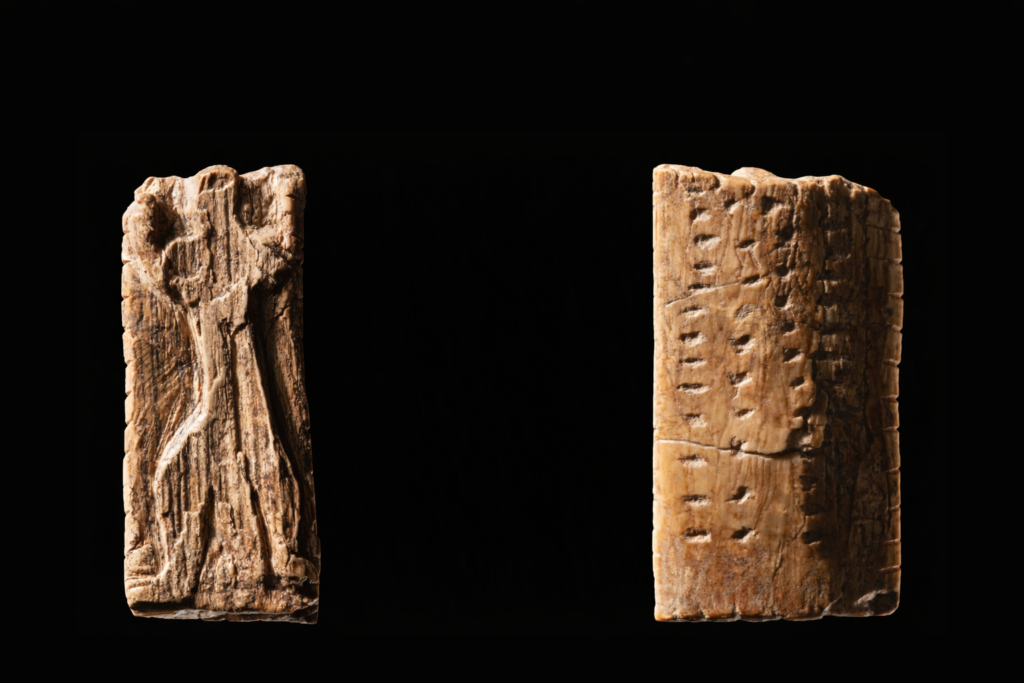
Another object, known as the “Adorant,” was uncovered in Geißenklösterle Cave. This mammoth ivory plate depicts a hybrid lion-human figure and is similarly marked with systematic rows of dots and notches.
A comparable lion-human figure—the famous “Lion Human”—was found in Hohlenstein-Stadel Cave. Notches appear at regular intervals along its arm.
For decades, archaeologists debated the meaning of these marks. Were they symbolic? Decorative? Ritualistic? The new study suggests they were functional—used intentionally to encode and convey information.
A Computational Approach to Ancient Signs
Rather than trying to decipher what the signs meant, Bentz and Dutkiewicz asked a different question: How did the signs function as a system?
Using computational modeling, statistical analysis, and machine learning classification methods, the team examined more than 3,000 individual signs found on 260 objects dating between 34,000 and 45,000 years ago.
They measured properties such as: Frequency of sign repetition
Predictability of the next sign in a sequence
Information density (entropy)
Their results were surprising.
The repeated patterns—cross, cross, cross; line, line, line—do not resemble modern writing systems, which represent spoken language and exhibit high informational variation. However, when compared statistically to early proto-cuneiform tablets, the Ice Age sign sequences showed remarkably similar levels of complexity and information density.
In other words, while not “writing” in the modern sense, these Palaeolithic markings functioned as structured information systems.
Comparable to Proto-Cuneiform
Proto-cuneiform emerged around 3,000 BCE in ancient Mesopotamia as one of the earliest known writing systems. It was used primarily for accounting and record-keeping.
Like the Palaeolithic sign sequences, proto-cuneiform tablets feature frequent repetition and predictable sign order. According to Bentz, the entropy levels—the mathematical measure of information density—are statistically comparable between the two systems.
This finding surprised the researchers. They initially expected proto-cuneiform to more closely resemble modern writing systems due to its relative proximity in time. Instead, the data suggest that for tens of thousands of years, humans relied on visual encoding systems that were structurally similar.
Only around 5,000 years ago did writing systems evolve to represent spoken language directly, fundamentally changing their statistical characteristics.
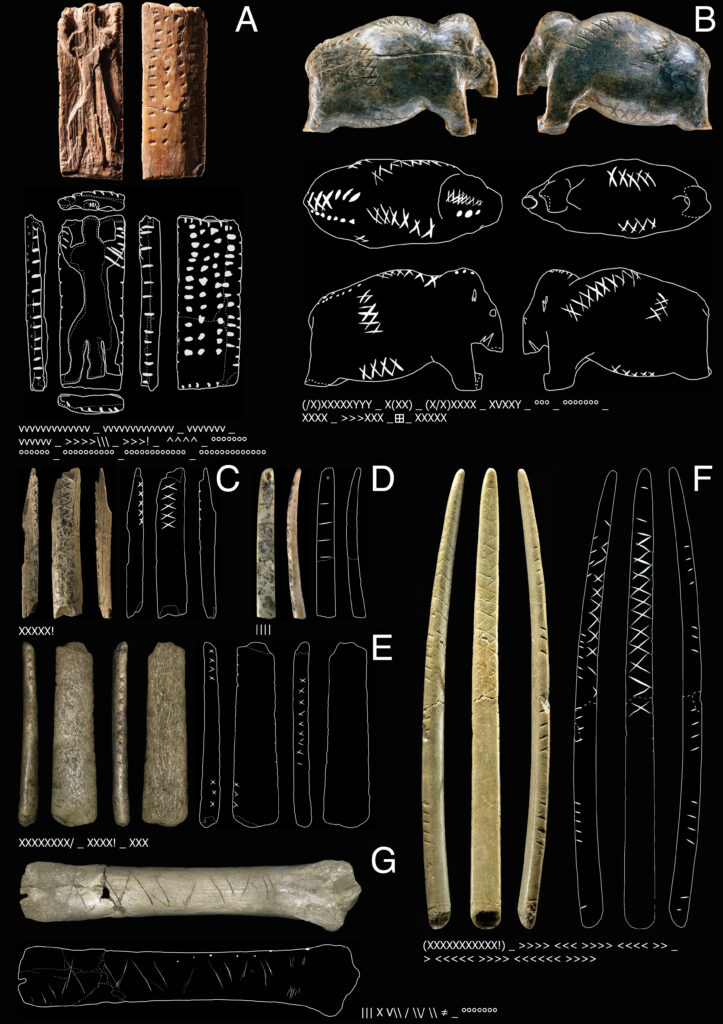
(A) Ivory plaquette with hybrid creature (“Adorant”), Geissenklösterle. © Landesmuseum Württemberg, Hendrik Zweitasch. (B) Ivory mammoth figurine, Vogelherd. © University of Tübingen, Juraj Lipták. (C) Ivory rod/bâton, Vogelherd. © University of Tübingen, Ewa Dutkiewicz.
(D) Ivory personal ornament, Geissenklösterle. © University of Tübingen, Ewa Dutkiewicz. (E–F) Bone spatulas/lissoirs, Vogelherd. © University of Tübingen (E: Dutkiewicz; F: Lipták). (G) Bone artifact (undetermined), Hohle Fels. © University of Tübingen, Ewa Dutkiewicz.
Drawings: Ewa Dutkiewicz. License: CC BY-SA 4.0.
The EVINE Project: Tracing the Evolution of Visual Encoding
The study is part of the ERC-funded research initiative “The Evolution of Visual Information Encoding” (EVINE). Supported by the European Research Council through an ERC Starting Grant, the project investigates how humans developed increasingly complex systems for encoding information visually.
Professor Bentz began the project at the University of Tübingen, continued it at the University of Passau, and now leads it at Saarland University.
The team is building a comprehensive digital database of Palaeolithic sign sequences across Europe. According to Dutkiewicz, “We’ve only just scratched the surface.” Similar sign systems appear on countless tools and sculptures from the Old Stone Age.
Why Information Encoding Matters
The study does not reveal the precise meaning of the signs. However, the statistical findings narrow down the possibilities.
During the period when these artifacts were created, Homo sapiens had recently migrated out of Africa and settled across Europe, encountering Neanderthals. Anatomically and cognitively, they were already comparable to modern humans.
The ability to record and transmit information would have been critical for survival. Portable objects—many small enough to fit in the palm of a hand—suggest these items may have been carried and shared within groups.
Encoding information visually could have helped coordinate hunting, track seasonal patterns, reinforce social identity, or preserve cultural knowledge.
As Bentz explains, writing is only one form within a long lineage of symbolic systems. Humans have continuously developed new methods for encoding information—from carved ivory to clay tablets to digital code.
Interestingly, modern artificial intelligence systems operate on a similar principle. Large language models rely on predictability in sequences—calculating which word or character is statistically likely to come next. In that sense, today’s digital information systems share a conceptual foundation with Ice Age sign sequences.
Rethinking the Origins of Writing
The discovery reshapes our understanding of human cognitive evolution. It suggests that the capacity to structure and encode information symbolically developed tens of thousands of years before traditional writing systems emerged.
Rather than appearing suddenly in ancient Mesopotamia, writing may represent just one stage in a much longer evolutionary process of visual information encoding.
The marks etched into mammoth ivory in the caves of the Swabian Jura are no longer silent decorations. They are statistical fingerprints of early human thought—evidence that 40,000 years ago, our ancestors were already experimenting with complex symbolic systems.
The roots of writing, it seems, run far deeper into prehistory than previously imagined.
Bentz, C., & Dutkiewicz, E. (2026). Humans 40,000 y ago developed a system of conventional signs. Proceedings of the National Academy of Sciences, 123(9), e2520385123. https://doi.org/10.1073/pnas.2520385123
Cover Image Credit: The Adorant figurine from Geißenklösterle Cave, approximately 40,000 years old, consists of a small ivory plate bearing an anthropomorphic figure and multiple sequences of notches and dots. The application of these marks suggests a notational system, most notably in the rows of dots on the back of the plate. Credit: Landesmuseum Württemberg / Hendrik Zwietasch, CC BY 4.0
