
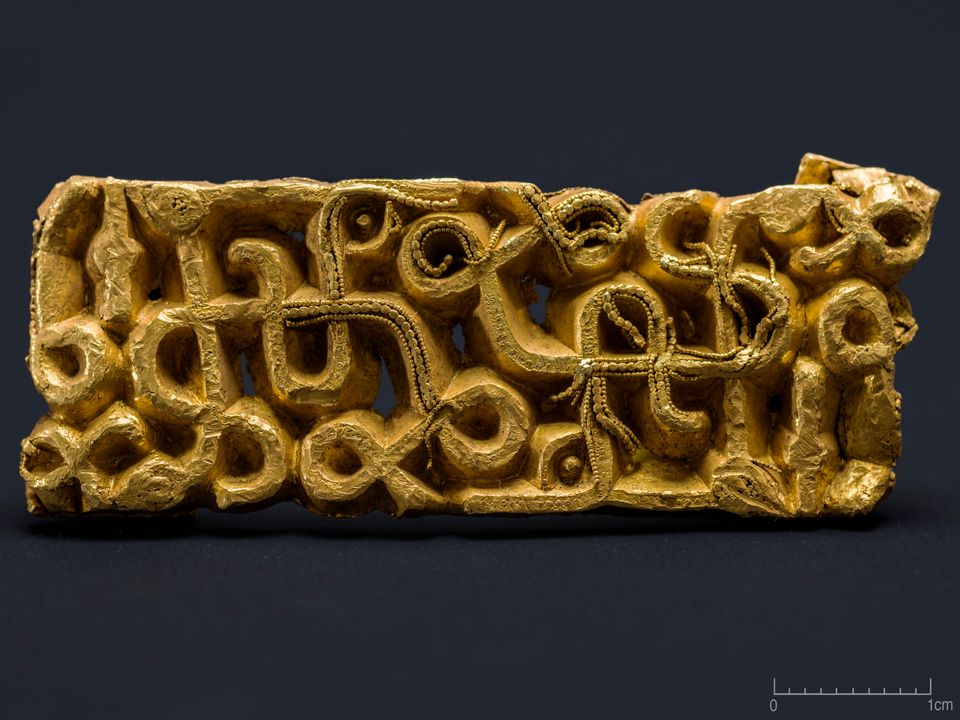
A 1,500-year-old gold sword-scabbard fitting found by a local walker beneath a storm-felled tree in Sandnes, Norway, is offering archaeologists a rare glimpse into a powerful warrior elite that ruled the region during the Migration Period.
The discovery was made in Austrått, a district of Sandnes in Rogaland county, near the hill known as Riaren. The finder, a father of two who lives nearby, had been exploring the local walking area when he noticed an old tree that had been torn from the ground by a storm years earlier. Curious about the soil exposed beneath its roots, he used a stick to prod a small rise in the earth. Something flashed.
At first, he did not know what he had uncovered. Archaeologists at the Archaeological Museum, University of Stavanger, soon realized the object was extraordinary: a richly decorated piece of gold, most likely once mounted on the scabbard of a high-status sword.
A rare object from Norway’s Migration Period
The fitting dates to the first half of the 500s, a time known in Norwegian archaeology as the Migration Period. It was an age of shifting alliances, local power centers and warrior leaders whose authority was displayed through weapons, gold and ritual offerings.
According to archaeologist and associate professor Håkon Reiersen at the Archaeological Museum, University of Stavanger, the find is exceptional. “The odds of finding something like this are minimal,” he said in the museum’s announcement.
Only 17 comparable pieces are known from Northern Europe, and this is the first discovery of its kind in Rogaland. That rarity alone would make the object important. But its location, wear and decoration make it even more valuable for understanding the political landscape of western Norway around 1,500 years ago.
The gold fitting measures about six centimeters wide, a couple of centimeters high and only a few millimeters thick. It weighs 33 grams. Though small, it belonged to a world of power. Such fittings were associated with prestigious swords carried by men at the very top of society.
Reiersen believes the person who carried the sword was probably a leader in the Hove area during the early 6th century. Such a figure would likely have commanded a retinue of loyal warriors and used ornate weaponry to signal authority.
Worn gold, not ceremonial display alone
One of the most striking details is that the object shows heavy wear. Gold sword-scabbard fittings of this type are often preserved with little evidence of use, suggesting that many were made for display, ceremony or ritual deposition rather than everyday carrying.
The Austrått fitting is different. It is worn and well used. That detail suggests the sword was not simply an untouched symbol kept for special occasions. It may have been carried repeatedly by a leader who used it as a visible sign of status.
The decoration also places the object among the finest metalwork of the period. Although the surface is worn, traces of filigree remain visible. Fine beaded gold wires once followed the lines of the design, creating a shimmering effect across the surface.
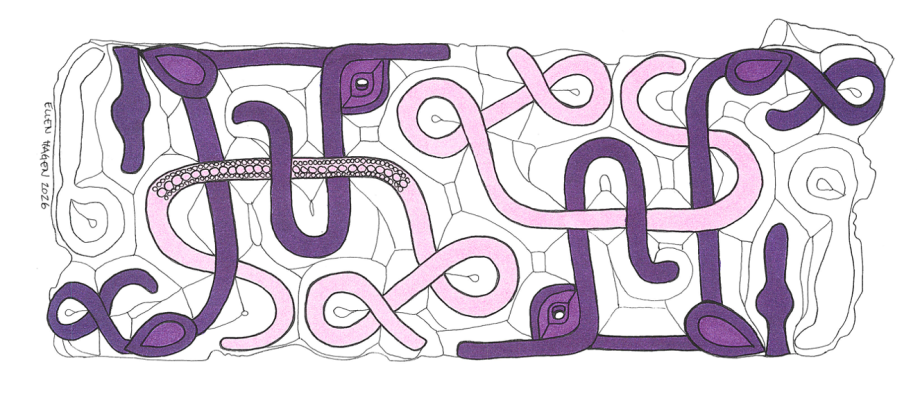
The main field is covered with animal ornamentation, one of the most distinctive artistic languages of Migration Period Scandinavia. Tiny stylized animals and possible human-animal hybrid figures are arranged symmetrically across the object. To modern eyes, the pattern may look abstract at first. Archaeologists often begin by searching for the eye of the creature, then following the head, body, limbs and interlaced bands.
Here, two profile animals appear to face one another. Their narrow bodies run along the length of the fitting, with shaped thighs, forelegs and hind legs worked into the design. The style belongs to a later phase of animal ornamentation and supports a date in the first half of the 6th century.
A possible offering to the gods
The findspot may be just as important as the object itself. The gold fitting appears to have been placed in a crack in the bedrock, not casually lost. Archaeologists therefore interpret it as a likely offering, deposited for religious reasons sometime in the 500s.
This interpretation fits a wider pattern in the area. Two earlier spectacular finds were made in the marshes below Riaren. In the 19th century, silver neck rings decorated with gold were uncovered during ploughing. In 1907, an unusually large Roman bronze cauldron was found at the neighboring farm of Høyland. That vessel had been made near the Rhine around AD 300.
Together, these finds point to Riaren and the Hove area as more than an ordinary settlement zone. They suggest a place where wealth, ritual and authority met. Leaders may have offered valuable objects to the gods during periods of hardship, reinforcing their own status while seeking protection or better times for the community.
In the 500s, crisis and poor years may have shaped such practices. Sacrificing gold was not merely an act of loss. It was a public statement. Only powerful families could give away objects of such value.
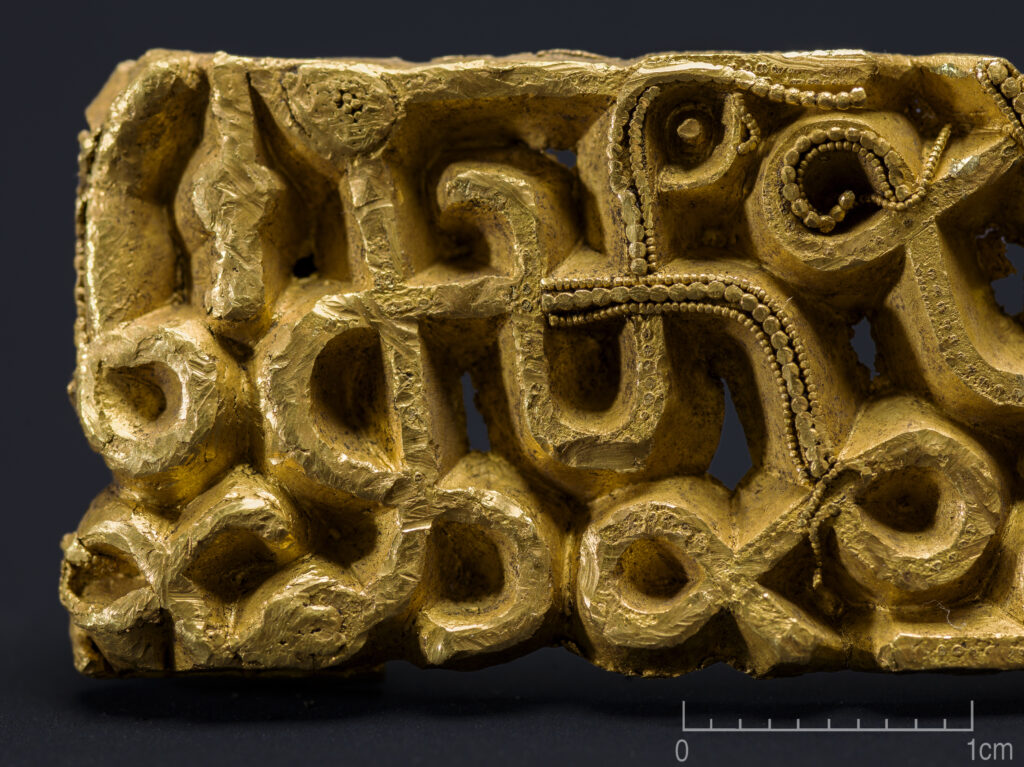
The sword-scabbard fitting is six centimeters wide, a couple of centimeters high, and only a few millimeters thick. It once belonged to a prestige sword used only by the most powerful individuals of the period. Credit: Annette Græsli Øvrelid, Arkeologisk museum, Universitetet i Stavanger
A new piece in the puzzle of Hove
Museum director and archaeology professor Kristin Armstrong-Oma described the discovery as a new piece of evidence for the Migration Period power center at Hove. The Archaeological Museum plans to make the object available to the public as soon as possible.
For researchers, the find opens several lines of inquiry. Its size and ornamentation connect it with a rare group of gold fittings known from deposited hoards in Scandinavia, sometimes found with gold spiral rings and bracteates. The closest parallel may be a fitting from the Vindelev hoard in Jutland, Denmark, discovered in 2020. Other comparisons include the Bergsaker find from Lyngdal in Agder and prestigious sword equipment such as the famous Snartemo sword.
Yet the Austrått object may also challenge existing categories. It resembles gold scabbard fittings linked to ritual hoards, but its dimensions also match mounts used on elite Migration Period swords. If it once belonged to a sword of Snartemo-level quality, it would place the lost weapon among the most prestigious objects of its age.
For now, one thing is clear: a casual morning walk has brought a rare fragment of Norway’s warrior aristocracy back into daylight. Beneath the roots of a fallen tree, a small piece of gold survived for 1,500 years, carrying with it the memory of power, belief and a leader whose sword once spoke before he did.
Cover Image Credit: Annette Græsli Øvrelid, Arkeologisk museum, Universitetet i Stavanger
