

A previously unknown Turkic stone sculpture in Kyrgyzstan has been documented beside a complex of nine ancient stone enclosures near Lake Issyk-Kul, placing the newly recognized monument within an archaeological setting rather than leaving it as an isolated figure in the landscape.
The sculpture was recorded in the Juu-Ku River valley on the southeastern shore of Issyk-Kul during an international expedition carried out from August 22 to 29. The fieldwork involved researchers from Altai State University’s Great Altai Research and Education Center for Altaic Studies and Turkology and Kyrgyz National University named after J. Balasagyn.
Researchers were surveying a group of nine Turkic-period stone enclosures when they documented the sculpture nearby. Instead of removing the monument, the team used photogrammetry to create a detailed digital record and left the stone at the site. Photogrammetry combines overlapping photographs to reconstruct an object in three dimensions, allowing archaeologists to study its form and surface without physically moving it.
Alexey Tishkin, head of the Department of Archaeology, Ethnography and Museology at Altai State University, described the documentation of another Turkic sculpture at a known archaeological monument as an important result. He also raised a practical concern: long-term protection. Tishkin suggested that the sculpture could eventually be transferred to the nearby museum in Orgocor, accompanied by information explaining where it was found and its archaeological context.
That context may ultimately prove as important as the sculpture itself.
Stone enclosures are a recurring feature of early medieval Turkic archaeology across a vast part of Inner Asia. Research by Tishkin and expedition member Vadim Gorbunov has documented comparable complexes from the Altai to Mongolia, Kyrgyzstan and Kazakhstan, where stone enclosures can occur together with sculptures, stelae and other elements of commemorative landscapes. Some excavated examples elsewhere date to the second half of the sixth and first half of the seventh centuries, although the newly documented Juu-Ku sculpture has not yet been assigned such a precise date.
This distinction matters. Without excavation results or a detailed scientific publication, the Juu-Ku monument can currently be described securely only as belonging to the Turkic period. Its position beside a nine-enclosure complex, however, gives archaeologists a defined setting in which its relationship to the surrounding structures can now be investigated.
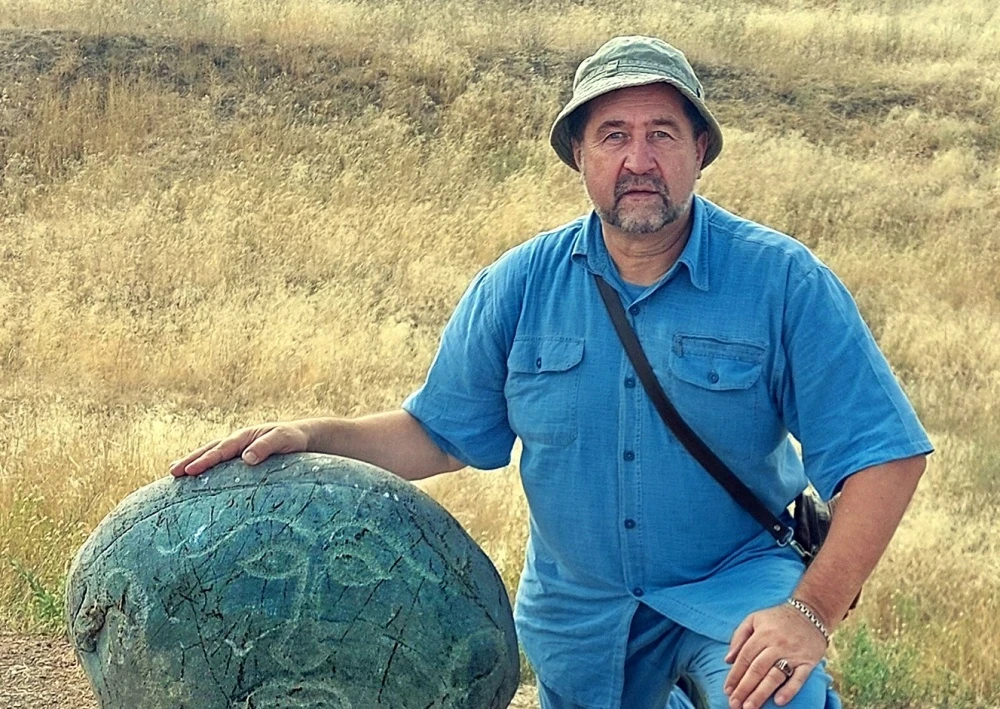
The Issyk-Kul discovery was only one part of a wider effort to digitally record Kyrgyzstan’s Turkic stone heritage. The expedition also worked with the National Historical Museum of Kyrgyzstan, whose collection has gained two Turkic-period sculptures during the past year. Researchers photographed those objects and other statues in the museum collection for three-dimensional reconstruction.
At the Burana Tower Archaeological and Architectural Museum Complex, the scale of the documentation expanded considerably. More than 80 stone sculptures were surveyed, while another object offered an unexpected connection with the monumental culture of the ancient Turkic world.
For the first time within the project, archaeologists carried out photogrammetry of a fragmentary stone stela from a Buddhist temple showing two intertwined dragons. Researchers noted parallels with stelae from the monumental complexes of Bilge Khagan and Kül Tigin in Central Mongolia. Yet the Kyrgyzstan fragment lacks the characteristic tamga associated with the Ashina ruling clan.
Rather than treating that difference as evidence for a firm new interpretation, the team has left several possibilities open. The missing symbol could indicate that the monument was never completed, or that the stela served a different purpose from its better-known Mongolian counterparts. Further analysis will be required before that question can be resolved.
The expedition also involved archaeologist Temirlan Charginov of Kyrgyz National University, Altai State University professor Vadim Gorbunov, and Kubatbek Tabaldiev of Kyrgyz-Turkish Manas University. Their work contributes to a growing database being assembled for the virtual museum project “Great Altai — Homeland of the Turks.”
The next stage will turn the field records into 3D models and detailed digital renderings before the objects are formally described in scientific publications. For the newly documented sculpture beside Issyk-Kul, that process may be particularly valuable: a stone figure that remained unnoticed in the landscape is now tied to a specific Turkic archaeological complex and preserved digitally for future study.
