2 January 2026 The Future is the Product of the Past

Underwater excavations start at 1,700-year-old ancient Black Sea port Kerpe

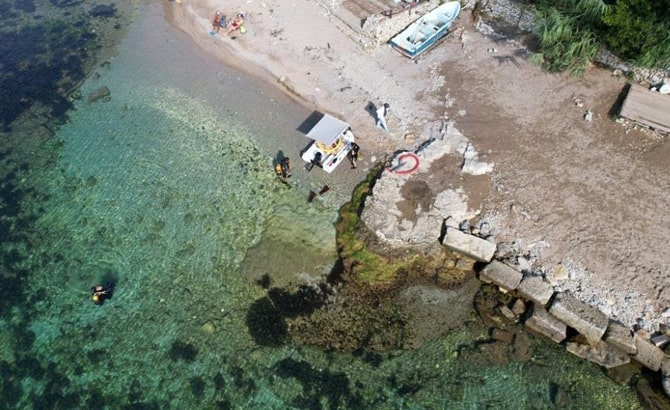
The traces of the ancient harbor on the Black Sea coast of Kerpe, in Kocaeli’s Kandıra district, are being brought to light again.

Underwater excavations have begun to excavate the historic port, which is located on the Kerpe shore of Kocaeli, on the Black Sea coast, and operated as an important trade route from the ancient through the Ottoman periods.

The 1,700-year-old port in the bay was built by the colonists of the Megara settlement, which was originally based in modern-day Greece and offered access to Black Sea commerce routes as well as a vital site for a military presence.

In this context, the Kocaeli Provincial Directorate of Culture and Tourism and the Kocaeli Museum Directorate began underwater excavations at the Ancient Kerpe Harbor and underwater research on the Black Sea coast of Kocaeli with the approval of the General Directorate of Cultural Heritage and Museums of the Republic of Turkey Ministry of Culture and Tourism.
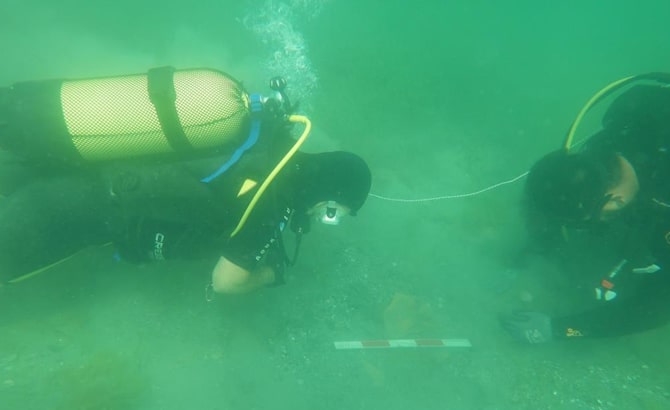
Divers work to mark areas for excavations in the ancient Kerpe Harbor on the Black Sea coast in Kocaeli's Kandıra district, Turkey. (Provincial Directorate of Culture and Tourism via AA)
Divers work to mark areas for excavations in the ancient Kerpe Harbor on the Black Sea coast in Kocaeli’s Kandıra district, Turkey. (Provincial Directorate of Culture and Tourism via AA)

In addition, Kocaeli Metropolitan Municipality, Kandıra Municipality, Düzce University Underwater Application, and Research Center, Watsan Elektrik, and Kerpe Sea Stars Diving School are also participating in the excavations.


📣 Our WhatsApp channel is now LIVE! Stay up-to-date with the latest news and updates, just click here to follow us on WhatsApp and never miss a thing!!


Researchers think that beneath the depths of Kerpe Harbor, once part of important settlements during both the Roman and Byzantine eras, a plethora of historically significant artifacts and ruins await discovery.

Researchers hope the excavations will lead to the discovery of cultural assets in the region. Along with artifacts, the team hopes to also determine the Black Sea trade route used by the Ottoman Empire and uncover information regarding regions that once hosted intense trade activity.

Related Articles

Unique 2,000-year-old Decorated Roman Sandal Discovered in Spain

20 October 2023

20 October 2023 1

A 2,000-year-old Roman sandal was discovered during archaeological excavations at Lucus Asturum (modern-day Lugo de Llanera) in Asturias, northern Spain....

The 1,000-year-old Church found under a cornfield in Germany

2 July 2021

2 July 2021

The foundation walls of the large church of the rediscovered Royal Palace of Helfta in Eisleben in the German state...

Hand disease known as Viking disease may have its origins in Neanderthal genes

14 June 2023

14 June 2023

A recent study in the Oxford University Press journal Molecular Biology and Evolution demonstrates that a condition known as Dupuytren’s...

10,500-year-old stone Age Hunter-Gatherer settlement found in England

20 January 2023

20 January 2023

A team of archaeologists from the University of Chester and Manchester has discovered a stone age Hunter-Gatherer settlement during excavations...

Rare Bronze Age Metalworking Hoard Discovered in Wiltshire, Including an Anvil

20 February 2025

20 February 2025

A remarkable discovery has been made in Urchfont, a village located in Wiltshire, England, where a Bronze Age hoard of...

Battle of the Egadi Islands: Rome’s deadly weapons discovered off Sicily

3 September 2021

3 September 2021

Underwater archaeologists from the Soprintendenza del Mare Regione Siciliana, RPM Nautical Foundation, and the Society for the Documentation of Submerged...

Iron Age Fortification Unearthed on the Trave: A Forgotten Stronghold of the Roman Imperial Period

26 September 2025

26 September 2025

Archaeologists investigating the Stülper Huk, a headland on the River Trave located in the German federal state of Schleswig-Holstein, have...

Archaeologists find the earliest evidence Maya sacred calendar in the Guatemalan pyramid

14 April 2022

14 April 2022

Archaeologists identified two plaster fragments depicting a date that the Maya civilization called ‘7 deer’ and was part of the...

6,000 Years of Human History Unearthed in Brittany: From Stone Age Villages to Roman Farms

25 October 2025

25 October 2025

A large-scale archaeological excavation in the heart of Brittany has unveiled more than six thousand years of continuous human occupation,...

Archaeologists find 4,000-year-old Sanctuary in Netherlands

22 June 2023

22 June 2023

Archaeologists discovered a 4,000-year-old sanctuary during excavations of the model industrial estate in the town of Tiel, located 72 kilometers...

Archaeologists Uncovered a Tile Workshop From the First Century in Corsica

3 December 2024

3 December 2024

Archaeologists from the French National Institute for Preventive Archaeological Research (INRAP) excavations on the east coast of Corsica have uncovered...

1.5 Million-Year-Old Hand Axes and Seven Paleolithic Sites Discovered in Iraq’s Western Desert

30 January 2025

30 January 2025

Archaeologists from the Free University of Brussels (VUB) uncovered hand axes dating back 1.5 million years and discovered seven Paleolithic...

Archaeologists Found 1,600-year-old Burials of Noble Women and Gold Jewelry in the Mountains of Crimea

4 December 2024

4 December 2024

Archaeologists found burials of noble women filled with gold and silver jewelry in the Crimean mountains in the Bakhchisaray region...

2,050-Year-Old Assembly Building Discovered in Ancient City of Laodicea Marks Architectural First in Anatolia

2 August 2025

2 August 2025

During the 2025 excavation season, archaeologists in the ancient city of Laodicea have unearthed a 2,050-year-old Roman-era assembly building with...

Earliest evidence of forest management discovered at the La Draga Neolithic site in Spain

19 July 2023

19 July 2023

Archaeologists have discovered the earliest evidence of forest management at the La Draga Neolithic site in northeastern Spain. A scientific...