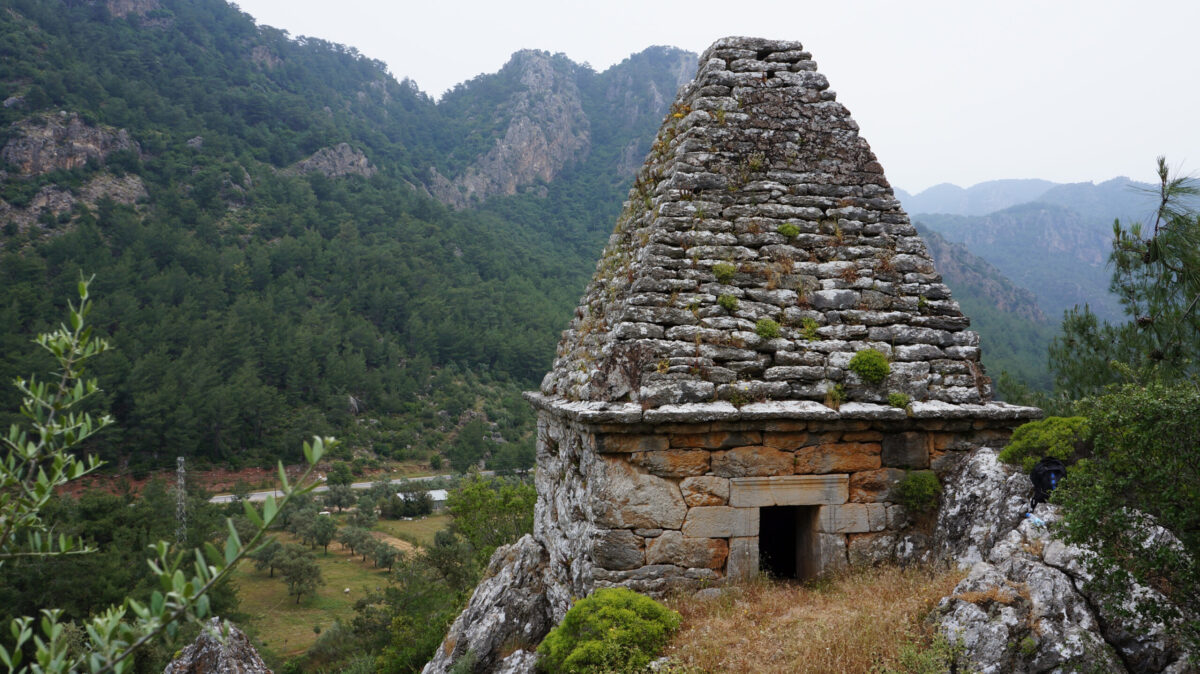
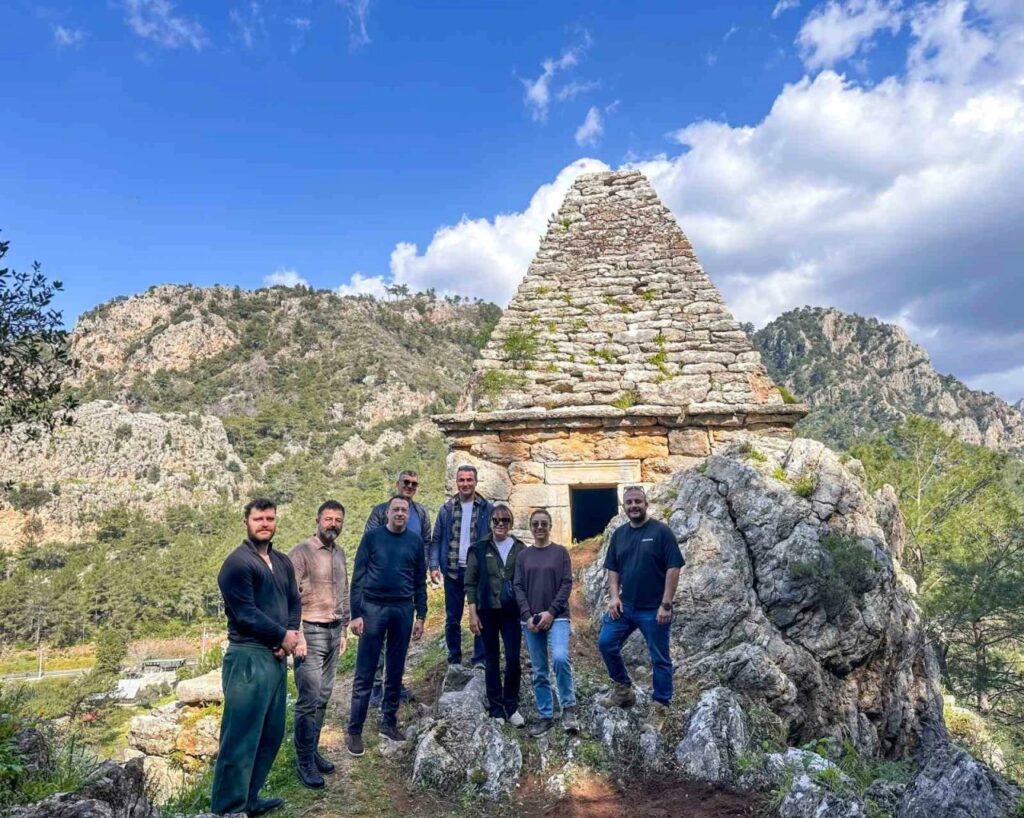
A rare funerary monument overlooking the hills of southwestern Türkiye is entering a new phase of protection. Conservation and landscape works have officially begun at the Pyramid Tomb in Turgut Neighborhood, one of the most distinctive cultural heritage landmarks in the Marmaris region. The initiative aims not only to safeguard the structure but also to make the site safer and more accessible for visitors.
The project is financed and coordinated by the Marmaris Chamber of Commerce and proceeds under the authorization of the Muğla Regional Board for the Protection of Cultural Heritage. Field supervision is being carried out by the Marmaris Museum Directorate, while scientific consultancy is provided by Assoc. Prof. Dr. Mehmet Gürbüzer of the Muğla Sıtkı Koçman University Department of Archaeology.
A Singular Monument from the Hellenistic World
Dating to the Hellenistic period, the monument stands apart from nearly all other funerary architecture in Anatolia. Its sharply rising pyramidal form gives it a silhouette more commonly associated with far older civilizations, yet this tomb belongs to the cultural landscape of ancient Caria.
A marble inscription placed on the structure preserves its human story. Written in the Greek alphabet, the text identifies the tomb as the burial place of Diagoras and his wife Aristomakha. Such epigraphic evidence transforms the monument from an abstract relic into a personal memorial—one that has endured for more than two millennia.
Archaeologists consider the structure exceptionally rare in architectural terms. It is widely recognized as the only surviving pyramid-type tomb in Türkiye, a distinction that elevates its importance far beyond the local scale. The monument is officially registered as an “Immovable Cultural Property Requiring Protection” by the Ministry of Culture and Tourism of Türkiye, underscoring its national heritage value.
📣 Our WhatsApp channel is now LIVE! Stay up-to-date with the latest news and updates, just click here to follow us on WhatsApp and never miss a thing!!
Protection First, Access Second
Initial works focus on environmental stabilization. Dense vegetation surrounding the tomb is being cleared to prevent root damage and moisture retention—two major long-term threats to ancient stone structures. Once the terrain is stabilized, a controlled protection perimeter will be established around the monument.
Visitor safety and site management form the second phase of the plan. A stepped access route and designated walking path will guide visitors while minimizing ground erosion. Informational and warning signage will be installed to improve interpretation and responsible visitation.
Security infrastructure is also being upgraded. Motion-activated wildlife cameras and fixed surveillance systems will monitor the area against vandalism and illicit activity. Carefully designed lighting will illuminate the tomb after dark, allowing the monument’s distinctive geometry to remain visible while enhancing site security.
Cultural Heritage and Regional Identity
Set within the wider cultural landscape of Marmaris, the Pyramid Tomb represents more than an isolated archaeological curiosity. The region is better known internationally for its coastline and tourism economy, yet its inland terrain preserves layers of ancient settlement and funerary traditions that reflect Caria’s role in the eastern Mediterranean.
Protecting such monuments strengthens the cultural profile of the region and diversifies heritage tourism beyond resort centers. For local institutions, the project signals a growing alignment between academic research, public heritage management, and regional development strategies.
A Monument Without Parallel in Türkiye
Pyramid-form tombs are extraordinarily uncommon in Anatolia. Most Hellenistic burials followed different architectural traditions, making this monument an outlier that challenges standard typologies. Its preservation therefore contributes not only to cultural tourism but also to scholarly understanding of regional funerary architecture, identity, and cross-cultural artistic influences.
As conservation progresses, the Marmaris Pyramid Tomb is expected to become a more visible and better-interpreted heritage site—protected against environmental risk while open to responsible visitation.
Cover Image Credit: İHA