
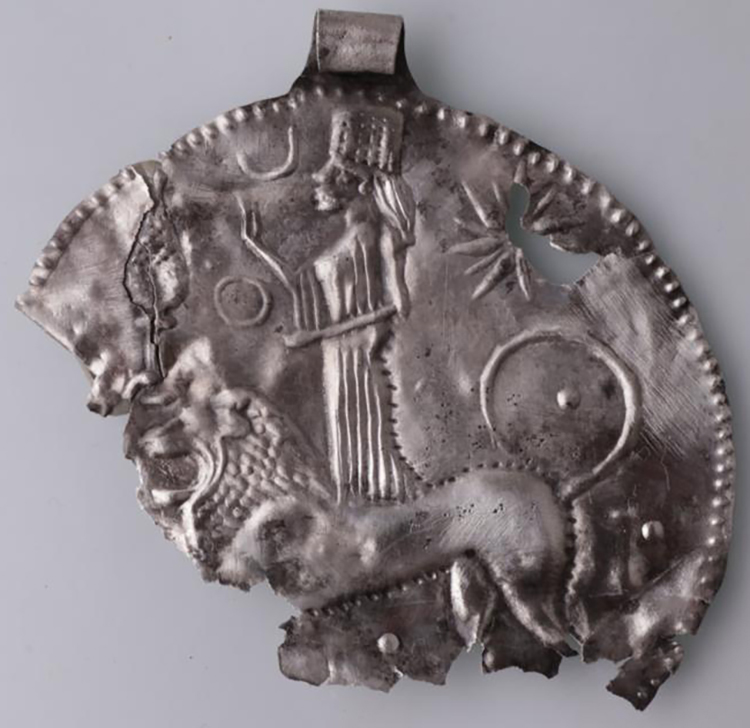
A striking archaeological discovery has been made in Türkiye’s southwestern Muğla province, where excavations at the Amos Ancient City in Marmaris have revealed a silver necklace believed to depict the Assyrian goddess Ishtar. The jewelry piece features a lion motif and an eight-pointed star — powerful symbols historically associated with the revered goddess of love, war, and fertility in the ancient Near East.
The ongoing excavations at Amos, whose history dates back more than 2,200 years, are conducted under the authorization granted by presidential decree in 2022 and supported by Türkiye’s Ministry of Culture and Tourism within the Heritage for the Future Project. The work continues with the sponsorship of Marmaris Chamber of Commerce, Marmaris Municipality, and Martı Hotel & Marina, under the leadership of Assoc. Prof. Mehmet Gürbüzer from Muğla Sıtkı Koçman University.
A Unique Artifact Signaling Cultural Interaction
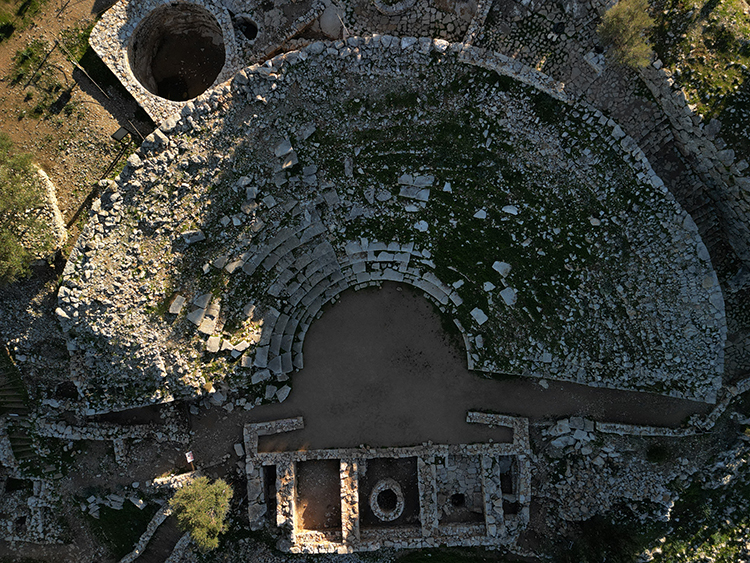
Speaking about the discovery, Gürbüzer emphasized that each excavation season brings new and compelling findings that deepen understanding of the site’s past. This year’s standout artifact is the silver necklace found during excavations in the theater’s orchestra area and nearby residential sectors.
“The necklace bears the attribute of the goddess Ishtar, along with a lion figure and an eight-pointed star,” Gürbüzer noted, highlighting its symbolic and cultural significance. He explained that Ishtar — known earlier in Sumerian culture as Inanna — became one of the most influential deities of the Assyrian and Babylonian worlds. Her imagery frequently included lions, representing strength and sovereignty, and the eight-pointed star, a celestial emblem linked to power, fertility, and protection.
According to Gürbüzer, the artifact suggests that Amos was not only a local settlement but a city engaged in wide-ranging cultural, economic, and commercial exchange with regions of the Near East. From the 7th century BCE onward, maritime and military connections helped transfer advanced cultural elements across the Eastern Mediterranean — and Amos appears to have been an active participant in this network.
Amos: A Strategic Harbor City of the Eastern Mediterranean
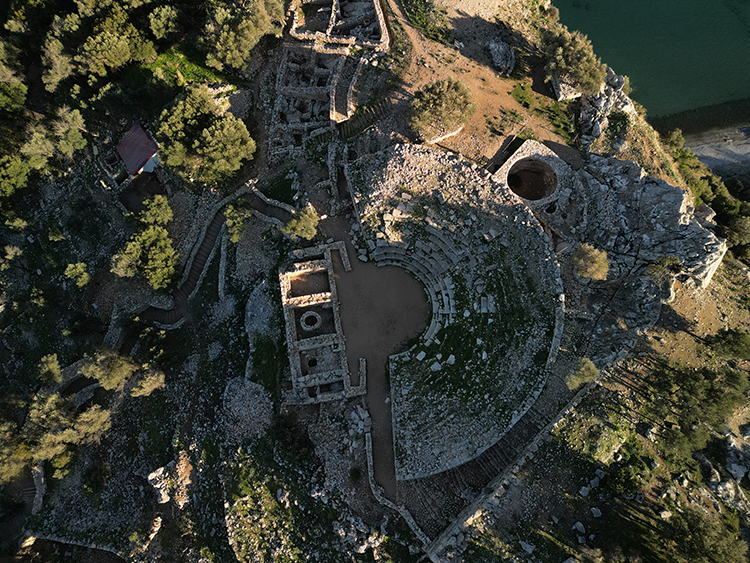
Situated on Asarcık Hill, overlooking the Gulf of Marmaris, Amos was a strategically positioned settlement that flourished under Hellenistic and Roman influence. Archaeological evidence reveals the presence of impressive city walls, a well-preserved theater, terraces, and sacred areas such as the Temple of Apollo Samnaios, where recent work has cleared dense vegetation and rubble.
Historically, Amos has been recognized as a coastal city connected to major trade routes and politically aligned with the Rhodian Peraea, the mainland territories governed by the island of Rhodes. Its harbor access and fortified landscape indicate that Amos functioned as both a defensive stronghold and a regional commercial hub.
One of the most remarkable earlier discoveries at the site dates back to the mid-20th-century excavations led by G. E. Bean. Researchers uncovered stone-inscribed lease contracts related to lands rented out by the city — documents that provided rare insights into the economic administration and land management practices of ancient Amos. These contracts, estimated to be nearly two millennia old, helped establish Amos’s reputation in international archaeological scholarship.
Excavations Continue With New Research Focus
The current excavation program — relaunched in 2021 and conducted year-round — explores multiple areas of the city, including residential districts, the theater complex, and sacred precincts. Gürbüzer stated that findings from early historical layers continue to offer crucial clues about the city’s origins, revealing Amos as a settlement of considerable economic and cultural strength for its time.
The 2026 excavation season is expected to continue in the civil architecture zones and around the Temple of Apollo Samnaios, further expanding knowledge of religious practices and urban life in the ancient settlement.
The Legacy of Ishtar and Her Symbols
Beyond its archaeological value, the Ishtar-themed necklace sheds light on the symbolic world of the ancient Mediterranean. Ishtar, or Inanna, was one of the most important deities of Mesopotamia — associated with love, fertility, political power, and warfare. Her cult spread widely through trade connections, diplomacy, and cultural exchange, influencing artistic and religious traditions across neighboring civilizations.
The lion, frequently shown alongside Ishtar, signified courage and royal authority, while the eight-pointed star became one of the most recognizable emblems of the goddess. The appearance of these symbols on an object found in Amos suggests the presence of inter-regional contacts, imported beliefs, or personal devotional items, possibly belonging to a high-status individual or merchant active in the city.
A Discovery Linking Cultures and Eras
For researchers, the necklace is more than a striking artifact — it stands as proof of Amos’s role within the interconnected world of the ancient Mediterranean. The find reinforces the view that cultural ideas and religious imagery traveled alongside goods and people, illustrating how a coastal Anatolian city could become part of a shared artistic and spiritual landscape stretching from Mesopotamia to the Aegean.
As excavations continue, archaeologists hope that future discoveries will further illuminate the social life, trade networks, and spiritual traditions that shaped Amos across centuries — and help restore this remarkable ancient city as an enduring heritage site for future generations.
Cover Image Credit: Sabri Kesen/AA
