
A medieval queen’s tomb in Barcelona has opened a rare window onto the lives, deaths, and hidden burial practices of a powerful female community in 14th-century Catalonia.
Researchers at the Royal Monastery of Santa Maria de Pedralbes have presented the first results of a major archaeological, anthropological, and genetic study of eight foundational tombs dating to the 1300s. The project, launched in late 2024 as part of the monastery’s 700th anniversary, has so far examined the remains of 25 individuals, including those attributed to Queen Elisenda of Montcada, the monastery’s founder and one of the most influential women of the Crown of Aragon.
The study is the first comprehensive investigation of the monastery’s early burials. It combines archaeology, physical anthropology, conservation, archaeobotany, textile analysis, radiology, 3D documentation, and paleogenomics. Its early findings are already changing long-held assumptions about who was buried in the monastery, how tombs were reused, and how death was ritualized inside one of medieval Barcelona’s most important religious houses.
A queen buried between crown and cloister
Queen Elisenda of Montcada was the fourth and last wife of King James II of Aragon. Born into the powerful Montcada lineage around 1292, she married James in 1322 and became queen consort at a moment when dynastic politics, royal piety, and aristocratic patronage shaped the future of Barcelona.
Her lasting legacy was Pedralbes. The monastery was founded with royal support in 1326 and consecrated in 1327 for the Poor Clares, a Franciscan female order. After James II died later that year, Elisenda moved to a palace built beside the monastery. She lived there for the remaining decades of her life, close to the nuns but never formally becoming one of them.
That distinction mattered. Elisenda was not simply a retired widow. From Pedralbes, she continued to exercise influence, issue ordinances for the community, manage patronage, and preserve the memory of her own political authority. The monastery became a religious house, but also a carefully constructed female center of power.
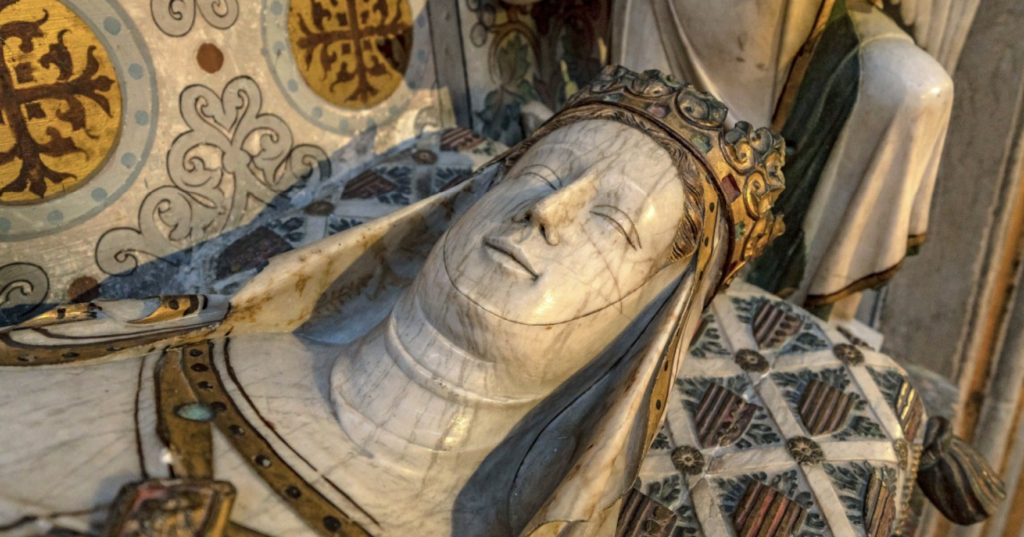
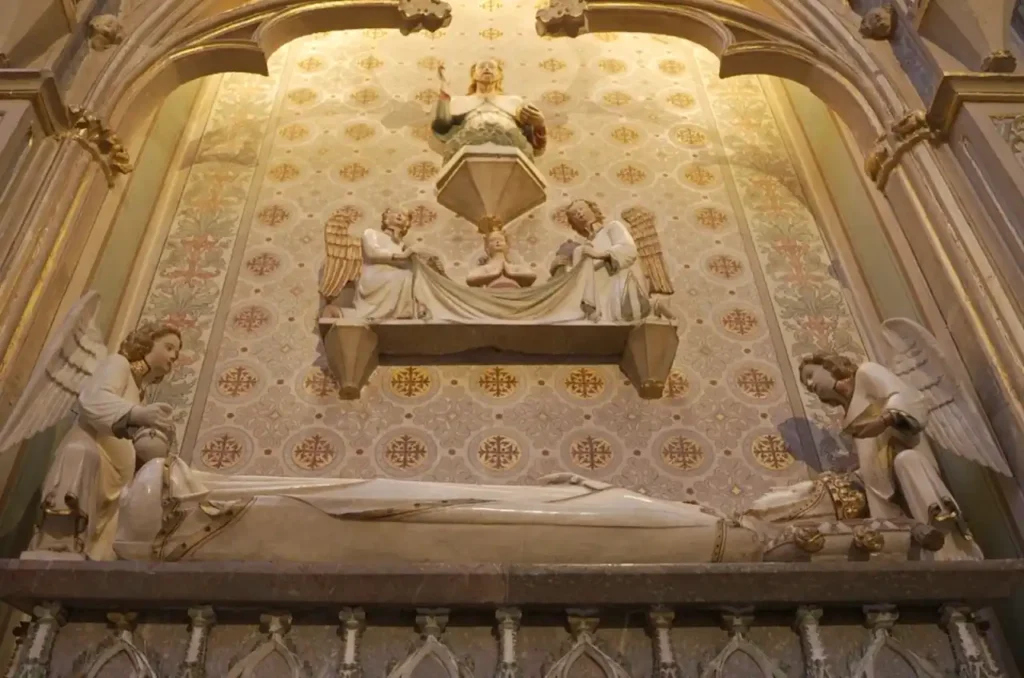
Her tomb expresses that dual identity with unusual clarity. Set between the church and the cloister, it presents two versions of the same woman. On the church side she appears as a crowned queen in royal dress. On the cloister side she appears as a penitent widow in Franciscan simplicity. Few medieval monuments make the tension between worldly authority and spiritual withdrawal so visible.
Remains found inside a medieval wooden box
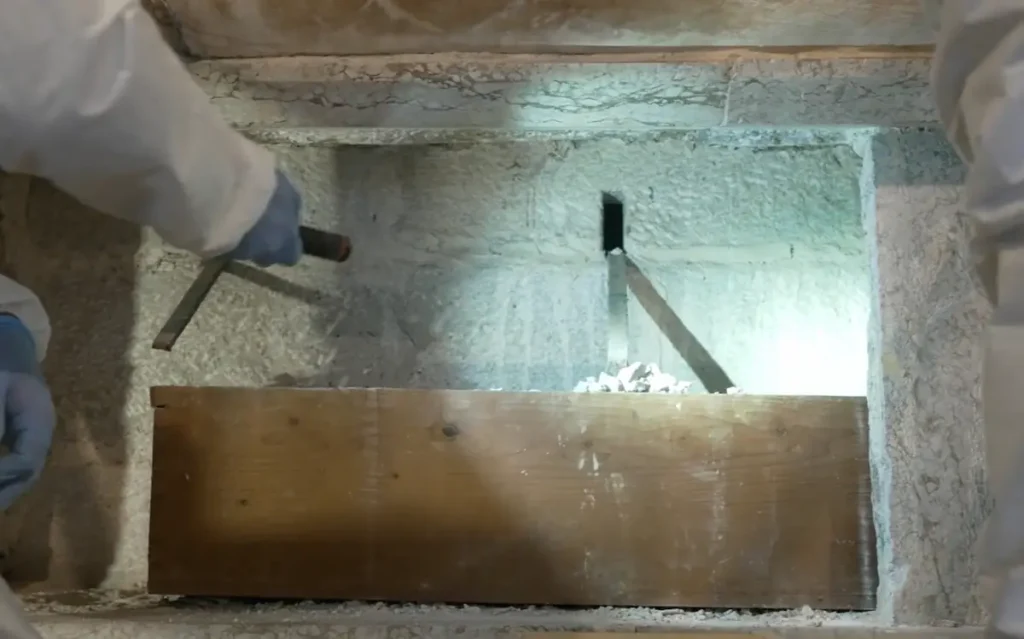
The new investigation of Elisenda’s sepulchre confirmed the presence of remains attributed to the founder queen inside a medieval wooden box. Initial anthropological analysis indicates that they belonged to a woman of about 70 years old, with age-related pathologies.
The burial also suggests deliberate austerity. The remains were associated with simple clothing, probably linked to monastic dress, yet fragments of textile were also recovered, including silk with metallic thread. This contrast fits the image Elisenda created for herself: humble before the religious community, but never stripped of royal memory.
The discovery does not close every question. Genetic work is still in progress, and the researchers expect further analyses to refine identifications, kinship links, biological origins, and possibly health data. But the tomb has already become a key piece of evidence for understanding how a medieval queen curated her image after death.
Tombs that challenge old names
The project has also questioned several historical attributions that had long been treated as secure. In the tomb traditionally associated with Artau de Foces, researchers did not identify a male individual. Instead, they documented the remains of two women and three children.
The tomb of Francesca Saportella, the monastery’s second abbess and Elisenda’s niece, proved even more complex. It contained at least nine individuals from different periods, showing that the tomb had been reopened and altered over time. These findings suggest that the sepulchres were not always fixed memorial spaces for single named figures. They could become layered places of reburial, family memory, institutional continuity, and later reorganization.
The study has also identified funerary practices previously little known at Pedralbes. Some bodies were wrapped in textile bundles or funerary sacks. Others appear to have been deposited directly inside tombs. Ritual elements such as candles, cords, floral offerings, and aromatic plants point to ceremonies that combined devotion, remembrance, and the sensory language of medieval death.
More than 200 archaeobotanical samples have revealed plant remains linked to funeral rites, including flowers and aromatic species. Some may have carried medicinal, symbolic, or liturgical meanings.
A rare record of elite women’s lives
The human remains examined so far mostly belong to adult women, including some who reached advanced ages for the medieval period. Children and adolescents were also present. Bioanthropological analysis has identified osteoarticular conditions, possible metabolic disease, and traumatic injuries, offering a more physical picture of life inside a high-status female religious environment.
That makes the Pedralbes project especially important. Written documents often preserve the names of queens, abbesses, donors, and noble families. Bones, textiles, plants, and burial containers reveal another layer: how these women lived, aged, were cared for, and were remembered.
The research will continue through 2026 and until May 2027. Pending work includes radiocarbon dating, dye analysis, further study of documentary materials, and expanded ancient DNA research.
For now, the opening of the Pedralbes tombs has already done more than recover a queen. It has exposed a medieval world in which women shaped memory, property, devotion, and political influence from within the walls of a monastery.
Institut de Cultura de Barcelona
Cover Image credit: Institut de Cultura de Barcelona
