

More than four thousand years ago, prehistoric communities in northern England appear to have faced an extraordinary engineering challenge. They selected enormous sandstone blocks weighing around 25 tonnes, moved them roughly 18 kilometres across the landscape and raised them into a monumental stone alignment that still towers above North Yorkshire today.
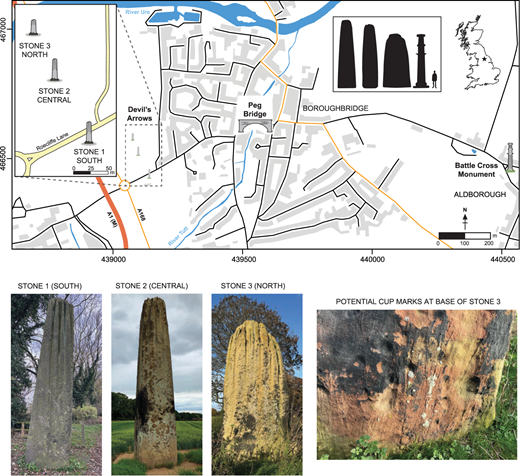
A new study published in Proceedings of the Royal Society A has traced the most likely geological source of the Devil’s Arrows, three immense standing stones on the outskirts of Boroughbridge. The results indicate that the megaliths were deliberately brought from Brimham Rocks, a dramatic sandstone landscape in the Pennine uplands to the west, rather than collected from material available close to the monument.
A Monument Built From Stone Brought From Afar
The Devil’s Arrows are already exceptional. The three surviving stones stretch across an alignment about 174 metres long and form Britain’s tallest surviving standing stone row. The southern stone rises to approximately 6.86 metres, while the central stone stands around 6.7 metres high. Archaeologists generally date the monument to the Late Neolithic or Early Bronze Age, although its exact construction date remains uncertain.
For generations, researchers debated where these massive stones came from. Plumpton Rocks, around 13 kilometres away, had often been suggested because its weathered gritstone resembles the surfaces of the Devil’s Arrows. Another possibility was that glaciers had carried large sandstone blocks into the Boroughbridge area long before prehistoric people erected them.
The new research approached the question through the stones’ microscopic mineral signatures. Scientists analysed uranium-lead ages in zircon and apatite grains taken from the megaliths and compared them with potential geological sources.
The strongest match came from Brimham Rocks, approximately 18 kilometres west of Boroughbridge. Statistical comparisons showed a close correspondence between the zircon populations of the monument and Brimham, while samples from Plumpton Rocks differed significantly.
Ice or Human Engineering?
That still left one major question. Could glaciers have moved the blocks into place?
The researchers examined reconstructions of Late Devensian ice movement across the region. These suggest that glaciers generally advanced from northwest to southeast through the Vale of York, rather than eastward from Brimham Rocks toward Boroughbridge.
The authors acknowledge that glacial transport can be complex, but argue that moving such massive blocks along the required route is improbable. More importantly, all three surviving stones share closely related geological signatures, pointing toward selection from a specific source rather than a random collection of glacial erratics.
The implication is striking. Prehistoric communities appear to have deliberately chosen, extracted, and transported enormous blocks across kilometres of landscape before raising them vertically.
Why Choose Brimham Rocks?
Practical considerations may have helped. Brimham Rocks contains natural joints and bedding planes that produce elongated sandstone blocks, potentially making it easier to detach pieces suitable for monumental construction.
But convenience alone does not explain the decision, because closer gritstone sources existed.
The researchers suggest that Brimham itself may have mattered. Its landscape is filled with unusual towers, eroded formations and sculptural rock shapes. Such places may have carried stories, memories or spiritual associations for prehistoric communities.
The authors therefore propose that stone selection could have combined engineering opportunity with symbolic importance. In other words, the builders may not simply have wanted a large stone. They may have wanted stone from a particular place.
There are also hints that Brimham Rocks already formed part of a prehistoric cultural landscape. A nearby three-metre-long gritstone bears around 21 cup-and-ring marks dating from the Late Neolithic to the Bronze Age, while faint markings near the northern Devil’s Arrow may also resemble cup marks. The connection remains tentative, but it strengthens the idea that the source area may have held significance beyond its geology.
The Missing Stones May Not Be Entirely Lost
The study also addresses another long-standing mystery: what happened to the rest of the original monument?
Historical accounts suggest that the Devil’s Arrows once included additional stones, some of which were later broken up and reused. Zircon grains from the nearby Battle Cross Monument and Peg Bridge are compatible with the same geological source as the surviving megaliths.
That supports the possibility that fragments of the missing stones survived inside later buildings and infrastructure.
What stands at Boroughbridge today may therefore represent only part of a much larger prehistoric project. The new evidence suggests its builders were capable not only of raising some of Britain’s tallest standing stones, but of selecting a distant source landscape and moving tens of tonnes of rock across 18 kilometres to create them.
Anthony Clarke, Jim Leary, Chris Kirkland; Deliberate prehistoric sourcing of the Devil’s Arrows, Britain’s tallest stone row. Proc. R. Soc. A 1 September 2026; 482 (2345): 20260504. https://doi.org/10.1098/rspa.2026.0504
