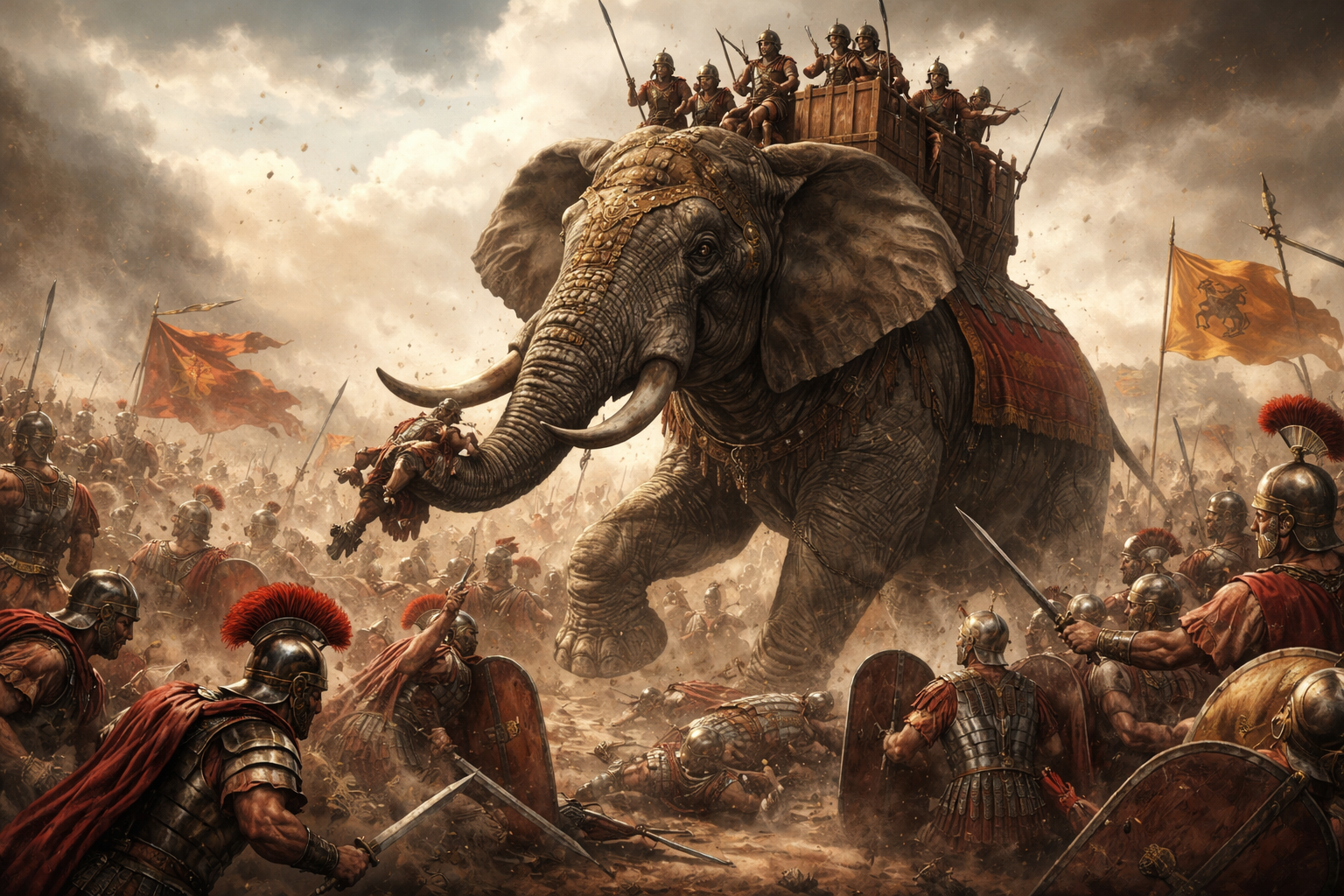
Archaeologists in Córdoba uncover the first physical evidence of Carthaginian war elephants in Western Europe, shedding new light on the Second Punic War.
The image of war elephants thundering across ancient battlefields has long belonged to the realm of classical texts, coins, and artistic imagination. From Hannibal’s legendary Alpine crossing to Roman accounts of battlefield terror, elephants have symbolized the overwhelming power of ancient warfare. Until recently, however, direct physical evidence of their presence in Western Europe remained elusive. A remarkable discovery at the archaeological site of Colina de los Quemados in Córdoba, Spain, has now changed that narrative.
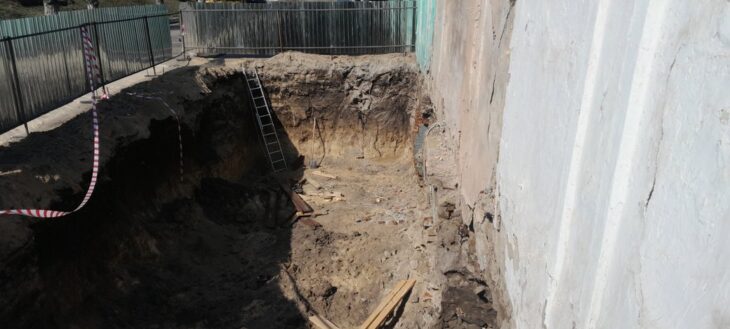
During an emergency excavation conducted in 2020 prior to the expansion of the Provincial Hospital of Córdoba, archaeologists uncovered a carpal bone from an elephant, dating to the late 4th–3rd century BCE. This find represents one of the few pieces of direct osteological evidence for the use of war elephants in Classical Antiquity in Europe, firmly linking material culture with historical accounts of the Second Punic War (218–201 BCE).
An Iberian Oppidum at the Crossroads of War
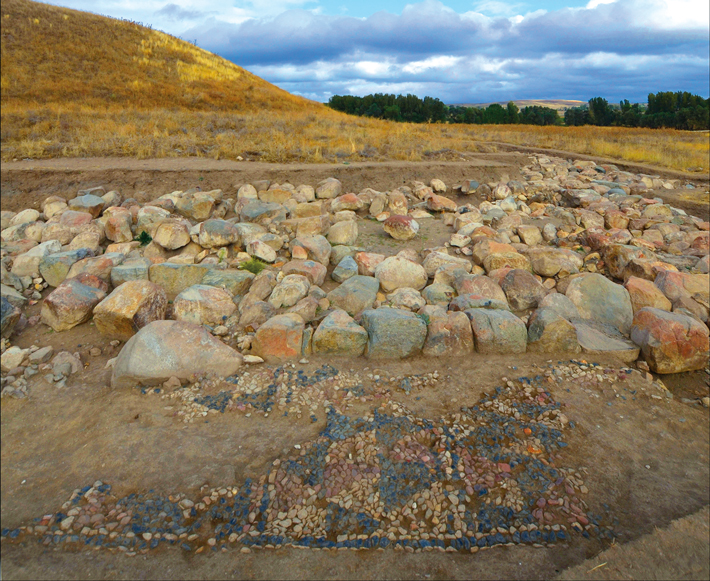
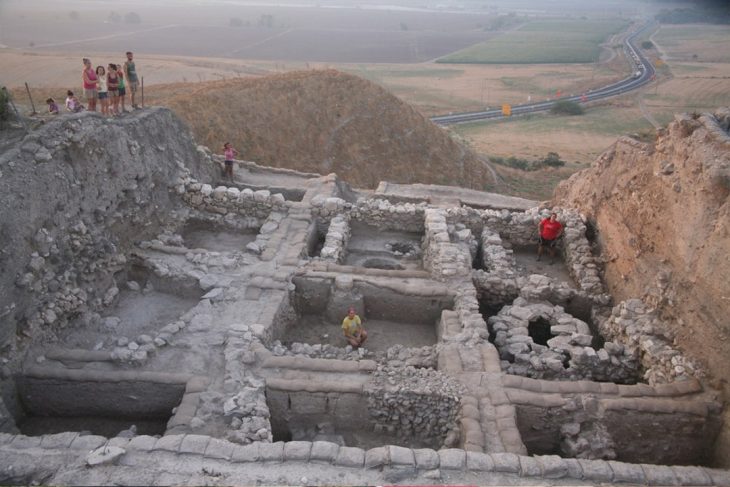
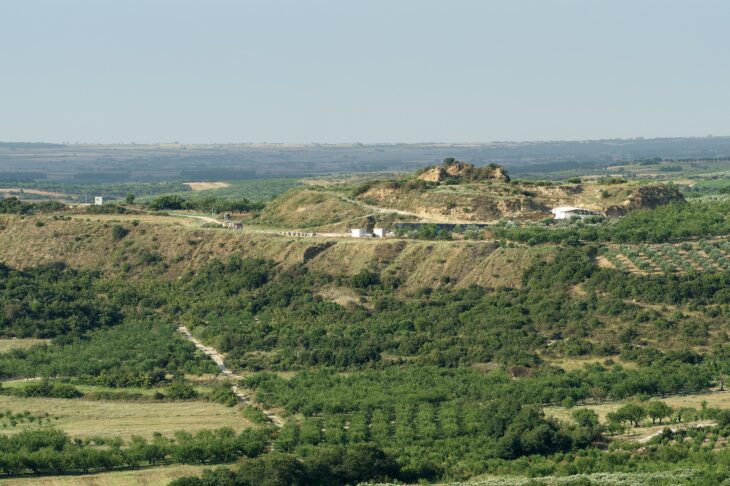
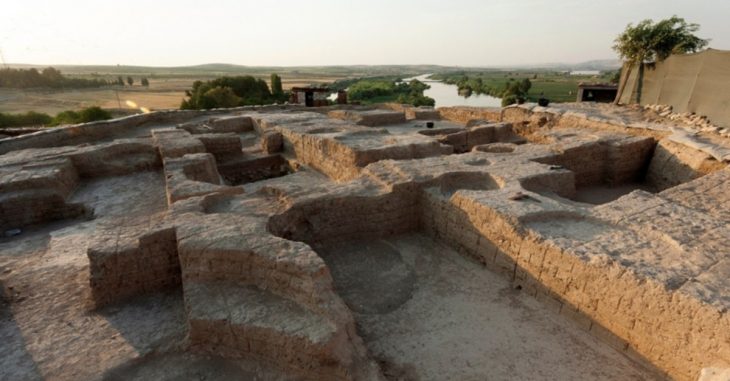
Colina de los Quemados is identified with the Iberian oppidum of Corduba, a major protohistoric settlement occupying a strategic terrace above the Guadalquivir River. Archaeological investigations have revealed a long sequence of occupation, from the Late Bronze Age to the Islamic medieval period. Of particular interest is a Late Iron Age phase marked by streets, ovens, and industrial installations—evidence of a thriving urban center before Roman refoundation.
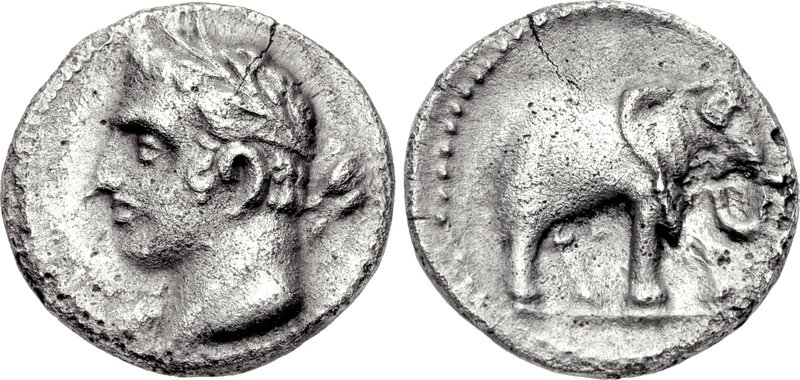
Within this layer, archaeologists documented stone artillery projectiles, heavy arrowheads associated with scorpio-type siege weapons, and Carthaginian coinage minted in Cartagena between 237 and 206 BCE. Together, these finds clearly indicate a military episode, most plausibly connected to the Second Punic War, when Iberia became a central theater in the struggle between Rome and Carthage for control of the western Mediterranean.
📣 Our WhatsApp channel is now LIVE! Stay up-to-date with the latest news and updates, just click here to follow us on WhatsApp and never miss a thing!!
It was beneath the collapse of an adobe wall sealing this occupation level that the elephant bone was found—protected from later disturbance and preserved as a silent witness to ancient conflict.
Identifying the Elephant
The bone, a cuboid element approximately 10 centimeters long, was identified as the third carpal bone (os magnum) of the right forelimb of an elephant. Comparative anatomical analysis with specimens from Asian elephants (Elephas maximus) and a steppe mammoth confirmed its proboscidean origin. Radiocarbon dating of the mineral fraction (bioapatite) placed the specimen firmly within the pre-Roman Iron Age, ruling out both fossil and modern origins.
While the bone does not allow for definitive species identification, its size exceeds that of modern Asian female elephants used for comparison. Classical sources suggest that Carthage primarily used African elephants, likely captured in North Africa and trained following knowledge transmitted through Hellenistic networks.
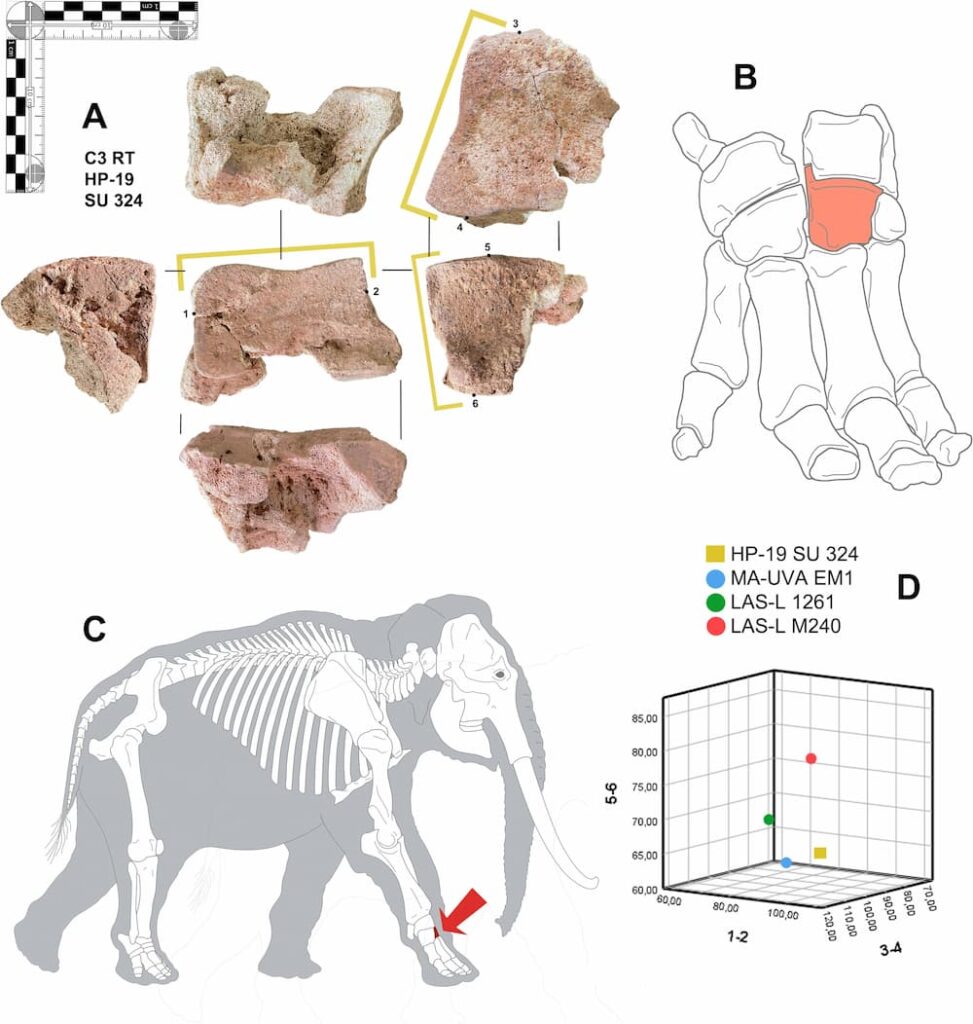
Credit: R. M. Martínez Sánchez et al., 2026.
Elephants and the Punic Wars
The Punic Wars (264–146 BCE) were a series of three conflicts that reshaped the Mediterranean world. The Second Punic War, in particular, is remembered for Hannibal Barca’s bold strategies and extensive use of war elephants. Ancient historians such as Polybius and Livy report that Carthaginian generals maintained dozens, sometimes hundreds, of elephants in Iberia at the outbreak of hostilities.
Elephants served not only as shock troops but also as psychological weapons, terrifying infantry and cavalry unfamiliar with their size, sound, and smell. Although Rome eventually learned to counter them, early encounters were devastating. Iberia, as a Carthaginian power base, hosted training grounds, supply routes, and military engagements—many of which went unrecorded in surviving texts.
The Córdoba find strongly suggests that elephants were present not only in famous battles but also in localized sieges or skirmishes, reinforcing the idea that the Second Punic War left a deeper archaeological footprint in Iberia than previously assumed.
Why Only One Bone?
One of the most intriguing questions raised by the discovery is why only a single elephant bone was found. Researchers propose several possibilities: the animal may have died during a military event, with most of its remains later destroyed, reused, or scattered; alternatively, the bone may have been displaced during post-conflict activity.
What is clear is that the bone was not a trade object. Unlike ivory, short carpal bones held no economic or artisanal value. Transporting such an unremarkable element would make little sense unless it originated locally from a live animal.
Its position beneath a structural collapse likely saved it from destruction, making its survival an archaeological exception rather than the rule.
Rewriting the Archaeology of Ancient Warfare
Until now, evidence for war elephants in Europe relied almost entirely on texts, iconography, andcoinage. The Córdoba carpal bone provides direct, physical proof that these animals were present in Iberian military contexts during the Punic Wars. It bridges the gap between historical narrative and material evidence, offering new insight into the logistics, scale, and reality of ancient warfare.
Although this elephant was not one of Hannibal’s famous Alpine travelers, it may represent something equally significant: the first tangible relic of Carthaginian war elephants in Western Europe.
Buried for more than 2,200 years beneath an adobe wall, a small bone has transformed our understanding of the Punic Wars. The elephant carpal from Colina de los Quemados stands as rare and compelling evidence of how deeply global, complex, and violent ancient conflicts could be. It reminds us that behind legendary stories were real animals, real battles, and real landscapes forever changed by war.
Rafael M. Martínez Sánchez, Agustín López Jiménez, Santiago Guillamón Dávila et al., The elephant in the oppidum. Preliminary analysis of a carpal bone from a Punic context at the archaeological site of Colina de los Quemados (Córdoba, Spain). Journal of Archaeological Science: Reports, Volume 69, February 2026, 105577. doi.org/10.1016/j.jasrep.2026.105577
Cover Image Credit: AI-generated representational image of a Carthaginian war elephant during the Second Punic War; intended for illustrative purposes only.