
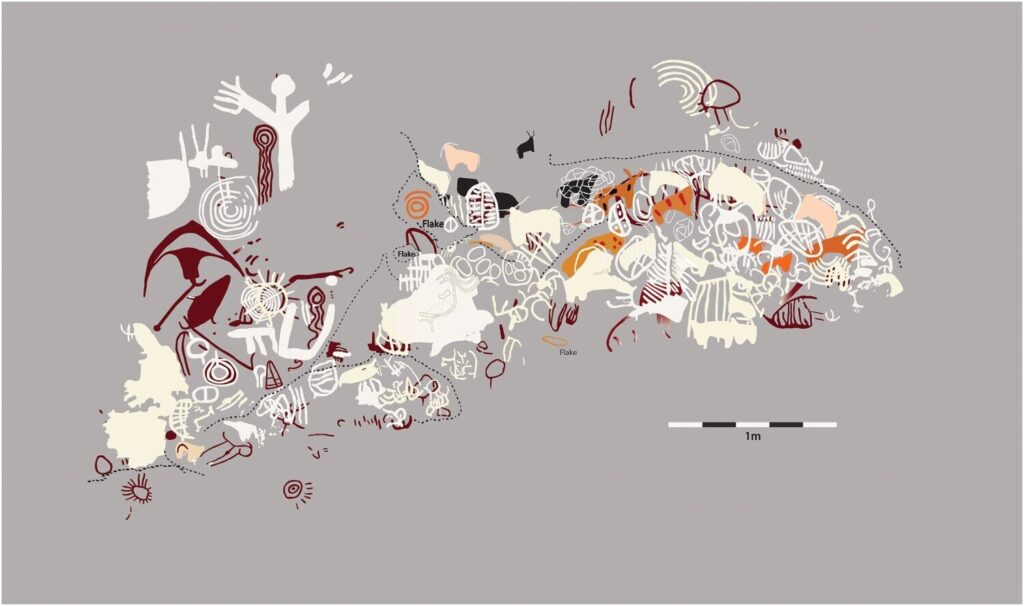
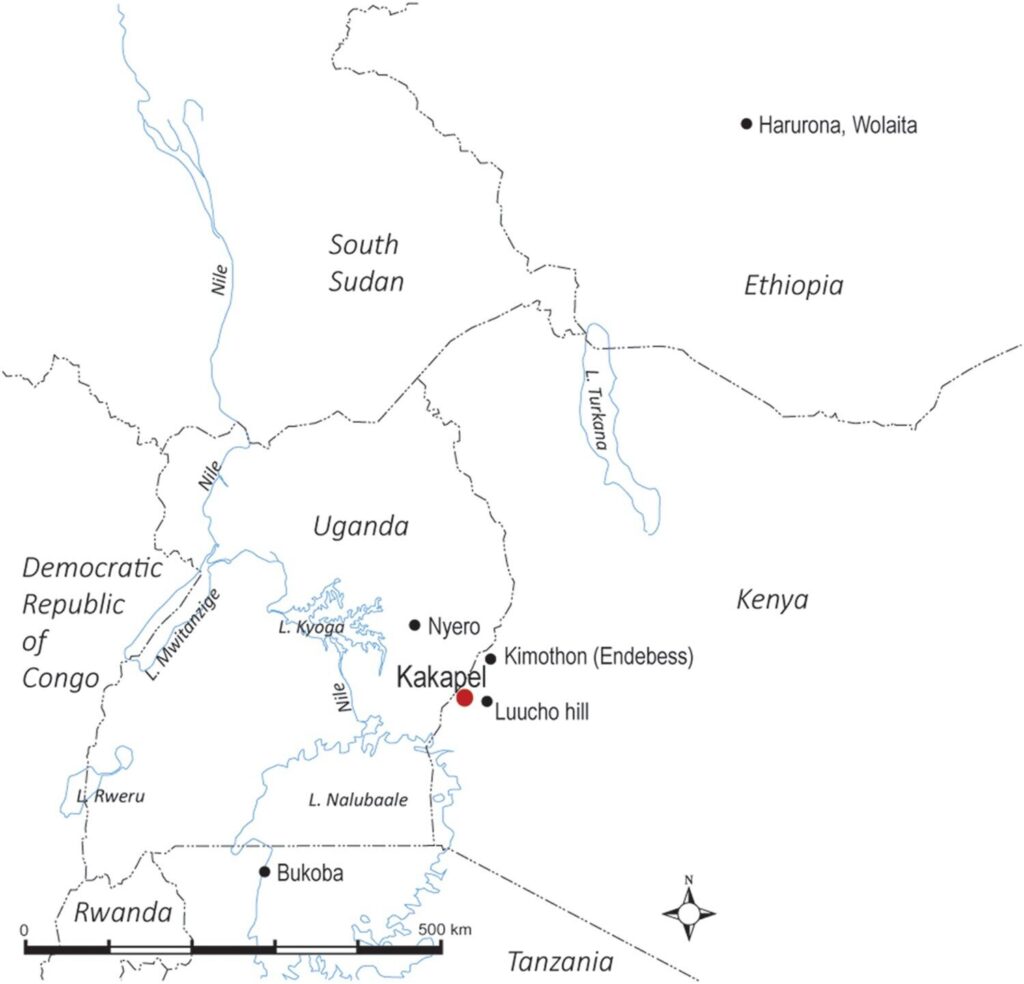
A major breakthrough in African archaeology has revealed who created one of East Africa’s most enigmatic rock art sites. At Kakapel Rockshelter in western Kenya, researchers have reconstructed a nearly 9,000-year-long visual record—linking ancient paintings to specific human communities for the first time.
The discovery, published in Azania: Archaeological Research in Africa, combines high-precision rock art recording, archaeological excavation, and ancient DNA analysis to unlock a question that has long challenged researchers: who made these paintings, and when?
A Rare Case Where Rock Art Meets Genetics
Rock art is notoriously difficult to date. Even more challenging is identifying the people behind it. At Kakapel, however, scientists had a rare advantage. They could directly compare painted layers on rock surfaces with excavated human remains and genetic data from the same site.
The result is one of the clearest chronological frameworks ever established for African rock art.
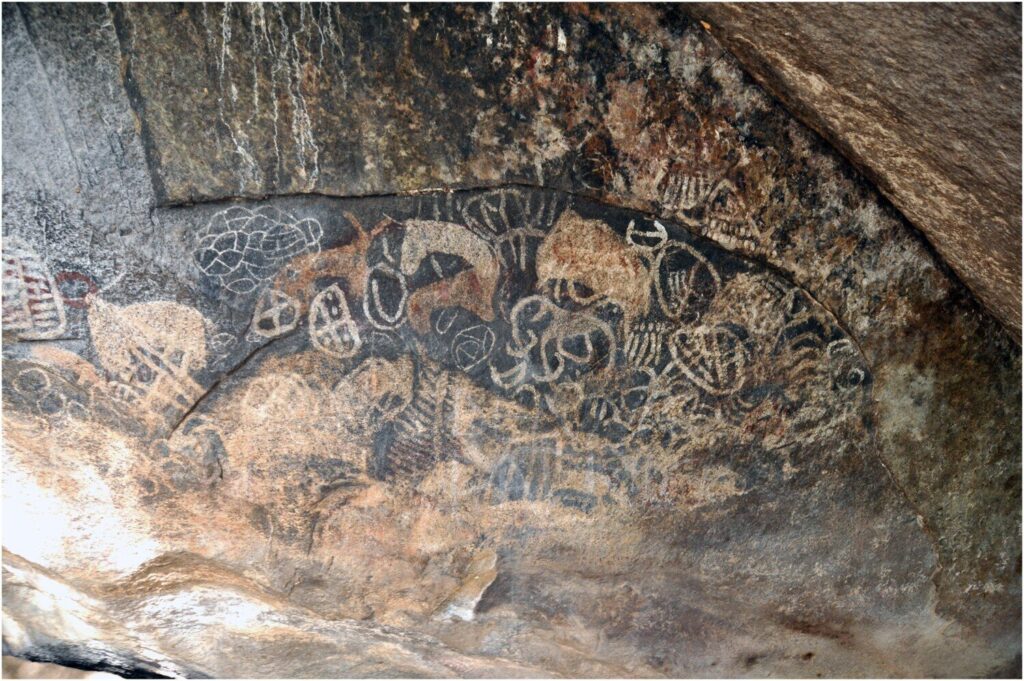
Researchers produced the first millimeter-accurate tracing of the main rock panel, capturing hundreds of previously undocumented figures. By analyzing overlapping images, they identified four distinct painting phases, each corresponding to different cultural groups that occupied the shelter over thousands of years.
The Earliest Artists: Hunter-Gatherers with Deep Central African Roots
The oldest layer of Kakapel’s rock art dates back roughly 9,000 years. These early paintings consist of geometric motifs—circles, concentric patterns, and abstract symbols rendered in red and white pigments.
Archaeological evidence links these artworks to fisher-forager communities of the Kansyore tradition, who lived at the site between about 9000 and 3900 years ago .
What makes this phase remarkable is the genetic evidence. Ancient DNA from a skeleton found at Kakapel shows a strong affinity with modern Mbuti hunter-gatherers from Central Africa. This suggests that the artists belonged to a broader network of forest-dwelling populations, sometimes referred to as “Twa” groups.
The implication is significant: these geometric paintings are not just abstract art, but part of a long-standing cultural tradition tied to Central African hunter-gatherer identities.
A Dramatic Shift: The Arrival of Pastoralists
Thousands of years later, Kakapel’s visual language changed dramatically.
A second layer of paintings features long-horned cattle, carefully depicted in profile with exaggerated horns and solid-filled bodies. These images mark the arrival of pastoralist communities, likely linked to Nilotic-speaking groups who entered the region during the Iron Age.
Unlike the earlier abstract designs, these paintings reflect a society centered on livestock, mobility, and herd identity. The cattle resemble Sanga-type breeds, still found among East African pastoral groups today.
This transition is not only artistic but economic. It mirrors a broader transformation in East Africa, where subsistence strategies shifted from foraging to herding and agro-pastoralism.
Layers of Meaning: Reuse Across Millennia
The Kakapel panel did not remain static. Instead, it was repeatedly revisited and repainted by different groups.
Later layers consist of simplified geometric designs, painted in thicker white pigments. These likely represent symbolic markings—possibly related to identity, ritual, or livestock ownership. The final phase includes finer white line drawings, suggesting even more recent additions, possibly within the last few centuries.
This layering effect reveals something rare in archaeology: a single site used continuously by culturally distinct populations over thousands of years.
Rather than replacing earlier art, each group added its own visual language, creating a cumulative record of cultural change.
Linking Art, DNA, and Migration
What sets Kakapel apart is the convergence of multiple scientific approaches.
By aligning rock art layers with archaeological strata and genetic data, researchers were able to associate each artistic phase with specific population movements. Early hunter-gatherers gave way to farming communities, followed by Nilotic-speaking pastoralists, each leaving traces in both the ground and on the rock walls.
This integrated method transforms rock art from isolated imagery into a historical document of migration, interaction, and cultural transformation.
Understanding the Broader Significance of Kakapel
Kakapel is now considered one of the best-understood rock art sites in East Africa—not because it has the most spectacular imagery, but because it offers something far more valuable: context.
The site provides a rare, layered narrative of how human societies in the region evolved. It captures shifts in economy, identity, and belief systems across millennia.
It also highlights a broader reality. Many rock art sites around the world remain disconnected from the people who created them. Kakapel shows that, with the right combination of methods, those connections can be restored.
A Fragile Archive Under Threat
Despite its importance, Kakapel faces ongoing risks. Deforestation, human activity, and environmental exposure continue to damage the site. Earlier reports already noted graffiti and deterioration, emphasizing the urgency of preservation efforts.
Protecting sites like Kakapel is not just about conserving art. It is about safeguarding one of the few direct records of human thought and identity that predates written history.
A New Model for Archaeology
The Kakapel study represents more than a local discovery. It offers a methodological blueprint for future research.
By combining high-resolution documentation, excavation, and ancient DNA, scientists have demonstrated how to move beyond description and toward attribution—answering not just what ancient people created, but who they were.
For a field long defined by uncertainty, that shift is profound.
Namono, C., Smith, B., & Vena, K. (2026). The rock art of Kakapel Shelter, western Kenya. Azania: Archaeological Research in Africa, 1–22. https://doi.org/10.1080/0067270X.2026.2652709
Cover Image Credit: Retracing of Kakapel rock art, showing all four layers of art. Tracings by C. Namono and B. Smith, redrawn by W. Voorveld and colored for publication by K. Vena. Namono et al. 2026
