
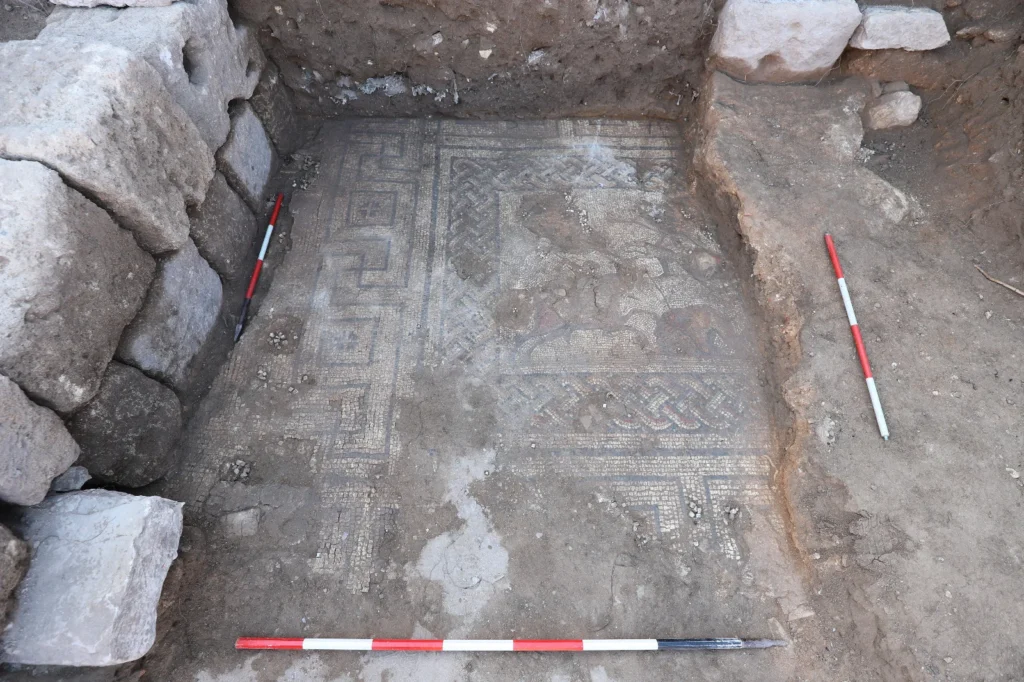
A Roman hunting mosaic hidden for more than half a century has reemerged in Marsala, Sicily, offering a vivid new look at the artistic life of ancient Lilybaeum, one of the most important cities of Roman Sicily.
The mosaic floor, decorated with a dynamic venatio, or hunting scene, was first identified in 1972 by archaeologist Carmela Angela Di Stefano in the Capo Boeo area, between the Church of San Giovanni Battista al Boeo and Viale Isonzo. After its discovery, the pavement was covered again with earth for protection. It has now come back to light during new archaeological investigations connected with the development of the Lilibeo Archaeological Park.
The rediscovery is significant not only because of the quality of the mosaic, but also because it belongs to the so-called Casa della Venatio, a late Roman domestic context that may help researchers better understand the urban history of Marsala between the Roman, Byzantine, Islamic and early medieval periods.
A hunting scene preserved in stone
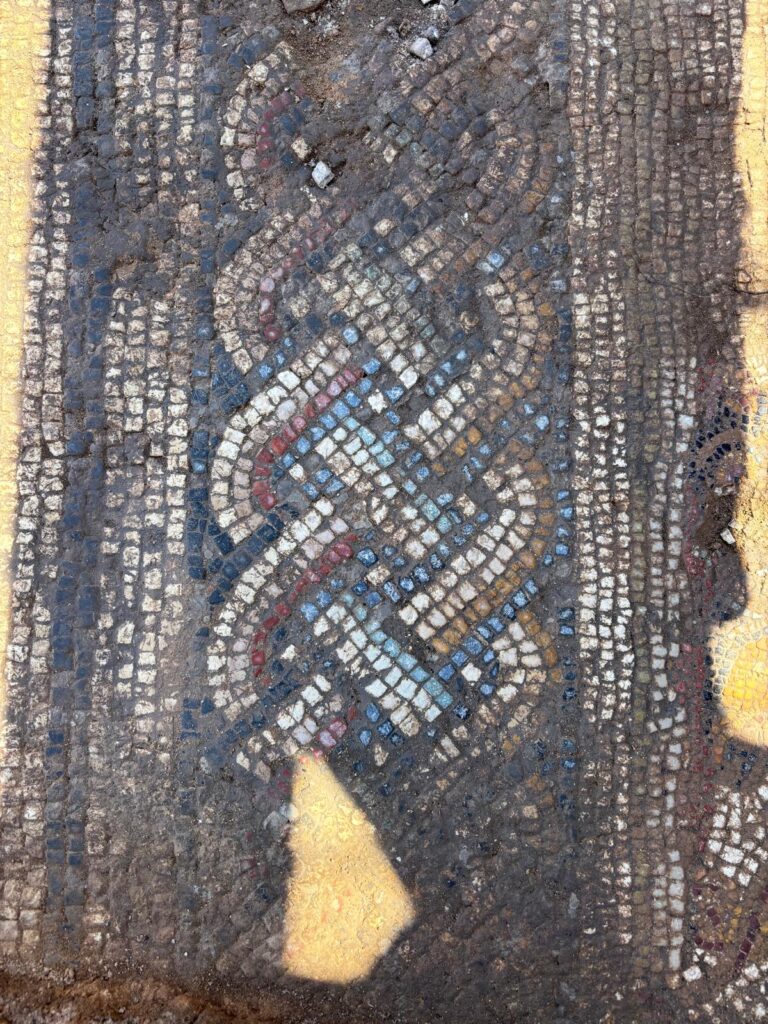
The mosaic is an elaborate example of Roman imperial-period floor decoration made in opus tessellatum, a technique that used small stone or glass tesserae to create images, patterns and colour effects. In this case, the ancient mosaicists used a wide palette of black, blue, light blue, red, ochre yellow and brown, with tonal variations that give the figures depth and movement.
The hunting scene is framed by two decorative borders. The outer border features an interlaced meander alternating with square panels containing a cruciform flower at the center. The inner border is formed by a four-strand braid, rendered in bright shades of blue and red with white tesserae.
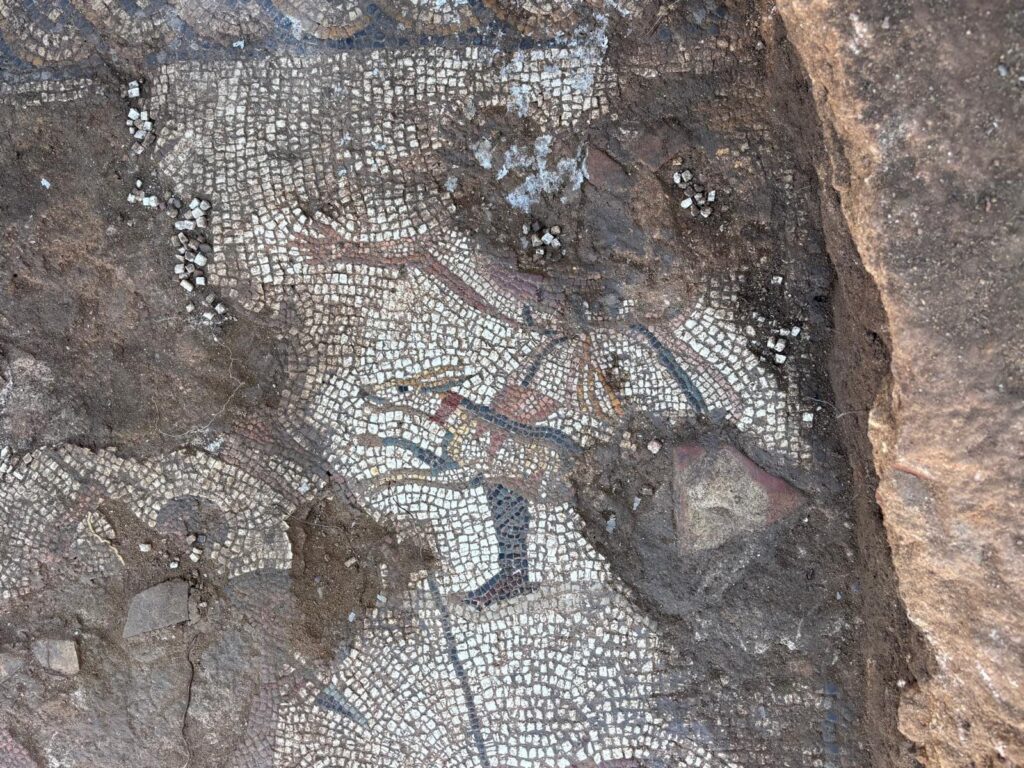
Inside this carefully designed frame, the venatio unfolds across two registers. In the upper section, a male figure wearing a short tunic and high footwear appears with a running dog, pursuing a deer whose body is partly lost because of a large gap on the left side of the mosaic. In the lower register, a mounted hunter thrusts a spear toward a lion, shown collapsed on the ground and bleeding from a wound.
The composition is dramatic, but also controlled. It reflects a visual language familiar across the Roman world, where hunting scenes could evoke elite identity, courage, mastery over nature and the pleasures of aristocratic life. In a domestic setting, such imagery was not merely decorative. It helped shape the cultural identity of the house and its owner.
The missing side may reveal more
One of the most important parts of the discovery is what remains unfinished. The right side of the scene was not excavated in 1972. Archaeologists say that two superimposed floor levels lie over that area, and the next excavation campaign will aim to expose it with strict stratigraphic methods.
That is a crucial detail. The goal is not only to recover the full mosaic, but also to understand the phases of use, renovation and abandonment of the house. Roman houses often changed over time, especially in cities with long and complex histories. Floors could be replaced, rooms reorganized and earlier structures absorbed into later buildings.
For Lilybaeum, this kind of stratigraphic evidence matters. The ancient city did not simply disappear after the Roman period. It continued to transform through late antiquity and the early medieval centuries, eventually becoming Marsala. The current research is therefore looking beyond one impressive artwork. It is investigating how an ancient urban landscape changed across centuries.
Ancient Lilybaeum beneath modern Marsala
Modern Marsala stands over ancient Lilybaeum, a city founded in the westernmost part of Sicily at Capo Boeo. Its position facing the Egadi Islands gave it strategic importance in the central Mediterranean. During the Punic and Roman periods, the city became a major urban and maritime center, closely tied to the movement of people, goods and military power across Sicily and North Africa.
The Lilibeo Archaeological Park preserves part of this ancient settlement, including remains of private houses, streets, baths, mosaics and other structures that show the long life of the city. The newly exposed hunting mosaic adds a particularly refined example to this archaeological landscape.
Its location is also important. The mosaic survived close to the boundary between the protected archaeological area and the modern urban fabric. That makes the find a strong example of how deeply ancient Marsala remains embedded within the contemporary city.
A wider project on late Roman and Byzantine Marsala
The current campaign was promoted by Anna Occhipinti, director of the Lilibeo Archaeological Park, with the collaboration of the ArcheOfficina cooperative and the scientific contribution of park archaeologist Maria Grazia Griffo.
The work forms part of a broader research project carried out in collaboration with the Escuela de Estudios Árabes, part of the Spanish National Research Council in Granada. The project is investigating less well-known phases of late Roman and Byzantine Lilybaeum, as well as the transition toward the Islamic and early medieval period, when the city’s name changed to Marsā ‘Alī.
That broader frame gives the mosaic added value. It is not only an isolated artwork from a Roman house. It belongs to a city whose identity changed repeatedly, from Punic stronghold to Roman center, from late antique settlement to medieval Marsala.
A new place in the visitor route
Park officials intend to include the mosaic in future visitor routes, returning an important piece of Marsala’s ancient history to public view. If fully conserved and displayed, the pavement could become one of the most attractive features of the Lilibeo Archaeological Park.
For archaeologists, however, the next stage will be just as important as the rediscovery itself. The unexcavated portion of the mosaic and the overlying floors may clarify how the house developed over time. The full scene may also change how scholars interpret the imagery, the room and the social world of the people who once lived there.
After more than 50 years under the soil, the Roman hunting mosaic of Marsala is no longer only a rediscovered artwork. It is a rare opening into the layered history of ancient Lilybaeum, where domestic luxury, urban change and Mediterranean history meet beneath the surface of a modern Sicilian city.
Parco Archeologico di Lilibeo-Marsala / Regione Siciliana
Cover Image credit: Parco Archeologico di Lilibeo-Marsala / Regione Siciliana
