
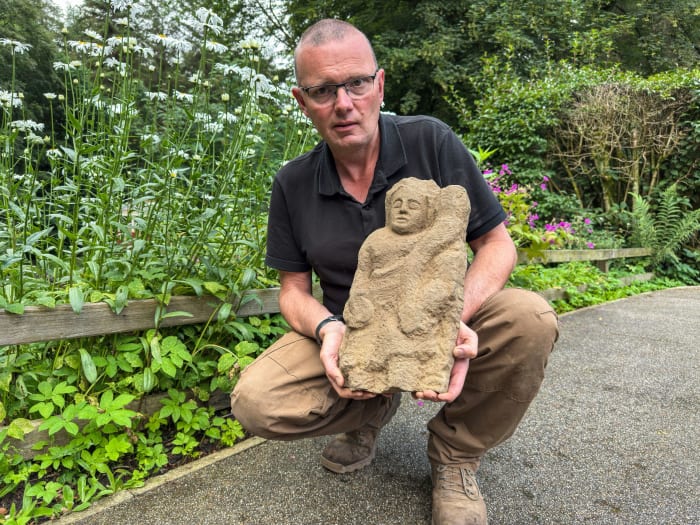
A finely carved Roman guardian spirit has emerged from beneath the floor of a late Roman barrack at Vindolanda, one of Britain’s most important frontier settlements. Protected by the stonework above it, the sandstone relief survived for more than 1,600 years with much of its carved detail intact.
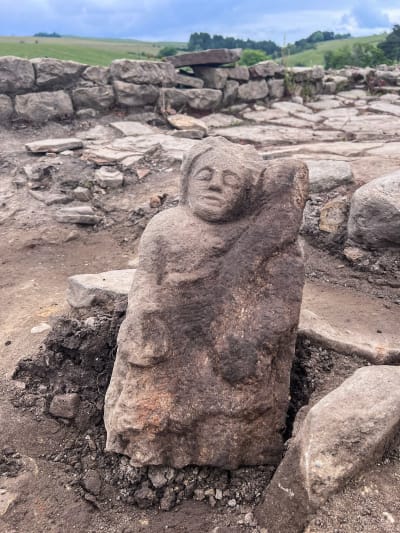
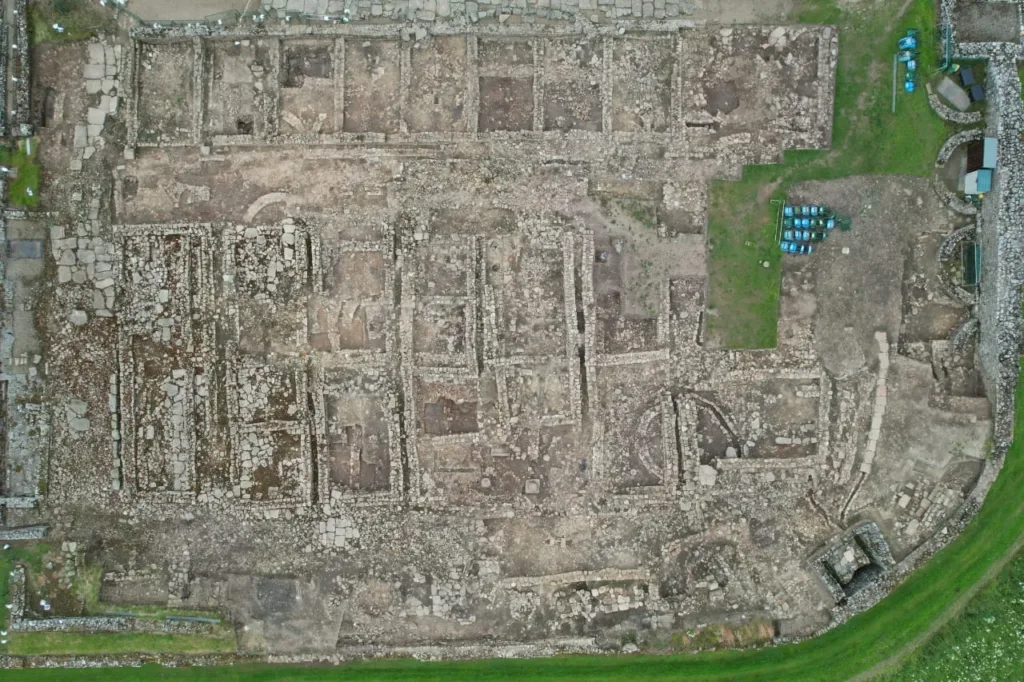
The discovery was made on June 16, 2026, as Dr Andrew Birley, director of excavations at Vindolanda, investigated a fourth-century barrack building. One floor stone appeared unusually rounded. When Birley lifted and turned it over, the weathered walking surface gave way to the face and body of a Roman figure carved on the opposite side.
“My first thought was simply, ‘Who on earth am I looking at?’” Birley recalled. Photographs were sent to Roman specialists Lindsay Allason-Jones, Fraser Hunter and Alex Rome-Griffin, who identified the figure as a Genius—a protective spirit associated with a person, household, community or place. Detailed examination of the carving is continuing.
A Roman Genius with symbols of prosperity
The relief measures 44 centimetres high, 23 centimetres wide and eight centimetres deep. It shows the Genius carrying a cornucopia in one hand and a patera, a shallow vessel used when pouring ritual offerings, in the other.
The pairing is characteristic of Roman representations of a Genius. The cornucopia evoked abundance and prosperity, while the patera connected the figure with sacrifice and religious observance. Similar imagery appeared throughout the Roman world, including on imperial coins showing a Genius pouring an offering from a patera while holding a cornucopia.
Archaeologists suspect that the carving once belonged to a domestic shrine before being removed and reused during a later phase of construction. Its position beneath the barrack floor preserved the carved surface, but the reason it was placed face down remains uncertain. Its reuse may have been practical rather than an attempt to conceal the figure for religious purposes.
The sandstone may have been carved at Vindolanda or supplied by a regional workshop. The excavation team has raised the nearby Roman fort at Lanchester in County Durham as one possible point of comparison, although conservation and specialist analysis will be needed before its origin can be assessed more closely.
Why the Vindolanda relief is unusual
Inscriptions invoking a Genius are known from numerous locations in Roman Britain, but surviving stone reliefs are much less common. The new discovery is particularly useful because it was recovered from a recorded archaeological context rather than as an isolated stone reused in a later building.
Its location beneath a fourth-century military structure also connects the carving to the final centuries of Roman rule in Britain. Vindolanda was not occupied exclusively by soldiers: archaeological finds show that women, children, traders and craftspeople formed part of the community surrounding its successive forts. A shrine image could therefore have belonged to a household within the wider settlement before it became building material inside the military complex.
A fort older than Hadrian’s Wall
Vindolanda stands in Northumberland, just south of Hadrian’s Wall, within the British section of the UNESCO-listed Frontiers of the Roman Empire. Its position south of the famous barrier sometimes causes confusion, but the earliest fort was built around AD 85—almost four decades before construction of Hadrian’s Wall began under Emperor Hadrian around AD 122.
The settlement originally guarded the Stanegate, an important east–west route that formed part of an earlier Roman frontier system. Vindolanda was subsequently absorbed into the Hadrian’s Wall military network and rebuilt repeatedly as garrisons and strategic requirements changed. Archaeologists have identified at least nine successive forts at the site.
Vindolanda is best known for its wooden writing tablets, which preserve military reports, requests for supplies and personal correspondence. The site has also produced leather footwear, textiles and wooden objects rarely found elsewhere. Many came from waterlogged, oxygen-poor deposits created when Roman builders sealed older occupation layers beneath clay, turf and vegetation.
Three generations of excavation
The discovery also continues a long connection between Vindolanda and the Birley family. Eric Birley established major excavations at the site during the 1930s. His son Robin Birley later directed decades of fieldwork, including the excavations that brought the writing tablets to international attention. Andrew Birley now leads the continuing research programme.
The relief is undergoing conservation and further study before its planned display at the Vindolanda Museum. Once exhibited, visitors will be able to see a figure that may once have been asked to protect a Roman household or community—and that remained hidden beneath the floor of a frontier barrack long after the people who placed it there had disappeared.
Cover Image Credit: The Vindolanda Trust
