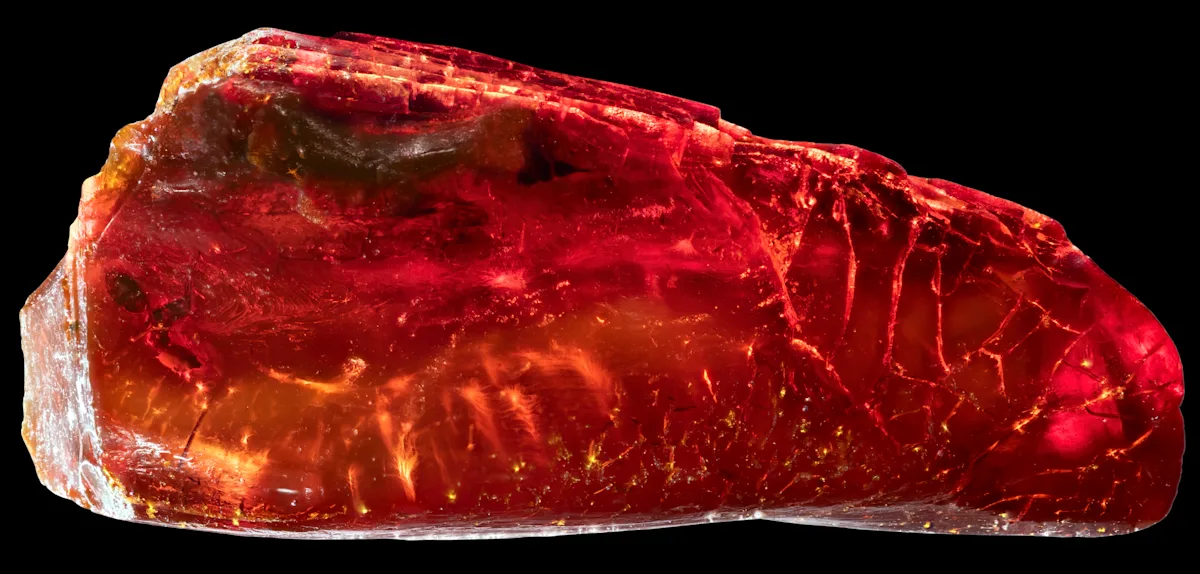
Johann Wolfgang von Goethe is best known as one of the greatest literary figures in history, but the German poet, philosopher, and statesman was also a passionate naturalist and collector. More than 200 years after his death, Goethe’s personal amber collection has revealed an extraordinary scientific discovery: a 40-million-year-old fossil ant hidden inside a piece of Baltic amber once held in his hands.
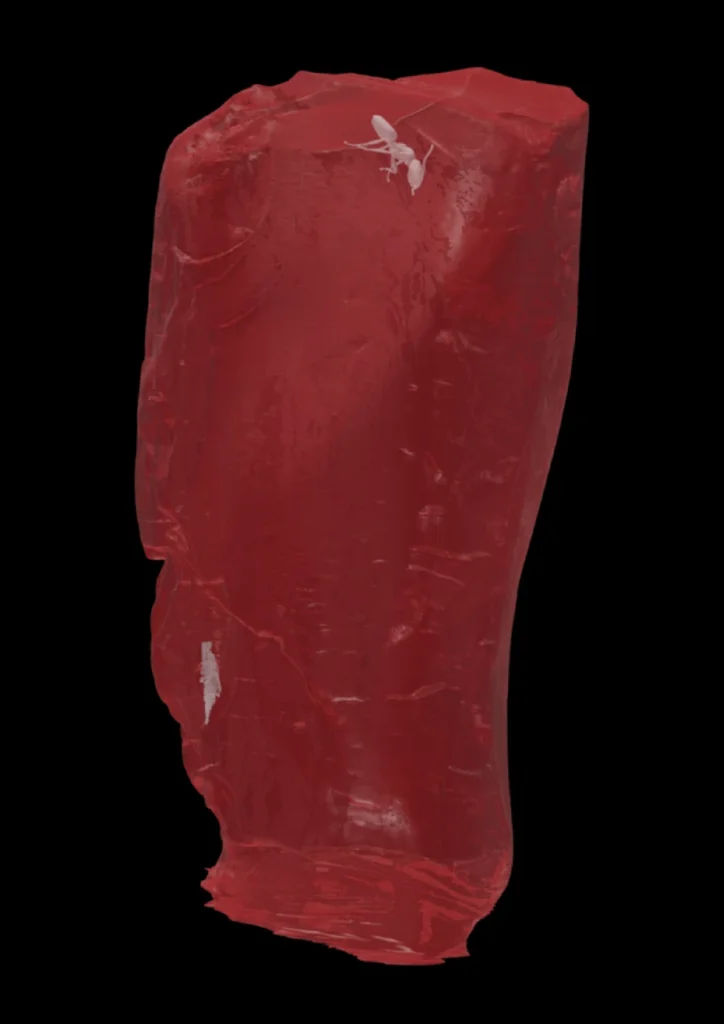
The remarkable finding was made by an international team of researchers led by scientists from Friedrich Schiller University Jena. Using state-of-the-art imaging technologies, the team identified the fossil in an unpolished amber specimen from Goethe’s collection—despite the fact that the insect is invisible to the naked eye.
Advanced Imaging Unlocks a Hidden Fossil
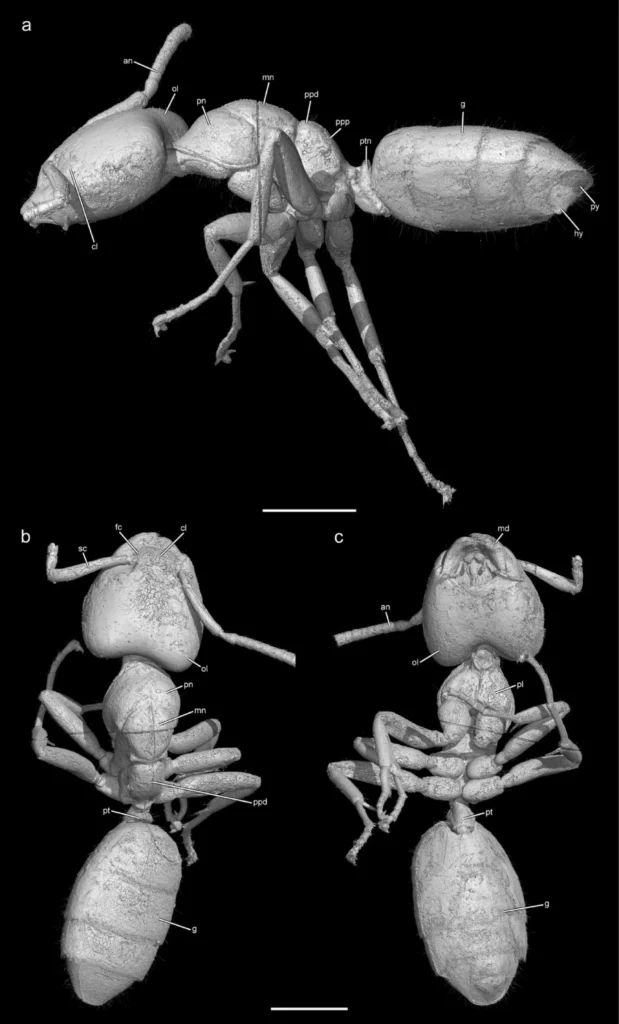
The fossil ant was discovered using synchrotron radiation–based micro-computed tomography (SR-µ-CT), a cutting-edge technique that allows scientists to look inside opaque materials without damaging them. This non-invasive method enabled researchers to digitally reconstruct the insect in three dimensions with unprecedented precision.
The ant was identified as †Ctenobethylus goepperti, an extinct species that lived during the Eocene epoch, approximately 47–34 million years ago. Although this species is relatively common in Baltic amber, the newly discovered specimen stands out due to its exceptional state of preservation and the level of anatomical detail revealed.
A First Look Inside an Ancient Ant
One of the most significant aspects of the discovery is that scientists were able to examine the internal anatomy of a fossil ant for the first time. Structures inside the head and thorax—normally lost during fossilization—were clearly visualized through 3D reconstruction.
📣 Our WhatsApp channel is now LIVE! Stay up-to-date with the latest news and updates, just click here to follow us on WhatsApp and never miss a thing!!
According to researcher Bernhard Bock from the Phyletic Museum in Jena, the study goes far beyond simply identifying a fossil: “This specimen allowed us to redescribe the species in much greater detail and to gain new insights into its evolutionary relationships.”
The findings suggest that †Ctenobethylus goepperti may be closely related to the modern ant genus Liometopum, which today includes tree-dwelling species known for forming large colonies.
Insights into Eocene Forest Ecosystems
Based on its morphology and evolutionary relationships, researchers believe that †Ctenobethylus goepperti was likely an arboreal ant, living in warm, humid, conifer-dominated forests that once covered large parts of Europe during the Eocene. Its abundance in Baltic amber suggests it may have been one of the dominant ant species of its time.
This discovery provides valuable information about ancient ecosystems and climate conditions, reinforcing amber’s reputation as a biological time capsule capable of preserving delicate life forms for tens of millions of years.
Goethe’s Amber Collection Revisited
Goethe’s amber collection consists of around 40 pieces, primarily sourced from the Baltic Sea region. Today, these artifacts are housed at the Goethe National Museum in Weimar, where they have been preserved largely in their original condition.
During the recent investigation, scientists examined all 40 amber pieces using modern imaging techniques. In addition to the fossil ant, they identified two other insect inclusions: a fungus gnat and a blackfly. It is believed that Goethe himself was unaware of the microscopic life trapped inside these amber specimens, as systematic studies of amber inclusions only became common toward the end of his lifetime.
Old Collections, New Discoveries
The study highlights the immense scientific value of historical museum collections, especially when revisited with modern technology. Objects once collected for aesthetic, philosophical, or personal reasons can still yield groundbreaking scientific insights centuries later.
To support further research, the team created interactive 3D models of the fossil ant, which are now available online. These models allow scientists worldwide to compare similar fossils and improve the identification of extinct ant species.
Where Science, History, and Culture Converge
For researchers, the discovery is more than a paleontological milestone—it is also a powerful symbol of continuity between past and present. A specimen collected during the Enlightenment era, at a time when modern natural science was still emerging, now contributes to cutting-edge evolutionary research.
As Bernhard Bock notes, “It is fascinating that an object from Goethe’s time—handled by someone who helped shape modern thought—can still expand our scientific knowledge today.”
The 40-million-year-old ant preserved in Goethe’s amber stands as a testament to the enduring value of curiosity, careful observation, and the timeless dialogue between science, culture, and nature.
Boudinot, B.E., Bock, B.L., Tröger, D. et al. Discovery of Goethe’s amber ant: its phylogenetic and evolutionary implications. Sci Rep 16, 2880 (2026). https://doi.org/10.1038/s41598-026-36004-4
Cover Image Credit: Boudinot et al., 2026