A remarkable archaeological breakthrough led by researchers from Goethe University Frankfurt is shedding new light on how Roman administration, culture, and everyday life functioned in the far northwestern provinces of the Roman Empire. By deciphering barely visible inscriptions on wooden Roman writing tablets discovered in present-day Belgium, scholars have reconstructed fragments of a long-lost world once thought to be silent forever.
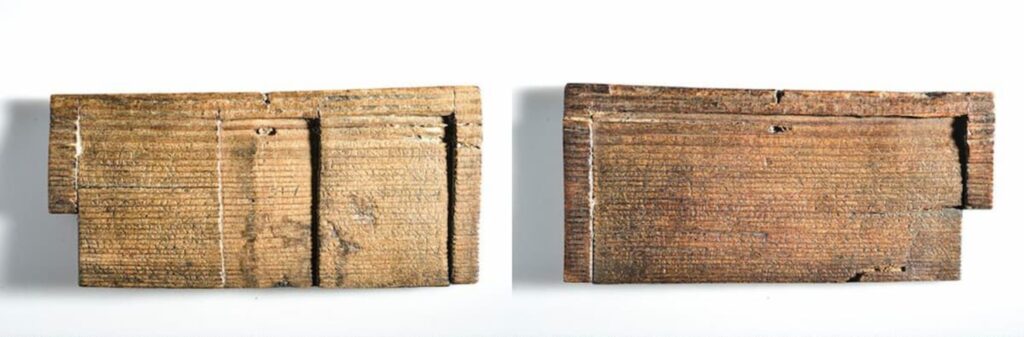
The objects at the heart of this discovery are Roman wooden writing tablets, known as tabulae ceratae. These tablets, which originally carried thin layers of wax for writing, were unearthed in Tongeren—Belgium’s oldest city and the former Roman settlement of Atuatuca Tungrorum. Although the wax itself has long since disappeared, the pressure of ancient styluses left faint impressions in the wood beneath, preserving traces of Latin texts for nearly two millennia.
The painstaking decipherment was led by Professor Markus Scholz, a provincial Roman archaeologist and epigraphy expert at Goethe University Frankfurt, together with Professor Jürgen Blänsdorf (University of Mainz, emeritus). Scholz is internationally known for his role in decoding the so-called “Frankfurt Silver Inscription,” which provided early evidence of Christianity north of the Alps in the 3rd century AD. This time, however, the challenge was even greater.
A Forgotten Discovery Revisited
Many of the wooden fragments were first excavated in the 1930s but were dismissed as unremarkable debris. Only in 2020 did Else Hartoch, director of the Gallo-Roman Museum of Tongeren-Borgloon, recognize their true significance and initiate a comprehensive re-examination. Additional tablets had also been discovered in 2013, bringing the total to 85 fragments from two distinct archaeological contexts.
One group was recovered from a well near the ancient forum and public buildings. The tablets appear to have been deliberately broken and discarded—possibly to prevent sensitive information from being read. Researchers suggest this could represent an early form of “data protection” in antiquity. The second group came from a muddy pit used to fill damp ground with refuse, including reused tablets and everyday waste.
📣 Our WhatsApp channel is now LIVE! Stay up-to-date with the latest news and updates, just click here to follow us on WhatsApp and never miss a thing!!
Contracts, Officials, and School Exercises
Deciphering the inscriptions proved extraordinarily difficult. The wood was heavily dried and marked by natural grain patterns, making it hard to distinguish letters from accidental scratches. Some tablets had been reused multiple times, creating palimpsests—layers of overlapping texts.
Despite these challenges, about half of the fragments yielded legible traces. The content is as revealing as it is diverse. Scholars identified contracts and official records, written with heavy pressure to ensure permanence. Other texts include administrative copies, writing exercises by students, and even the draft of a dedication inscription for a statue of the future Emperor Caracalla, dated to AD 207.
The tablets also provide rare evidence of high-ranking Roman officials operating in the region. Mentions of a decemvir—a senior magistrate—and lictors, ceremonial attendants of state officials, demonstrate that complex Roman governance extended deep into the northern provinces.
A Multicultural Roman Society
Beyond administration, the inscriptions illuminate the people of Roman Tongeren. Personal names of Roman, Celtic, and Germanic origin appear side by side, some previously unknown to scholars. Several individuals can be identified as military veterans, including former members of the Roman Rhine fleet who settled in the area after completing their service.
This diversity underscores the processes of Romanisation and Latinisation, showing how local populations, soldiers, and migrants interacted within a shared administrative and cultural framework.
Cutting-Edge Science Meets Ancient Wood
The research combined traditional disciplines such as palaeography, philology, and onomastics with advanced scientific methods. These included wood species identification, wax residue analysis, and high-resolution visualization using Multi-Light Reflectance Imaging (RTI). In some cases, progress required researchers to study the originals together in person—despite pandemic restrictions.
The full results have now been published in a richly illustrated scholarly volume, introducing both specialists and the wider public to the writing tablets of Roman Tongeren.
While less visually spectacular than precious-metal inscriptions, these modest wooden fragments have profoundly expanded our understanding of Roman life at the empire’s edge—proving once again that even the faintest marks can speak volumes across time.
Else Hartoch (ed.), The writing tablets of Roman Tongeren (Belgium) and associated wooden finds (Turnhout 2025). (S. 21-32 Abschnitt 1.2 über die entzifferten Texte und ihre Bedeutung sowie kommentierter Katalog S. 185-280 Catalogue Part 1; S. 281-314 Catalogue Part 2 von Jürgen Blänsdorf and Markus Scholz)
“The book has also been published in open access: https://www.brepols.net/products/IS-9782503616872-1”
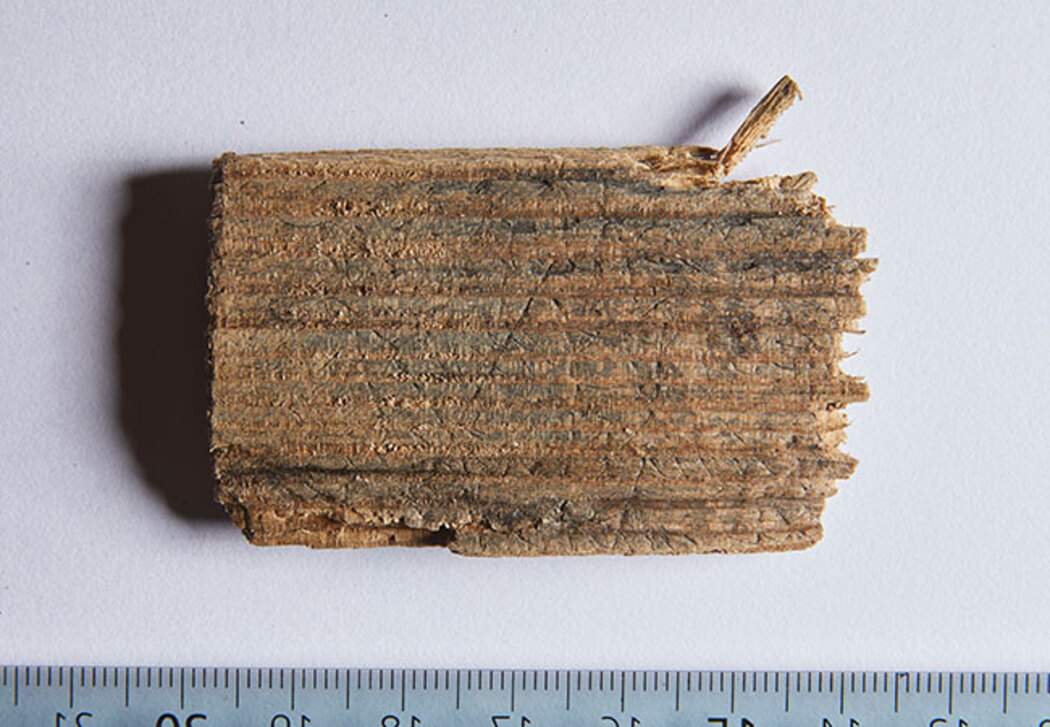
Cover Image Credit: Atuatuca Tungrorum / Tongeren. Fragment of a wooden writing tablet (Cat. No. 32) mentioning honorably discharged naval soldiers (classici). Gallo-Romeins Museum Tongeren-Borgloon