

A pair of extraordinary silver ornaments from a medieval burial in southern Siberia may preserve a rare image associated with Umay, the ancient Turkic goddess linked to women, children, and protection.
Archaeologists found the elaborate objects at the Koibaly cemetery in Khakassia. Each one shows a winged human figure holding a vessel beneath a halo-like element. Researchers have connected this striking imagery with Umay for decades, drawing on the figure’s appearance, the burial context and descriptions preserved in Turkic tradition.
A new technological study has now revealed another remarkable part of their history. Researchers from the Institute of Archaeology and Ethnography of the Siberian Branch of the Russian Academy of Sciences and Novosibirsk State University determined that the ornaments did not begin their lives as earrings. Instead, one highly skilled jeweler created them for another purpose, a second craftsman later transformed them into earrings, and a third eventually repaired one after years of use.
The study, published in Archaeology, Ethnology & Anthropology of Eurasia, suggests that the ornaments may have survived for generations as valuable family heirlooms whose symbolic meaning mattered more than changing fashion.
A Winged Figure Linked to the Goddess Umay
An archaeological expedition led by Sergei Skobelev discovered the pair in 1985 while excavating Kurgan 7 at the Koibaly burial ground on the right bank of the Abakan River in Khakassia.
The excavators found the ornaments inside a small cache built into the grave wall.
Each object centers on an anthropomorphic figure with distinctly feminine forms. The figure wears a tall hairstyle or headdress beneath a halo-like element and holds a vessel with both hands at chest level. Wings descend along either side of the body, while a curved tail continues toward the back.
Large diamond-shaped pendants hang near the tail. Seven hollow spherical ornaments attached to twisted wires complete the composition around the halo, wings, and lower pendants.
The imagery led Skobelev to publish a detailed interpretation in 1990 in which he associated the figure with Umay, one of the most important female supernatural beings in the early Turkic religious world.
Early Turkic traditions placed Umay alongside Tengri and the sacred Yer-Su, or “Earth-Water,” within a broader divine order. Later traditions especially associated her with fertility, motherhood, women, and the protection of children.
The Koibaly figure also shares several features with Turkic stone sculpture. It faces forward in a static pose and holds a vessel with both hands in front of the body, a convention that appears repeatedly in Turkic anthropomorphic monuments.
Researchers have not yet identified another artifact that matches the Koibaly ornaments in artistic style, function, and manufacturing technique. For that reason, the identification with Umay remains an interpretation, but the unusual iconography continues to make the association significant.
The Earrings Originally Had Another Function
The latest research focused on how ancient craftsmen made, modified, and repaired the ornaments.
Oleg Mitko of Novosibirsk State University and Pavel Volkov of the Institute of Archaeology and Ethnography reconstructed three separate stages in the objects’ history, involving craftsmen with noticeably different levels of skill.
During the first stage, a highly experienced jeweler created two almost identical flattened figures from a silver alloy containing around 1–2 percent copper.
At this point, the objects apparently served another function.
The original design resembled decorated bird-like forms with human figures at their centers. The jeweler covered the surfaces with sophisticated ornamentation using twisted metal thread and fine filigree wire. The precision of this work points to a craftsman with considerable technical experience.
A second artisan later transformed the objects into complex earrings.
He attached hollow spherical pendants with thin silver wire and added loops and ear hooks. The hooks curve like question marks, a form that allowed wearers to suspend the ornaments securely through pierced earlobes. Researchers note that people used similar fastening systems as far back as the Bronze Age.
The second craftsman did not match the technical skill of the original jeweler. His work left dents, burrs, and other marks on the surfaces. Even so, he shaped the ear hooks with considerable precision.
The transformation fundamentally changed the function of the objects while preserving the central winged figures.
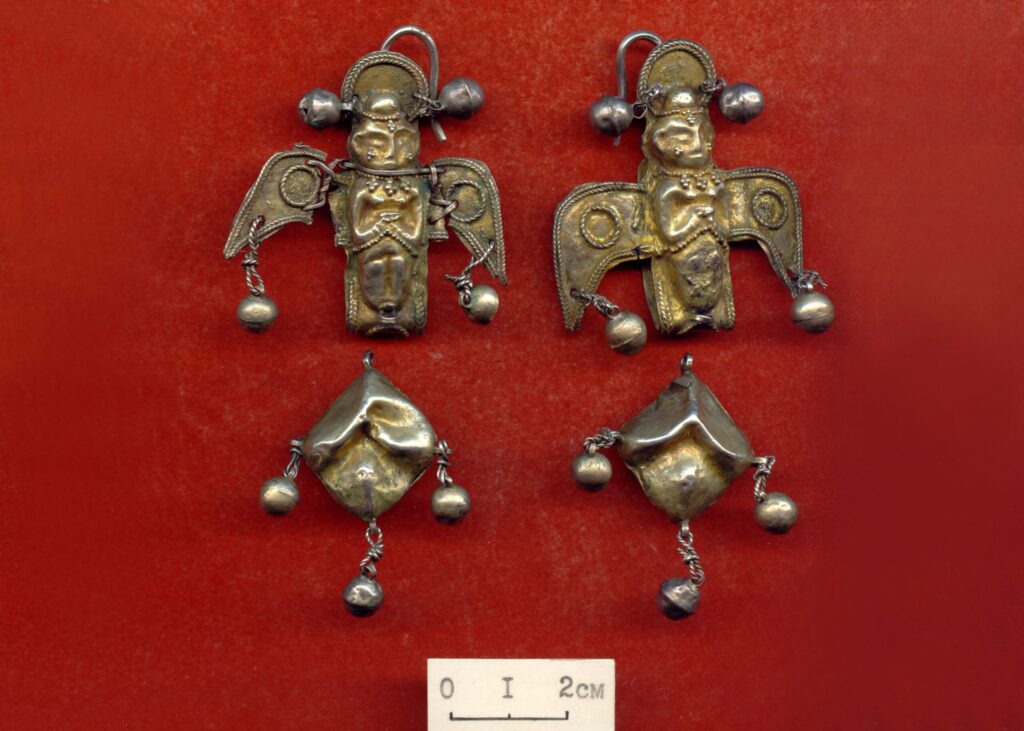
The latest research focused on how ancient craftsmen made, modified and repaired the ornaments. Credit: Institute of Archaeology and Ethnography, Siberian Branch of the Russian Academy of Sciences
A Valuable Heirloom Repaired After Years of Use
The ornaments did not disappear into a grave soon after their conversion into earrings. Wear traces show that someone used them for a substantial period.
Eventually, lateral pressure cracked and broke part of a wing on one earring.
A third craftsman then attempted a repair. Instead of soldering the damaged section, he punched relatively large holes through the metal and tied the broken part together with wire. His tools and methods differed from those employed during the earlier stages, and the repair showed considerably less technical sophistication.
This crude intervention provides one of the strongest clues to the earrings’ personal value.
By the time their owner used and repaired them, the ornaments may already have looked old-fashioned. Yet she or her family chose to preserve them rather than replace them with newer jewelry.
Mitko argues that their symbolic importance probably outweighed their physical condition or stylistic age. The quality of the original craftsmanship, together with the extensive wear and later repair, supports the idea that a family may have passed the ornaments from one generation to another.
Such jewelry could have expressed much more than wealth. It may also have signaled family identity, social maturity or membership in an elite group.
If the central figure did indeed represent Umay, the ornaments may also have carried a protective or religious meaning connected specifically with women and family life.
A Woman Buried with Horse Equipment
The burial itself offers additional clues about the person who owned the ornaments.
Ancient looters had already disturbed Kurgan 7 before archaeologists excavated it. They removed the skull and most of the human skeleton, preventing researchers from determining biological sex directly from the surviving remains.
The grave goods, however, led researchers to suggest that the burial most likely belonged to a woman.
The excavators found the skull and long leg bones of a horse, two stirrups and iron fittings from horse harness equipment. Both men and women could receive horse-related equipment in early medieval Turkic burials.
What the grave lacked may prove just as important.
The assemblage contained none of the objects more strongly associated with the male warrior sphere, such as belt-set fittings, arrowheads or horn reinforcements from a composite bow.
Taken together, the evidence points toward a high-status woman whose burial combined prestigious personal jewelry with horse-related funerary practices.
Connections with the Uyghur and Yenisei Kyrgyz Worlds
Researchers still face a more difficult question: which cultural or political community produced and used the ornaments?
Some features of the burial rite may connect the grave with populations associated with the Uyghur Khaganate, whose tribal base included Tiele groups.
The Uyghurs and Yenisei Kyrgyz fought for roughly two decades during the final phase of Uyghur political power. The conflict ended when the Kyrgyz captured Ordu-Baliq, the Uyghur capital in present-day Mongolia, in the ninth century and established their own dominance across a wide part of Inner Asia.
The broader Koibaly cemetery also includes burials associated with the Yenisei Kyrgyz and later periods, although Kurgan 7 belongs to an earlier ancient Turkic phase.
The ornaments themselves offer few straightforward answers. Their unusual design and individualized craftsmanship suggest that a workshop produced them as special commissions rather than as standardized jewelry.
Researchers therefore plan to compare their artistic style and manufacturing techniques with jewelry traditions from China, Central Asia, Western Asia and the Middle East. Such comparisons may eventually clarify where their craftsmen drew inspiration and which cultural networks influenced their design.
More Than Medieval Jewelry
The Koibaly ornaments stand out because they preserve multiple histories within a single object.
A highly skilled jeweler first created them as elaborate silver figures. Another craftsman later converted them into earrings. Their owner wore them long enough for one to break, and a third artisan repaired the damage rather than discarding the piece.
At the center of this long material history appears the same enigmatic winged female figure that archaeologists have associated with Umay, one of the most important female figures in ancient Turkic belief.
What the technological analysis does establish is that these were not disposable ornaments. They accumulated biographies of their own—manufactured by one skilled jeweler, transformed by another, worn for years and repaired by a third before finally being placed in a grave.
The meaning attached to the figure—and perhaps to Umay herself—may have mattered even more.
Volkov, P. V., & Mitko, O. A. “Technological Analysis of Earrings from a Burial with a Horse Hide at the Koibaly Cemetery in Khakassia,” Archaeology, Ethnology & Anthropology of Eurasia, pp. 83–90.
