

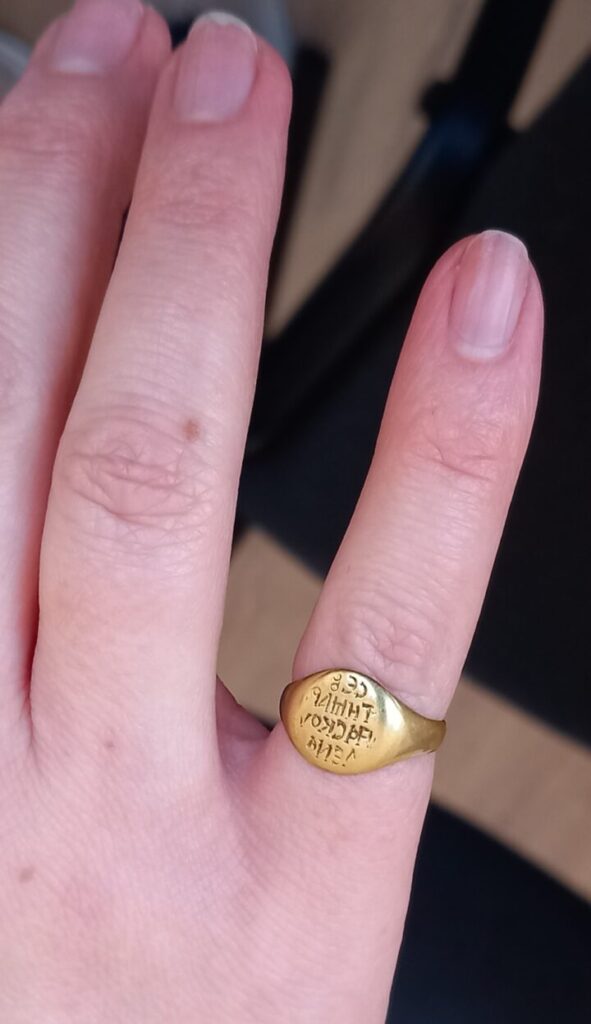
Nearly seven centuries ago, a woman named Maria Skulena possessed something that carried more weight than its gold alone suggested: a ring made to place her name onto documents. That 14th-century Byzantine gold signet ring has now emerged near Zlatograd in Bulgaria’s Eastern Rhodopes, preserving a rare and unusually personal trace of a woman who had the authority to authenticate documents in her own name.
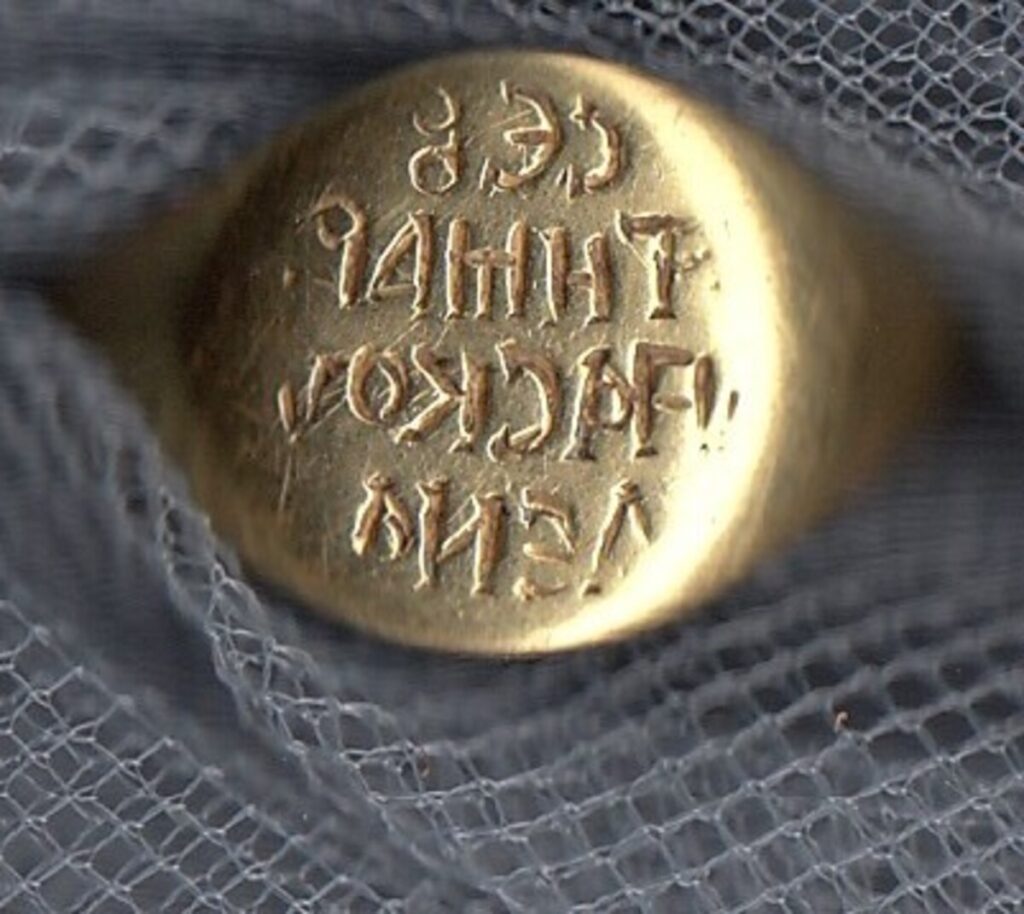
The inscription identifies her as “sevasta Maria Skulena.” Women’s signet rings from this period are considerably rarer than those associated with men, making the object important not simply as Byzantine jewelry, but as evidence of a woman whose social position allowed her identity to carry legal or administrative significance.
Archaeologist Prof. Nikolay Ovcharov, who shared a detailed account of the ring and its historical context, associates it with the medieval region of Achridos in the Eastern Rhodopes. Its exact archaeological context has not survived, but the ring is reported to have originated near Zlatograd and later entered the officially registered private collection of engineer Alexander Mitushev.
The Bulgarian News Agency, which reported on the ring when it was publicly presented in Zlatograd on September 5, adds a little more geographical precision. According to BTA, the object was found in a four-to-five-kilometer stretch near Zlatograd extending toward the Greek border.
Her Name Was Meant to Leave an Impression
At first glance, the ring belongs to the familiar world of medieval wealth and display. Yet its most important feature is not the precious metal but the inscription engraved into its surface.
Sigillography specialist Dimitar Stoimenov read the Greek text as referring to “sevasta Maria Skulena.” The letters were engraved in negative, allowing the inscription to appear correctly when the ring was pressed into softened wax.
That practical function changes how the object can be understood. This was jewelry, but it was also an instrument through which Maria could authenticate a document and leave an impression carrying her own name and title.
For women in the surviving documentary world of Late Byzantium, evidence of this kind is not common. Men more frequently appear as those signing and sealing official documents, and surviving named signet rings are consequently dominated by male owners.
Maria’s ring therefore gives historians something more intimate than a title preserved in a written list. It places a particular woman behind an object she could hold, wear and use as a visible expression of her social authority.
A Woman Within the Late Byzantine Elite
Paleographic features of the inscription point to the middle decades of the 14th century, probably between the 1330s and 1350s. Ovcharov believes the ring was produced in a provincial workshop of the Byzantine Empire during the Palaiologan period.
Maria’s title provides another clue to the world she inhabited. “Sevasta,” the feminine form associated with the Greek title “sevastos,” derives from a term carrying meanings such as “revered” or “exalted.”
The title had once occupied a much more prestigious place in Byzantine hierarchy, but its meaning changed over time. By the 13th and 14th centuries, sevastoi were more often connected with provincial elites and people holding middle- or lower-level judicial and fiscal positions.
Maria should therefore not automatically be imagined as one of the most powerful women at the imperial court. What the ring does show more securely is that she belonged to a social world in which status, property and documentary authority mattered—and that her own name could be used to validate an act.
That distinction makes the object more compelling rather than less. Maria emerges not as an anonymous “Byzantine noblewoman,” but as a woman occupying a recognizable place within the complicated provincial society of the empire’s final centuries.
Can Maria Skulena Be Identified?
Her surname may help narrow that world further. Skulena is the feminine form derived from Skules, a name recorded in 14th-century documents from areas including Thessaloniki, Serres, Chalkidiki and parts of the Rhodopes facing the Aegean.
People carrying the name belonged to different social levels. Among the more prominent was Michael Skules, who held the title of “general judge of the Romans” in 1370–1371.
Ovcharov also points to a document from 1338 mentioning a Sevast Skules who possessed land in the eastern part of the Serres plain. He proposes that Maria Skulena may have been the wife of this man, although the surviving evidence does not establish that relationship with certainty.
The suggestion is nevertheless geographically plausible. The known distribution of the Skules name across Aegean Macedonia, Thessaloniki, Chalkidiki and the surrounding region places members of this social network relatively close to the Eastern Rhodopes.
Maria may therefore have owned property in Achridos or even lived there, as Ovcharov suggests. Without a secure archaeological findspot or a document explicitly identifying her, however, that part of her biography must remain an informed hypothesis rather than a confirmed fact.
Between Perperikon and the Aegean
The landscape around Zlatograd was not isolated from the wider Byzantine world. Routes following the Arda and Varbitsa rivers connected the Eastern Rhodopes with the Aegean coast and urban centers including Thessaloniki, Xanthi, Drama and Serres.
Within this network stood medieval Hyperperakion, today associated with Perperikon, one of the important centers of Achridos. Archaeological research across the region has revealed a dense medieval landscape that also included places such as Ustra, Mneakos, Krivus, Patmos and Ephraim.
These connections offer a credible setting for a woman whose family or property interests may have crossed the political and economic landscapes between the Rhodopes and Aegean Macedonia. They cannot tell us exactly where Maria lived, but they help explain how a ring carrying her name could have reached the area around Zlatograd.
The lack of a documented excavation context remains the object’s greatest limitation. Archaeologists cannot securely associate the ring with a particular residence, settlement layer or moment of loss, and that missing context restricts what can be reconstructed about its final journey.
A Small Object, a Rare Female Voice
What survives is nevertheless unusually direct. Gold can tell us about wealth, craftsmanship and fashion, but the inscription on this ring gives the object something archaeology rarely preserves so clearly: a woman’s name tied to an act of authority.
Maria Skulena remains elusive. We do not know exactly where she lived, what documents she sealed or how much influence she exercised in everyday life, and even the proposed identity of her husband remains uncertain.
But the ring shows that her name mattered enough to be carved into gold and reproduced in wax whenever her seal was required. Nearly seven centuries later, that small personal instrument has preserved not only the name of a Byzantine woman, but also a glimpse of the agency she once possessed in a world whose written record so often places men in the foreground.
