

Archaeologists in southern Tajikistan have uncovered a rare Kushan royal seal made of fired clay, a discovery that could provide new evidence for how political authority and administration operated in one of ancient Central Asia’s most commercially connected regions.
The seal was discovered by specialists from the National Museum of Tajikistan during archaeological research at the Sayyod historical site in the Abdurahmoni Jomi District of Khatlon Province, according to an announcement by the museum. The National Museum of Tajikistan described the artifact as an unusually important find from the Kushan period.
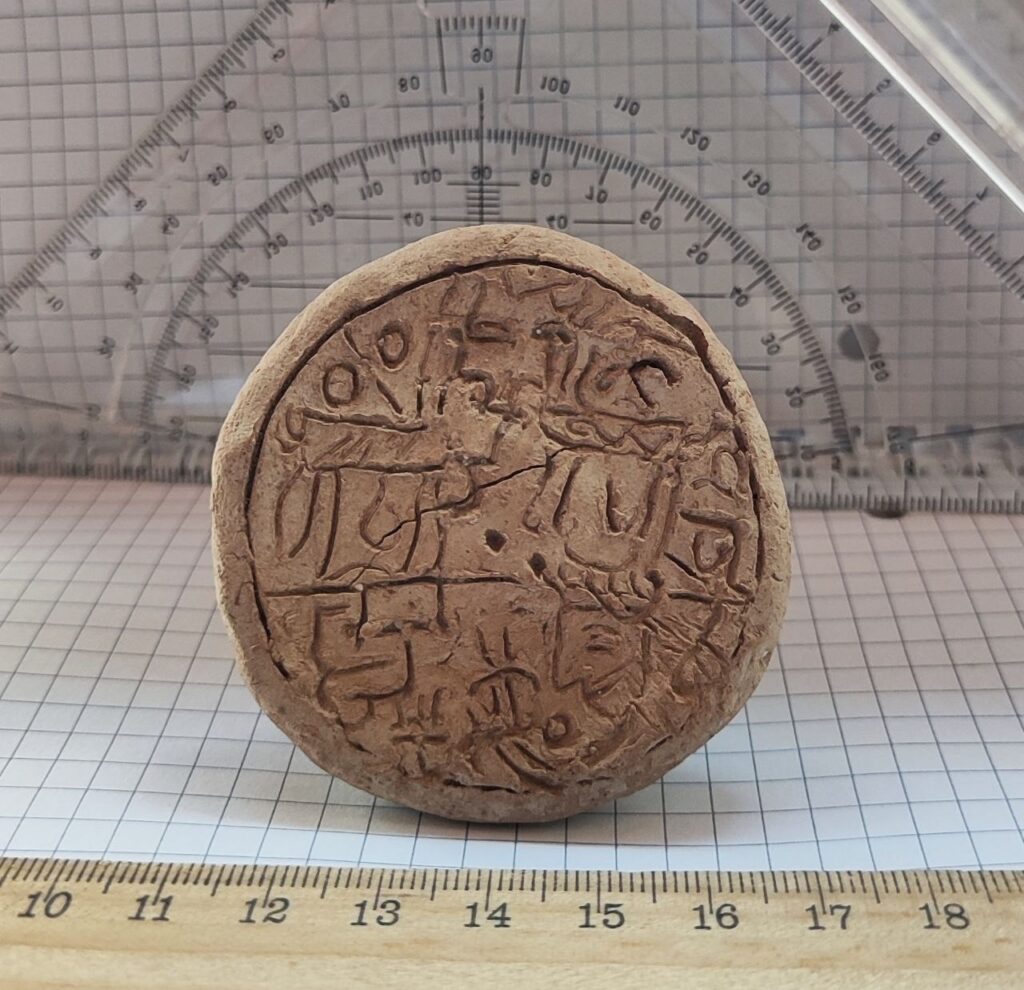
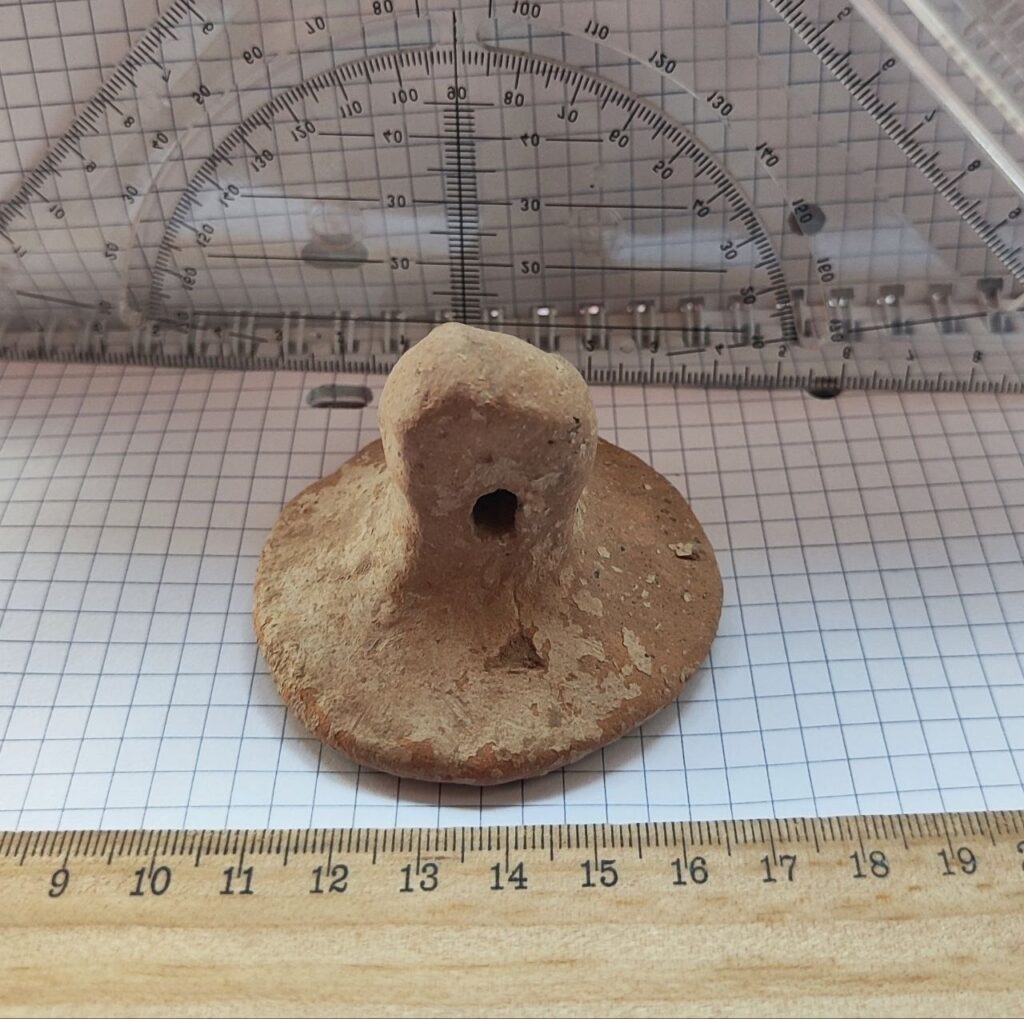
Despite its age, the object is reported to be well preserved. Beige in color and made from fired clay, it consists of a handle pierced with a hole, probably allowing it to be carried or suspended on a cord, and a larger circular stamping surface. The object measures about 5 centimeters in height, while the engraved circular face is approximately 6 centimeters in diameter.
What makes the find particularly significant is the imagery carved into its surface. The designs appear in reverse, as expected on a stamp intended to leave a correctly oriented impression. Archaeologists have identified a Bactrian inscription, geometric decoration, the bust of a ruler wearing a crenellated crown, mountain goats, symbols associated with Kushan kingship, and signs that may relate to local rulers.
Researchers have not yet published a complete reading of the inscription or a final interpretation of the seal. Specialists from the museum’s archaeology and numismatics department are currently studying and deciphering the artifact, meaning its owner, precise date, and exact administrative function remain open questions.
A seal from a major trading world
The discovery is particularly interesting because it comes from the broader world of the Kushan Empire, which emerged in Bactria and became one of the major political powers of Central and South Asia during the first centuries CE. Kushan territories eventually extended across parts of present-day Central Asia, Afghanistan, Pakistan and northern India.
Their geographical position placed Kushan-controlled regions within extensive networks connecting China and Central Asia with India, Iran and, indirectly, the Roman world. These networks contributed to a period of considerable commercial activity and urban prosperity under Kushan rule.
The routes often grouped under the modern term “Silk Road” were not a single highway controlled by one empire. They consisted of caravan routes, market towns and regional exchange networks through which goods frequently passed from one group of merchants to another. Silk, glass, precious stones, metals, textiles, ivory and other high-value commodities moved through these systems over enormous distances.
That commercial background makes the Sayyod seal potentially important for economic history, although there is no evidence yet that this particular object was directly used in trade. Across ancient administrative systems, seals could authenticate documents, identify officials or owners, secure containers and mark goods. If the Sayyod artifact can be tied to an official institution or ruler, it could eventually help researchers examine how political authority intersected with the movement, storage or administration of goods.
Bactrian inscription could provide the key
The Bactrian inscription may prove especially valuable. Bactrian, an Iranian language written using a modified Greek alphabet, became an important language of administration under Kushan rule, making inscriptions on official objects particularly useful for reconstructing political institutions and personal titles.
If the inscription can be securely read, it may reveal a name, title or institutional connection and help determine whether the seal belonged to a royal official, a local ruler or another figure operating within the Kushan political system.
The combination of royal imagery and symbols apparently associated with local authority is equally intriguing. Rather than simply documenting imperial power, the seal may ultimately provide evidence for the relationship between Kushan rulers and regional elites in what is now southern Tajikistan.
The National Museum of Tajikistan says the artifact is undergoing detailed archaeological, numismatic and epigraphic study, with the results expected to be published after the examination is completed. Until then, some of its most important questions — who used the seal, what it was intended to authenticate, and how it functioned within Kushan administration — remain unanswered.
Cover Image Credit: National Museum of Tajikistan
