
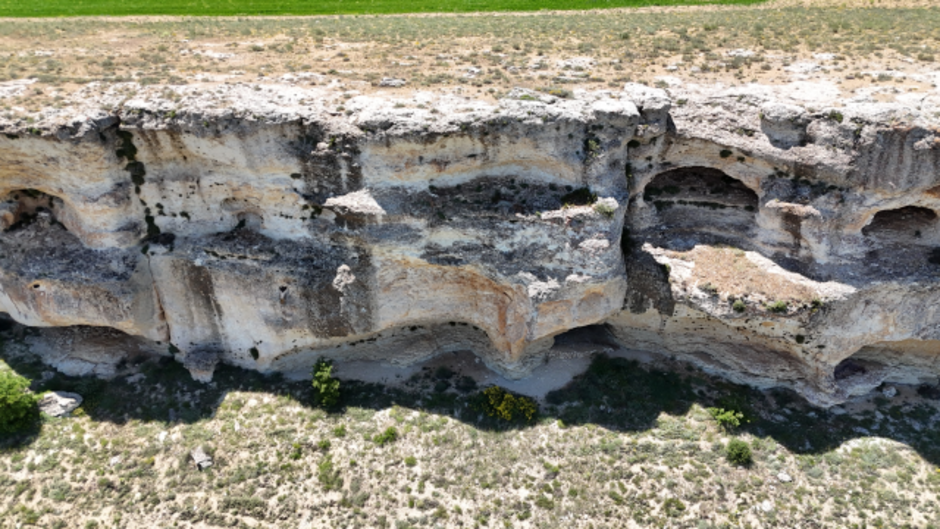
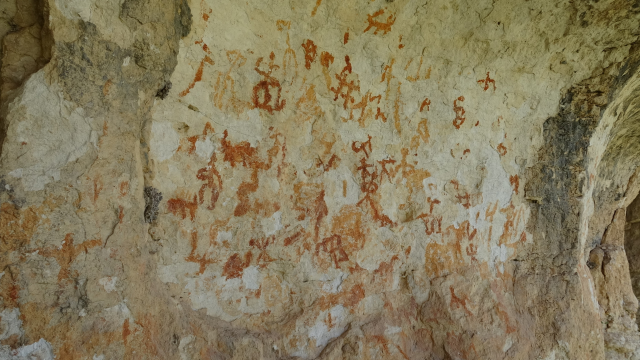
A newly identified prehistoric cave in eastern Türkiye may become one of the most important painted cave sites ever recorded in Anatolia. Discovered during fieldwork in Malatya’s Tohma Canyon, the cave contains nearly 100 human and animal figures, along with a dense group of geometric symbols painted in red and reddish-brown tones.
The first observations suggest a site that was not used once and then abandoned. Instead, researchers are looking at a layered visual surface, where figures overlap, lines intersect and stylistic differences point to repeated use over a long period. A cautious preliminary assessment places the cave in the Neolithic period, although its final chronology will depend on detailed documentation and laboratory analysis.
A prehistoric discovery in Tohma Canyon
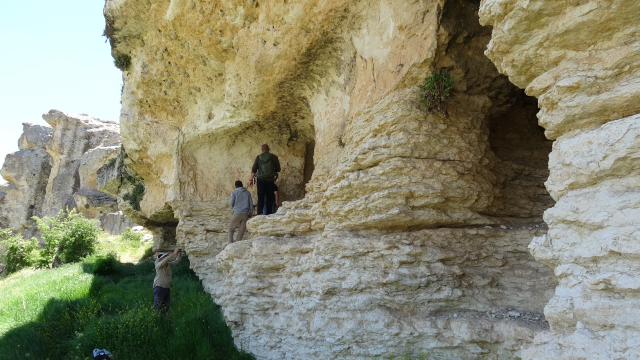
The cave was identified by an interdisciplinary research team led by Dr. Levent İskenderoğlu from the Department of Painting at İnönü University’s Faculty of Fine Arts and Design. The team includes academics from İnönü University, Istanbul University and Fırat University.
Tohma Canyon lies in the Darende district of Malatya, a province in eastern Türkiye, where natural corridors, river valleys and highland routes have long shaped human movement. The canyon is best known today for its steep rock walls and the Tohma watercourse running through it. The new discovery now adds a much deeper cultural layer to this already striking landscape.
According to the first field observations, the cave walls preserve a rich visual record made up of human figures, animal depictions and geometric motifs. The figures are not presented as isolated images. They appear in meaningful relationships with one another, suggesting a symbolic system rather than random decoration.
Red figures, symbols and layered memory
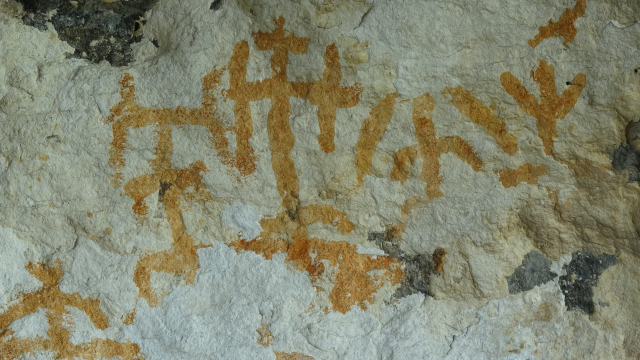
Dr. İskenderoğlu said the paintings carry a schematic and symbolic visual language. Unlike the naturalistic cave paintings known from parts of Europe, these images seem to rely more on simplified form, repetition and sign-like expression.
That distinction is important. The cave may offer clues not only about prehistoric art, but also about early ways of thinking, remembering and communicating. In this case, the line was not merely a tool for drawing a body or an animal. It may have been used to record ideas, beliefs or shared meanings.
Some surfaces show figures painted over earlier images. In other areas, lines cross each other, and changes in style can be seen. These details suggest that the cave may have been revisited and reinterpreted by different groups across generations, possibly even over thousands of years.
Researchers are therefore approaching the site as a visual archive. Each painted surface may preserve more than one moment in time.
Possible ritual use remains under study
The combination of human forms, animal figures and geometric signs has raised the possibility that the cave may have had a ritual or belief-related function. İskenderoğlu has been careful not to present this as a final conclusion. For now, it remains one of the questions that future research will examine.
Still, the density and variety of the paintings make the site especially significant. In Türkiye, prehistoric painted caves such as Beldibi in Antalya, the Latmos rock paintings on the Aydın-Muğla border and Doğu Sandal Cave in Mersin are among the better-known examples of Anatolian rock art. The Tohma Canyon cave is now being compared with these sites because of its figure density, subject diversity and symbolic richness.
If the preliminary observations are confirmed, the cave could become one of the richest painted cave sites known in Anatolia.
Scientific analysis will decide the cave’s age
The cave has not yet been definitively dated. Researchers plan to carry out detailed surface studies, pigment analysis, figure classification and inventory work. These steps are essential for understanding the painting techniques, the chronological range of the images and the possible phases of use.
The interdisciplinary team will also prepare initial assessment reports for the relevant conservation board. Proper documentation is especially urgent because the cave has already suffered recent damage.
İskenderoğlu warned against illegal digging and treasure hunting, stressing that there are no gold objects or valuables to be found in such places. What exists there, he said, is far more fragile: traces of human history. Damage to painted cave surfaces cannot be reversed once it happens.
A fragile record of Anatolia’s prehistoric past
The discovery in Tohma Canyon comes at a time when Anatolia’s prehistoric record is being reassessed through new finds, new technologies and more careful field documentation. Painted caves and rock art sites are particularly valuable because they preserve forms of expression that rarely survive in ordinary archaeological deposits.
The Malatya cave may eventually help researchers understand how prehistoric communities in eastern Anatolia marked space, represented animals and people, and used symbols to give meaning to their world.
For now, the most important step is protection. Before the cave can fully speak to archaeology, its painted surfaces must be secured, documented and studied without further damage.
If confirmed by scientific analysis, the Tohma Canyon discovery will not simply add another site to Türkiye’s archaeological map. It may open a rare window onto the symbolic world of prehistoric Anatolia.
Cover Image Credit: DHA
