
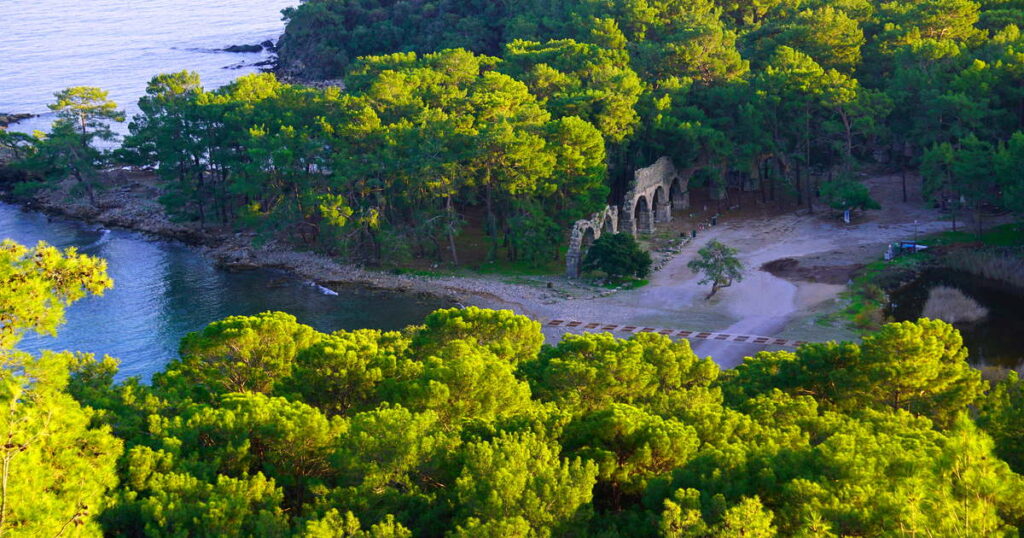
A rare Mediterranean site where ruins, pine forests, and clear bays meet
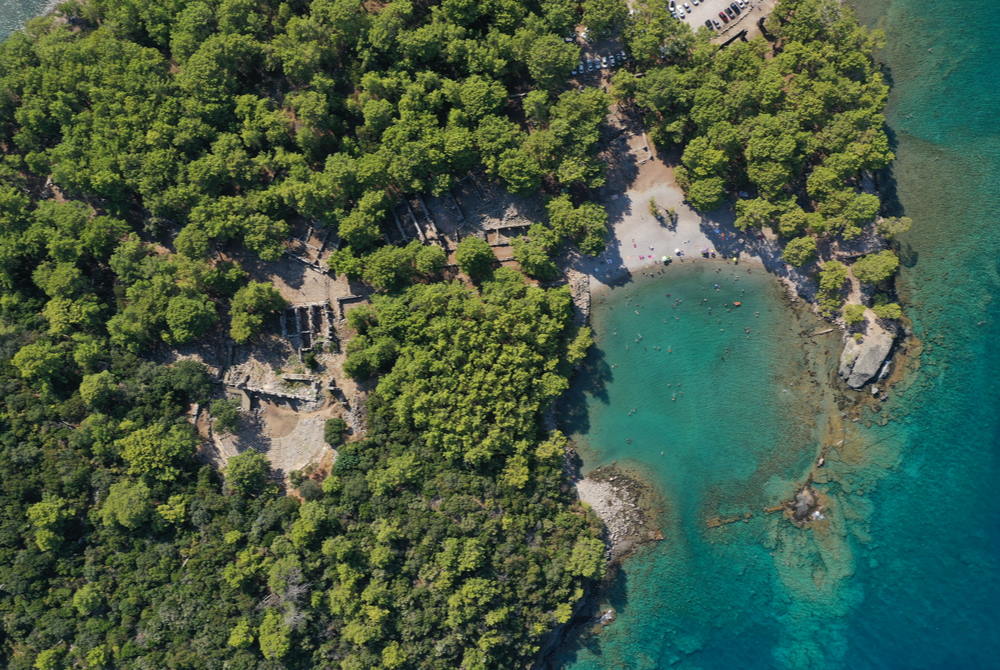
Phaselis ancient city is one of the most unusual archaeological destinations on Türkiye’s Mediterranean coast, not because its ruins stand apart from nature, but because they seem to grow directly out of it. Set near Tekirova in Antalya’s Kemer district, the ancient port lies between pine-covered slopes, the Beydağları mountains, and three sheltered bays that once made the city a maritime power.
For modern travelers, Phaselis offers something few ancient cities can: the chance to walk along a Roman street, pass aqueducts and agoras, then step into the same turquoise waters that carried merchants, soldiers, and sailors more than two thousand years ago. This is not only a visit to a ruin. It is a place where swimming can feel like moving through history.
Founded by Rhodians, shaped by the sea
Ancient sources and official museum information place the foundation of Phaselis around 691/690 BC, when settlers from Lindos on the island of Rhodes established a colony on this strategic coastal point. Its location was no accident. The city sat on major maritime routes linking the Aegean, Egypt, Phoenicia, and the wider eastern Mediterranean.
The three natural harbors were the key to its rise. In antiquity, harbors were not simply places to anchor ships. They were the gates through which a city exchanged goods, ideas, people, and power. Phaselis had an advantage that few cities could match: multiple protected anchorages on a compact peninsula, with access to both local resources and long-distance trade.
This geography helped turn Phaselis into one of the important port cities of the Lycian coast. Although it stood at the meeting point of Lycian, Pamphylian, and Greek cultural zones, its identity was strongly maritime. Coins, inscriptions, and the layout of the settlement all point to a city whose daily life was shaped by ships, cargo, merchants, and the rhythm of the sea.
Alexander the Great, Rome, and centuries of change
Phaselis passed through several political phases after its foundation. It came under Persian influence, later encountered the campaigns of Alexander the Great, and eventually entered the orbit of Hellenistic kingdoms and Roman power. According to the museum narrative, the city welcomed Alexander with a golden crown, a detail that reflects how carefully coastal cities managed power and diplomacy in a volatile age.
In 167 BC, Phaselis became a member of the Lycian League and minted coins. Later, like nearby Olympos, it suffered from pirate activity, a problem that affected many coastal settlements in the eastern Mediterranean during the late Hellenistic period. Roman control in the 1st century BC brought a new period of reconstruction and prosperity.
Many of the ruins visible today belong mainly to the Roman period. The broad main street, the theater, bath remains, agoras, water systems, and monumental gate near the South Harbor all speak to a city that was not merely surviving, but investing in public life, infrastructure, and urban display.
Walking the ancient street
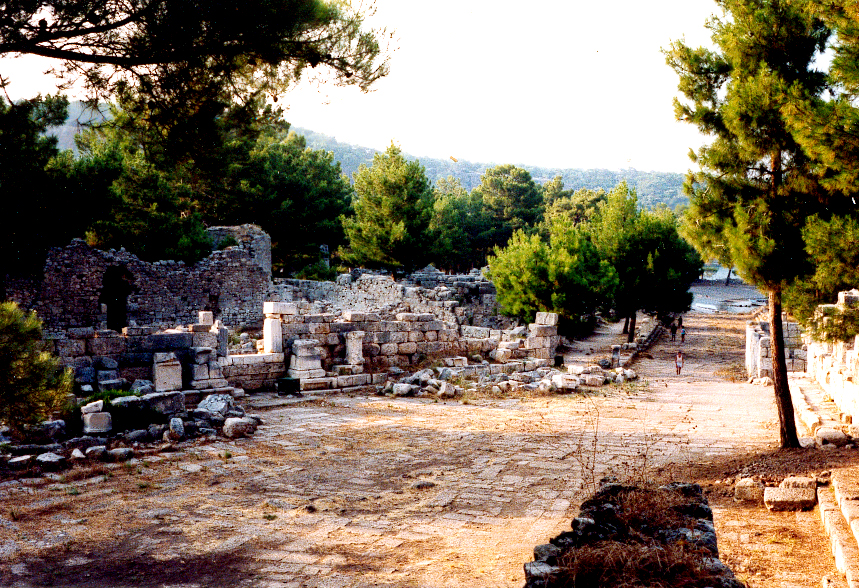
The heart of a visit to Phaselis is the main street that links the military harbor and the South Harbor. Roughly 125 meters long and about 20 meters wide, it once formed the urban spine of the city. Visitors walking along it today can still sense the logic of the ancient plan. Shops, public buildings and gathering spaces were arranged around a route that connected the city’s harbors and civic center.
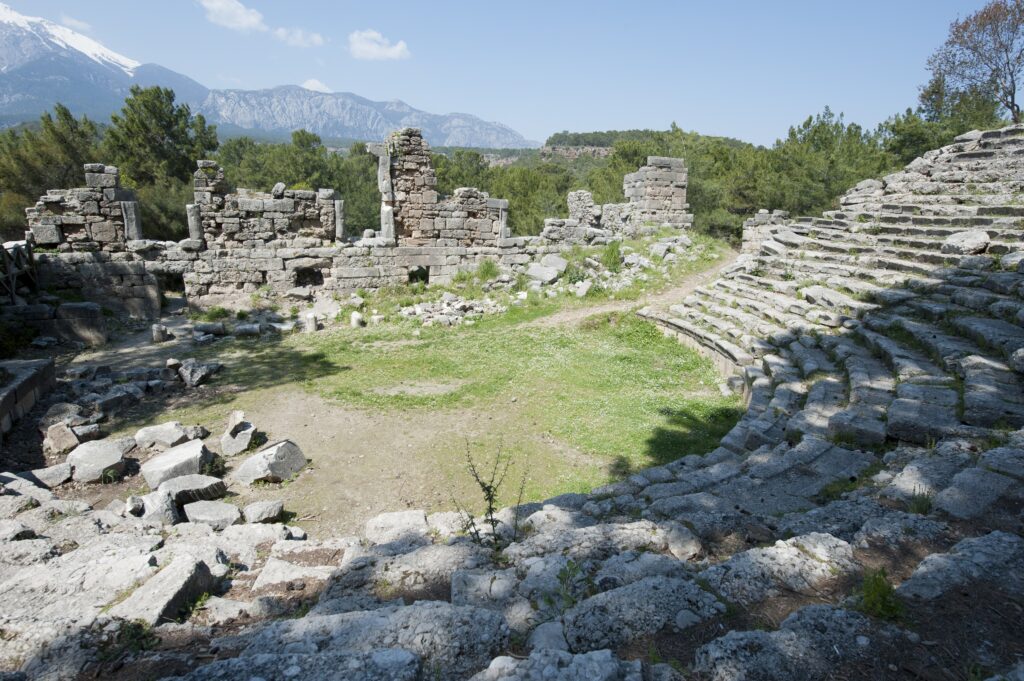
The theater rises on the slope near the acropolis, modest in scale but powerful in setting. From there, the view opens toward the sea and forest, giving travelers a clear sense of why Phaselis was both defensible and desirable. Nearby are remains of Roman baths, latrines, agoras and water channels. The aqueducts, among the best-preserved structures at the site, show how water was brought from northern sources and distributed through pipes and channels in the Roman period.
This engineering matters. Phaselis was not just a pretty coastal settlement. It was a working city with drainage, water management, harbor installations, and public architecture. Its beauty was built on practical systems.
The bays: swimming beside an ancient harbor
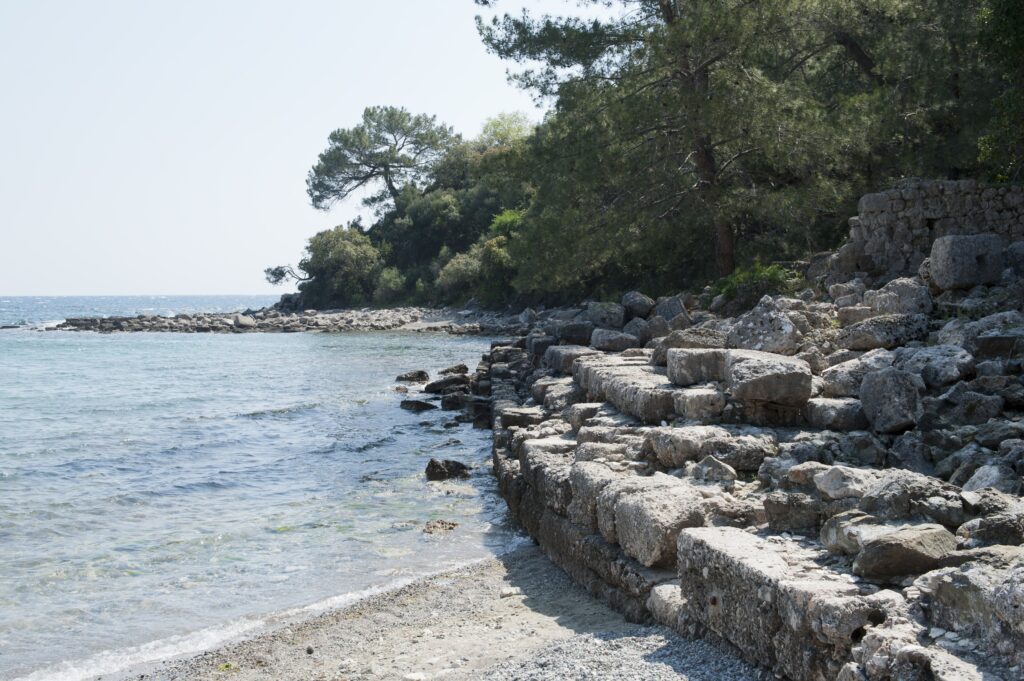
For many visitors, the most memorable part of Phaselis is the transition from stone to sea. One moment you are reading the remains of a Roman city; the next, you are standing at the edge of a calm bay with pine trees behind you and ancient harbor walls nearby.
The South Harbor is especially atmospheric. In antiquity, it was one of the city’s major maritime spaces, protected by natural topography and harbor structures. Recent studies of the harbor area have highlighted the importance of Phaselis as a rare three-harbor city in the ancient Mediterranean. Underwater finds, including amphora fragments and architectural pieces, also point to the long life of the harbor zone from classical antiquity into later periods.
This is what gives Phaselis its emotional force for travelers. You are not simply swimming at a beach near ruins. You are swimming in a landscape that once received trading vessels, imperial visitors, local fishermen and Mediterranean cargo. The water is part of the archaeological experience.
The coves also make the site unusually accessible for non-specialist visitors. Families come for the calm sea. History lovers come for the ruins. Photographers come for the meeting of stone, forest, and blue water. Few places combine these so naturally.
Why Phaselis belongs on a Mediterranean itinerary
Phaselis is often visited as a day trip from Kemer, Tekirova or Antalya, but it deserves more than a quick stop. Its value lies in the way it compresses the Mediterranean story into a walkable landscape: Greek colonization, Lycian connections, Hellenistic politics, Roman urban life, Byzantine traces, maritime trade, and modern travel.
It also offers a different kind of archaeological tourism. At many ancient cities, the visitor moves through stone and dust. At Phaselis, the route leads through shade, water, and scent. Pine resin, salt air, cicadas, and broken masonry all belong to the same experience.
For travelers seeking a site that is both historically serious and visually unforgettable, Phaselis remains one of Antalya’s strongest destinations. It is a place to read slowly, walk quietly, and swim with awareness. The ruins tell the story of a city built by the sea. The bays let visitors feel why that sea mattered.
Republic of Türkiye Ministry of Culture and Tourism
Cover Image Credit: Antalya Tourist Information
