
A major archaeological discovery in County Wicklow may rewrite what historians thought they knew about the origins of urban life in Ireland. Researchers working at the Brusselstown Ring — a vast hilltop enclosure in the Baltinglass Hillfort Cluster — have identified evidence of a massive Late Bronze Age settlement that may pre-date Viking urban foundations by nearly two millennia.
The findings, recently published in the peer-reviewed journal Antiquity, suggest that prehistoric communities in Ireland may have formed large, complex residential centres long before the arrival of Norse settlers in the 9th and 10th centuries. According to project lead Dr. Dirk Brandherm of Queen’s University Belfast, the scale and density of settlement at Brusselstown Ring marks it out as unlike anything previously documented in prehistoric Britain or Ireland.
A Settlement of Unprecedented Size
Through aerial survey and detailed mapping techniques, archaeologists identified more than 600 suspected roundhouse platforms spread across the enclosure. Approximately 100 of these structures lie within an inner rampart, while hundreds more extend into the outer enclosure between two widely spaced defensive walls. The enclosure itself spans not only one hilltop but also the adjoining Spinas Hill — an uncommon feature among European hillforts.
Based on excavation samples taken in 2024, most of the structures appear to date to around 1200 BC, placing the site firmly in the Late Bronze Age, with possible reuse extending into the Early Iron Age. The research team describes Brusselstown Ring as the largest known nucleated settlement of its time anywhere in the Atlantic Archipelago.
Until recently, archaeologists believed that Bronze Age communities in Ireland were small-scale and dispersed, typically consisting of isolated farmsteads or tiny hamlets. Earlier discoveries — such as the Corrstown Bronze Age village uncovered in 2002 — hinted that larger settlements did exist. However, the immense concentration of roundhouses at Brusselstown Ring represents a leap in settlement complexity.
“This isn’t simply a village,” Brandherm explained. “The number of domestic structures suggests an organised community on a scale that begins to resemble a proto-town.”

Rethinking the Viking Legacy
For decades, historians credited Viking settlers with founding Ireland’s first towns, including coastal hubs such as Dublin, Waterford, and Limerick. The discovery at Brusselstown Ring challenges that narrative by demonstrating that large-scale, centralised settlements may have existed far earlier than previously recognised.
If confirmed through further study, the site could represent one of Europe’s earliest examples of urban-like development outside the classical world. The research team stresses that while the term “town” must be used cautiously for prehistoric contexts, the site does exhibit characteristics of concentrated communal living, coordinated construction, and shared infrastructure.
Evidence of Advanced Engineering
Excavations also revealed a remarkable stone-lined, flat-floored structure near one of the trenches, believed to be a purpose-built cistern supplied by an upland spring. If radiocarbon dating confirms that the feature belongs to the same period as the roundhouses, it would be the first known Bronze Age water storage system of its kind in Ireland. Similar structures have previously been recorded only in regions of France and Spain.
The presence of such an engineered water source supports the idea that the community was permanent rather than seasonal. It also suggests a sophisticated understanding of resource management and settlement planning.
Clues to Social Structure
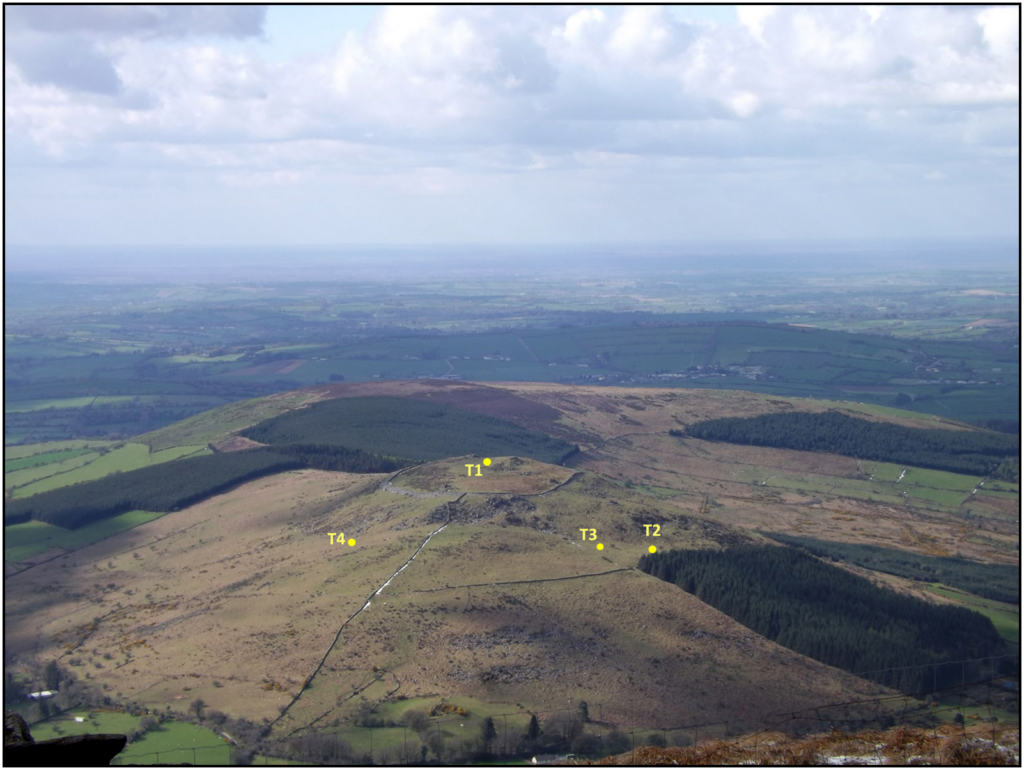
Test excavations across four house platforms revealed striking variation in dwelling size, ranging from compact four-metre structures to large buildings measuring up to twelve metres in diameter. Archaeologists are investigating whether these differences reflect social ranking, household status, or functional divisions within the community.
At present, the evidence is inconclusive. However, the range of architectural forms hints that Bronze Age society in the region may have been more socially complex than previously assumed.

A New Chapter for Irish Prehistory
Brusselstown Ring forms part of a wider network of monumental hilltop enclosures in the Wicklow Mountains, many of which show traces of occupation stretching back to the Neolithic period. Until now, the largest comparable settlement cluster in Ireland was at Mullaghfarna in County Sligo, where around 150 structures have been recorded. By contrast, the Wicklow discovery eclipses that figure by several hundred buildings.
Future research will focus on refining the chronology of the site, confirming the nature of the cistern, and analysing the construction and lifespan of the roundhouses and enclosing ramparts. Researchers hope that continued excavation will clarify how the settlement functioned and what motivated such a large community to gather in a high-altitude landscape.
As investigations continue, Brusselstown Ring is already reshaping scholarly understanding of Ireland’s prehistoric past — and raising profound new questions about when urban life on the island truly began.
Brandherm, D., Edwards, C., Boutoille, L., & O’Driscoll, J. (2025). Brusselstown Ring: a nucleated settlement agglomeration in prehistoric Ireland. Antiquity, 1–8. doi:10.15184/aqy.2025.10247
Cover Image Credit: Aerial photograph with indication of test-trench locations. Brandherm, D. et al. (2025)
