
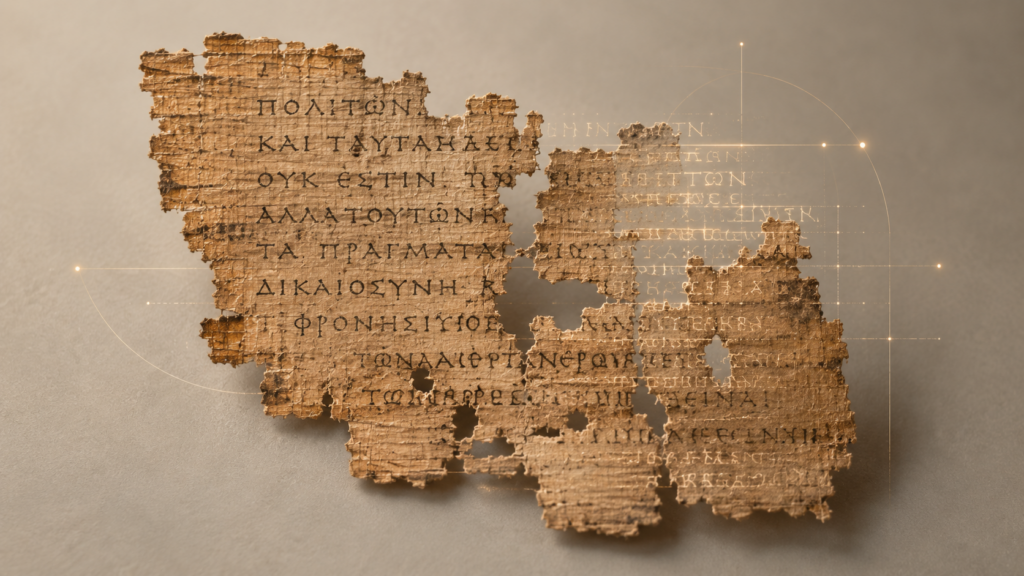
Museums and libraries around the world hold hundreds of thousands of ancient inscriptions and more than a million papyrus fragments, but scholars have fully deciphered only about 8 percent of those papyri.
Reading damaged Ancient Greek takes rare expertise and a huge amount of time, which is exactly where Apollo, a new AI model built specifically for the language, aims to help.
Apollo’s Purpose
The Austrian Academy of Sciences, AI company Mistral, SAIL Reply, and Northeastern University developed Apollo. The team describes it as the world’s first large language model built for Ancient Greek.
Its main job is filling gaps in ancient documents, where broken lines, missing words, and damaged sections are common. Apollo can suggest possible readings in seconds.
Results
Apollo was trained on about 600 million words of Ancient Greek. That is much smaller than the tens of billions of words often used to train modern language models.
Researchers tested Apollo on real papyri by hiding sections of texts that scholars had already reconstructed. Apollo included the correct reading among its top suggestions in about 80 percent of cases.
In a blind evaluation, 20 experts in papyrology, epigraphy, and philology compared Apollo’s suggestions with published scholarly readings. For documentary papyri, the researchers estimated that Apollo’s reading was at least as good as the published version in about 77 percent of cases.
When Apollo and the published reading disagreed, experts preferred Apollo in 16 percent of documentary-papyrus cases and about 20 percent of inscription cases.
First applications
Apollo has already been tested on several real ancient texts. In public demonstrations, it completed an ancient birth certificate, recovered important passages from a papyrus scroll damaged by the eruption of Vesuvius, and helped researchers trace evidence of Roman law in a city on the Black Sea, partly through a reference to a Roman tax linked to prostitution.
The model can also recognize different periods and writing styles. Dolganov says Apollo can identify when a passage matches the structure and vocabulary of works such as Homer’s Odyssey, then suggest missing text in a similar style.
What to expect
Apollo could speed up the study of ancient texts by giving researchers possible readings for damaged passages in seconds.
That could open thousands of unread papyri to closer study and reveal new details about ancient life, law, literature, and history.
Source
McGovern, H., Dolganov, A., Belkadi, S., Kunsch, G., Vlitas, D., & Smith, D. A. “Apollo Restore: A Foundation LLM for Historical Greek Optimized for Fill-in-the-Middle Restoration of Ancient Greek Texts.” arXiv (2026). doi.org/10.48550/arXiv.2609.22455
Announcement: Austrian Academy of Sciences (ÖAW), September 23, 2026.
