
8 November 2025 The Future is the Product of the Past

Medieval Secrets Revealed: Archaeologists Discover Reading Stone Beneath World-Famous University

Archaeologists at Oxford uncover a perfectly preserved medieval reading stone alongside ancient halls, manuscripts, and artifacts that shed new light on centuries of scholarship.

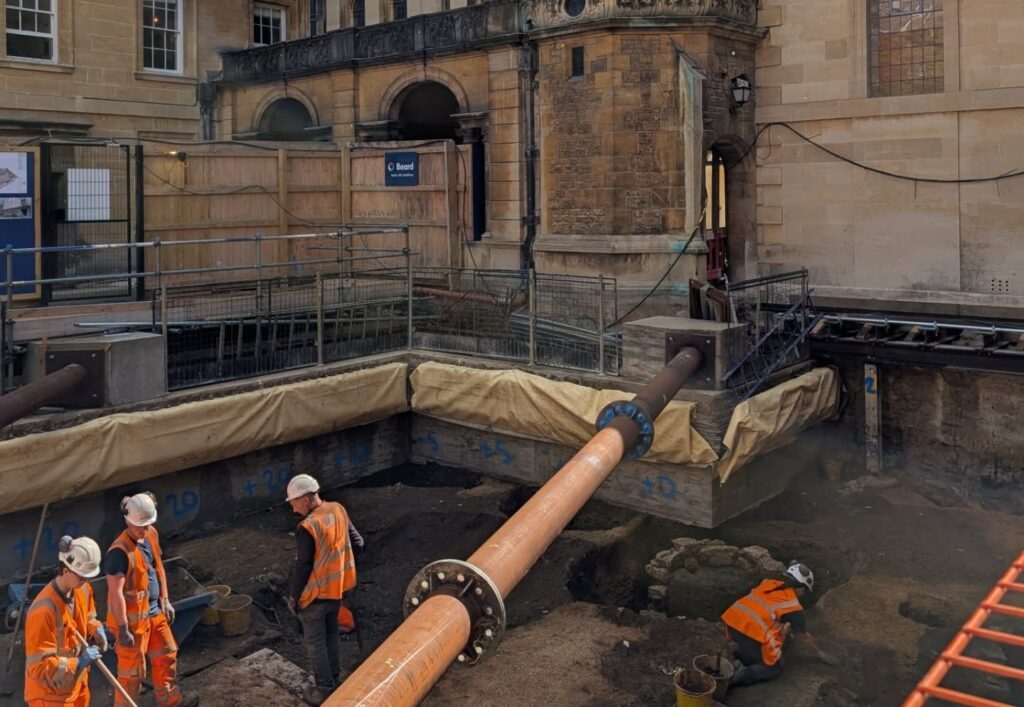
Archaeologists at Oxford University have unearthed a rare and perfectly preserved medieval reading stone, offering a striking glimpse into the intellectual life of scholars who studied at the institution more than seven centuries ago. The discovery was made during an extensive archaeological excavation beneath Hertford College, one of Oxford’s constituent colleges, where construction for a new library is currently underway.

The excavation, led by Oxford Archaeology since 2024, revealed remnants of three early academic halls — Hart Hall, Black Hall, and Catte Hall — dating back to the 13th century. Among the collection of medieval artifacts recovered from the site, including book clasps, styli, animal bones, and trade tokens, the most remarkable find was the reading stone, an object once essential for the careful study of illuminated manuscripts.
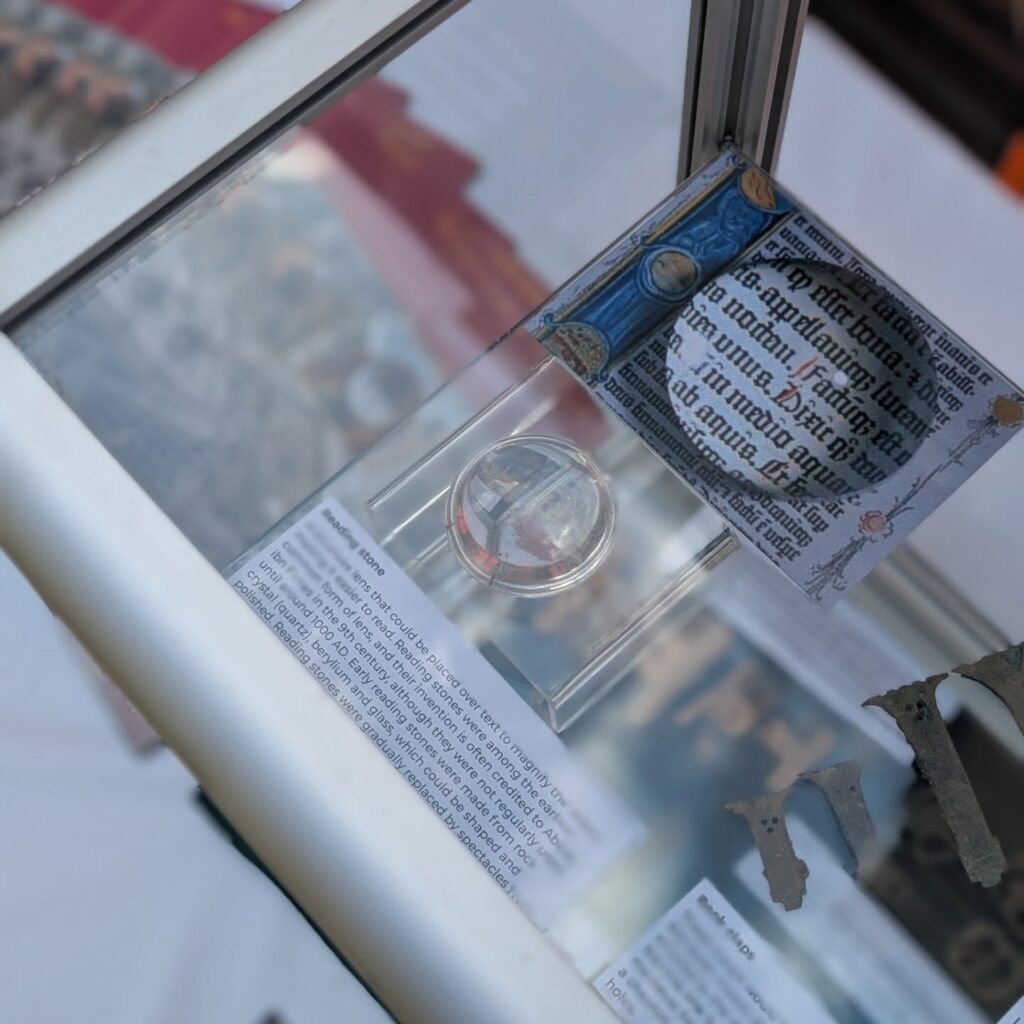
Made of rock crystal or glass, the medieval reading stone discovered at Oxford’s Hertford College was once used to magnify words in handwritten manuscripts. Credit: Hertford College via Facebook

A Window Into Medieval Study

The reading stone, likely made from rock crystal or glass, functioned as an early magnifying lens. Medieval scholars would place it directly over handwritten texts to enlarge the script and ease the strain of long hours spent reading by candlelight. According to Ben Ford, Senior Project Manager at Oxford Archaeology, the stone is “an exceptional find — not only because it is so intact, but because, unlike many archaeological artifacts, it can still be used for the purpose for which it was made.”

Ford added that the discovery is “particularly fitting” given that it emerged during the creation of a new library — a modern space rising above centuries-old evidence of book-making and scholarly pursuits. “The continuity between the medieval and modern traditions of study at Oxford is truly remarkable,” he said.


📣 Our WhatsApp channel is now LIVE! Stay up-to-date with the latest news and updates, just click here to follow us on WhatsApp and never miss a thing!!


Unearthing Oxford’s Hidden Academic Past

Excavations beneath Hertford College have exposed not only architectural remnants of Oxford’s early halls but also the material culture of student life spanning from the Norman Conquest (1066) through the 19th century. Archaeologists identified refuse pits filled with animal bones, oyster shells, and fish remains imported from London’s River Thames, some 50 miles away — suggesting a surprising degree of trade and connection between Oxford and the capital.

Other finds included medieval coins, trade tokens, combs, buckles, and even wooden bowling balls, hinting at recreational activities enjoyed by scholars of the era. Yet none captured public imagination quite like the reading stone, which remains fully functional despite centuries underground.


Excavations beneath Hertford College have exposed not only architectural remnants of Oxford’s early halls but also the material culture of student life spanning from the Norman Conquest (1066) through the 19th century. Credit: Hertford College via Facebook

Bridging Past and Present Scholarship

Historians note that reading stones represent a pivotal moment in the evolution of reading technologies, predating the invention of spectacles by several centuries. Their use was common among monks, scribes, and university scholars who painstakingly copied and studied religious and philosophical texts. The Oxford specimen, preserved in extraordinary condition, provides rare physical evidence of academic life in a period when education was reserved for a privileged few.

“The reading stone connects us directly to the minds and hands of medieval scholars,” said Dr. Eleanor Markham, a historian of medieval education not involved with the excavation. “It embodies the transition from oral learning to textual scholarship — a fundamental shift that shaped modern academia.”

Oxford’s Continuing Legacy of Discovery

The Hertford College excavation is one of several high-profile archaeological projects in the United Kingdom this year. As the new library rises above the ancient halls, university officials plan to display selected artifacts — including the reading stone — in a forthcoming public exhibition celebrating Oxford’s academic heritage.

From its medieval origins to its present role as a global research powerhouse, Oxford University continues to bridge past and present. And now, thanks to the light refracted through a crystal lens once held by a 13th-century scholar, the story of learning itself has come sharply back into focus.

Hertford College

Cover Image Credit: Hertford College via Facebook

Related Articles

Unique Iron Age Divination Spoon Found on the Isle of Man

21 February 2025

21 February 2025

A unique bronze spoon, dating back 2,000 years and believed to have played a role in divination rituals, has been...

Oil drilling uncovers a 2,000-year-old cemetery with giant Urn-like tombs in Southwest Iran

16 July 2022

16 July 2022

An ancient cemetery with urn-like tombs was discovered in Ahvaz, the capital city of Khuzestan province in southwestern Iran. The...

2,000-Year-Old Roman Stele Decorated with an Eagle and Greek Inscriptions Found in Manbij, Syria

23 August 2025

23 August 2025

A striking Roman-era stele carved from black basalt, featuring a detailed eagle clutching a wreath and adorned with Greek inscriptions,...

Archaeologists Unearth Rare Artifacts from the First Turkic Khaganate in the Altai Mountains

15 September 2025

15 September 2025

Archaeologists from Altai State University and their international colleagues have made a groundbreaking discovery in Russia’s Altai Republic, unearthing artifacts...

Archaeologists Uncover Previously Unknown Large-Scale Prehistoric Hunting Architecture in Europe

16 October 2025

16 October 2025

In a stunning discovery that reshapes our understanding of prehistoric Europe, archaeologists have uncovered monumental stone hunting megastructures hidden in...

A Polish-Croatian team discovered Ancient Roman Temple under a Croatian 18th Century church

24 November 2022

24 November 2022

Under an 18th-century church, the Church of St. Daniel in Danilo near Sibenik, Croatia, the foundations of an ancient Roman...

Outrage in Türkiye: 3,000-Year-Old Unesco Tomb in Phrygian Valley Turned Into Café

1 July 2025

1 July 2025

A 3,000-year-old rock-cut tomb located in the historical Phrygian Valley—hailed as Türkiye’s “second Cappadocia” and listed on the UNESCO World...

2-Meter-Long Stone Block Found at 12,000-Year-Old Boncuklu Tarla Site in Southeastern Türkiye

18 December 2024

18 December 2024

A remarkable 2-meter by 20-centimeter processed stone block was discovered during the archaeological excavations at Boncuklu Tarla (Beaded Field), which...

Largest ever Roman silver hoard in Germany found in Augsburg

12 November 2021

12 November 2021

Archaeologists in Augsburg, Germany, revealed unearthed a historical hoard including 15 kg of silver coins from the Roman Empire’s era....

Iron Age stone altar and gold-plated ceremonial sword discovered in Kazakhstan

14 August 2021

14 August 2021

A stone altar and a gold-plated ceremonial sword used in the early Iron Age were discovered during excavations along the...

Aldi construction uncovered Roman mosaic in UK

18 March 2023

18 March 2023

A team of Oxford Archaeology archaeologists discovered a Roman mosaic in the market town of Olney, Buckinghamshire, England. Ahead of...

A Baptismal Surprise: Triton Baths in Southeastern Rome Converted into Early Christian Church

7 May 2025

7 May 2025

Recent archaeological excavations within the monumental complex of the Villa di Sette Bassi, situated in the southeastern outskirts of Rome,...

Excavations show the Temple of Poseidon at Samikon is more Monumental than Previously Assumed -New Discoveries

3 November 2024

3 November 2024

New excavations by archaeologists from the Austrian Academy of Sciences and the Greek Ministry of Culture in Kleidi-Samikon in the...

3,000-Year-Old Iron Age Statuette Discovered in Italian Lake, With Fingerprints of Maker

17 August 2024

17 August 2024

During work in Lake Bolsena, a volcanic lake in central Italy, at the submerged archaeological site of Gran Carro, a ...

Imperial cult temple discovered in Spello: It opens a new chapter in the Roman Empire’s transition from paganism to Christianity

6 January 2024

6 January 2024

American researchers have announced the discovery of an Imperial cult temple in Spello, Italy. The discovery was announced by Douglas...

Comments
Leave a Reply

Your email address will not be published. Required fields are marked *