
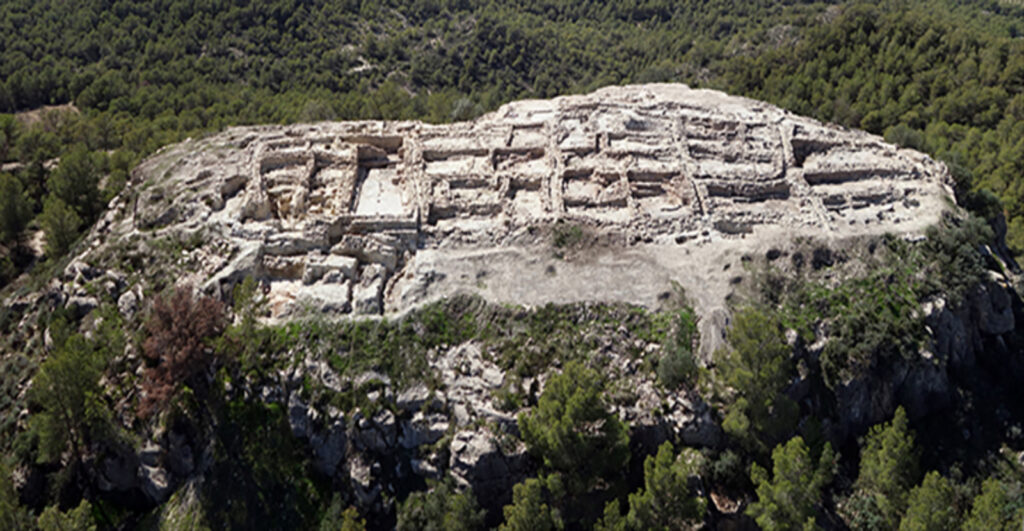
Archaeologists investigating a Bronze Age settlement in southeastern Spain have revealed a monumental defensive system with at least six towers. The discovery raises questions about why the inhabitants of La Almoloya, a major center of the El Argar culture, built such massive fortifications around a settlement already protected by steep natural cliffs.
Around 4,000 years ago, the people living in La Almoloya, in southeastern Spain, inhabited a location that was already difficult for enemies to access. Their settlement was perched on a hill surrounded by steep cliffs, accessible only from certain directions. Yet its inhabitants built an enormous wall, up to seven meters thick, reinforced with closely spaced towers, at the main entrance.
Recent archaeological research has revealed new details of this defensive system, which stretches about 40 meters and includes at least six towers. Its imposing scale and elaborate construction offer fresh insight into the military capabilities, organization of labor, and concentration of political power within El Argar society during the Bronze Age.
A Settlement Protected by Cliffs, Encircled by a Six-Towered Wall
La Almoloya is located near Pliego in the Murcia region, on a flat-topped hill about 585 meters above sea level. Its position offered a strategic vantage point, allowing inhabitants to survey the surrounding landscape and control access routes to the settlement.
Excavations led by the ASOME research group at the Universitat Autònoma de Barcelona have revealed new details about the settlement’s defensive architecture. Researchers identified a fortification system five to seven meters wide, at least six towers, supporting walls, and narrow passageways. The close spacing of the towers—about one meter apart—is particularly notable.
This dense arrangement may have been designed to restrict movement toward the settlement and help defenders monitor and control access. However, archaeologists have not yet determined the original height of the walls or how the entire defensive system functioned.
A Major Discovery from a Small Excavation Site
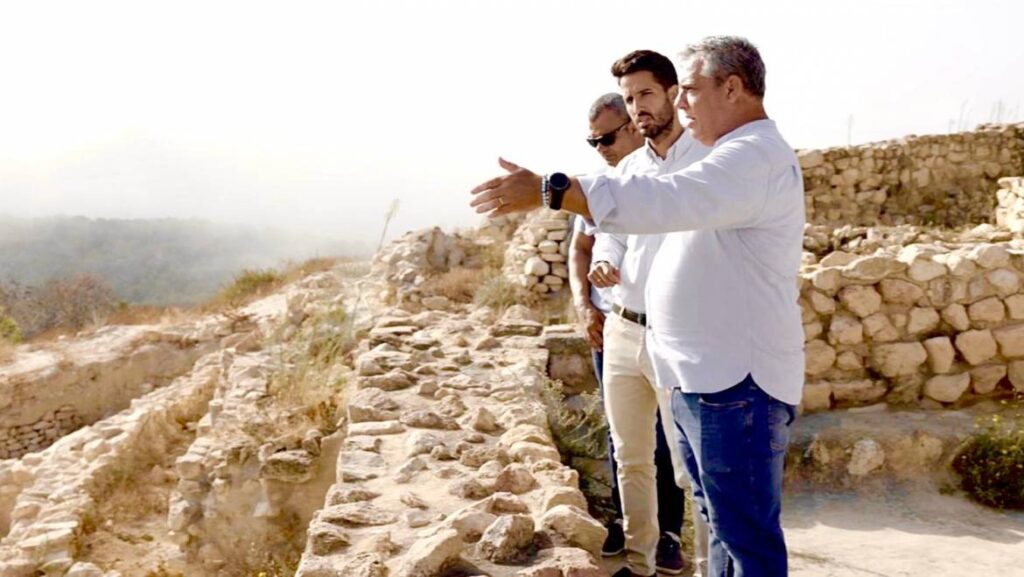
The wall research began in May 2025. According to an official statement from the Pliego Town Council dated September 16, 2025, archaeologists initially aimed to study the preservation of archaeological layers associated with an ancient road and staircase.
The excavation, conducted in an area of just 11 square meters, yielded unexpected results. Researchers uncovered two sections of defensive walls made of stone masonry, one of which was adjacent to two large structures. The builders had used a tight clay mortar to bind the stone fill.
One of the adjacent structures had a slightly trapezoidal rectangular plan. The other showed signs of possible reinforcement at its northern end. These initial findings point to the existence of a previously unknown, complex defensive system within the settlement.
New details shared by excavation directors Vicente Lull and Rafael Micó in an October 28, 2026 interview with El País suggest that the defensive line is more extensive than previously thought. The researchers also note signs of violent destruction, though the cause and responsible parties remain unknown.
A Powerful Political Center of the El Argar Society
The significance of La Almoloya extends beyond its walls. The settlement was one of the key centers of the El Argar culture, which flourished in southeastern Iberia between approximately 2200 and 1550 BCE.
Since 2013, research by UAB has uncovered residential complexes covering about 300 square meters, groups of buildings with eight to twelve rooms, narrow streets, and drainage systems. This layout indicates that the community planned its urban development systematically.
One of the most remarkable structures is a large hall or reception room covering about 70 square meters. In 2014, archaeologists discovered an exceptionally rich burial here containing gold, silver, copper, and amber artifacts.
These findings suggest that La Almoloya was not just a residential area but a major center for political and administrative activities. The elite burials and large meeting hall play a key role in research on hierarchy and governance within El Argar society.
Do the Massive Walls Tell a Story Beyond Defense?
The walls of La Almoloya open a new field of research into the threats faced by El Argar society. Adding such large defensive structures to a naturally protected settlement required significant labor and material organization.
One possibility is that the rulers sought tighter control over the settlement’s limited access points. Another interpretation is that the walls were not only for protection against attacks but also served to visibly display the power of the elite. However, these hypotheses must be tested against further archaeological evidence.
The signs of violent destruction also raise unanswered questions. Was the wall destroyed in a conflict, or did it suffer damage through another process? The answers remain uncertain.
