

The untold stories, forbidden passions, and enduring devotion behind history’s most legendary romances.
Before love was packaged, monetized, and scheduled into a single day on a calendar, it was something far more dangerous. Love once meant exposure—of the heart, of power, of legacy. To love deeply was to risk being remembered not for victory, but for vulnerability.
Across the last two thousand years, some lovers dared to feel without restraint. They loved with the recklessness of those who did not expect history to watch. And yet, history did watch. It watched as empires bent, faiths trembled, cities rose, and words outlived bodies.
These are not neat stories. They do not promise happiness. What they offer instead is intensity—the kind that leaves marks on stone, ink, and memory. Here are some of the most romantic gestures of the last two millennia—proof that love has always inspired humanity’s greatest creations.
Here are five loves that refused to remain private.
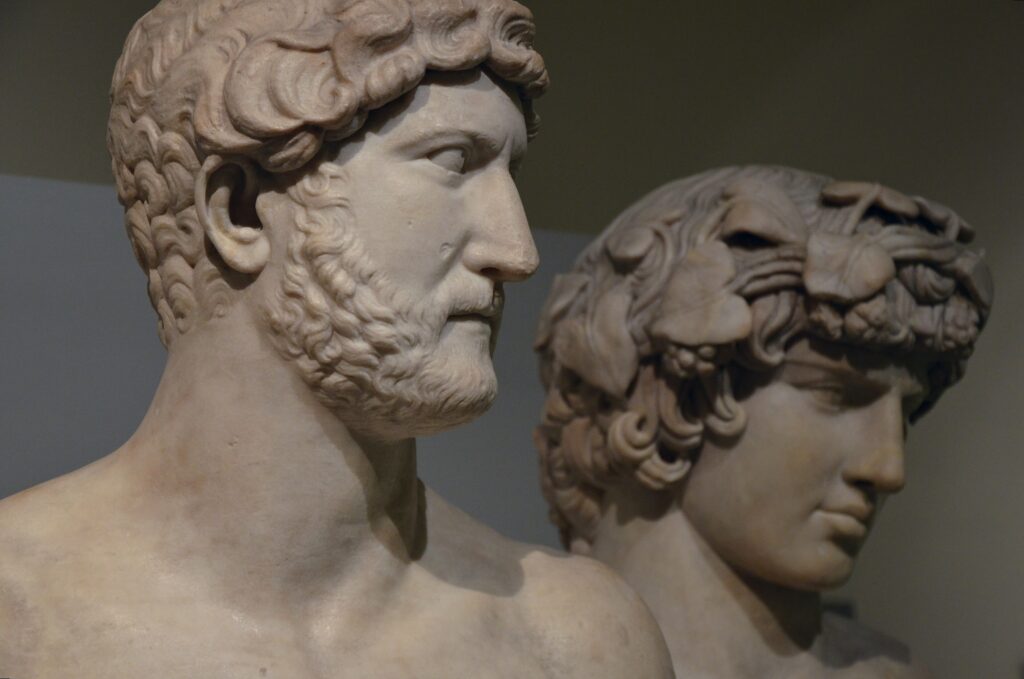
Hadrian and Antinous: Love That Refused to Die (2nd Century AD)
When the Roman Emperor Hadrian fell in love with Antinous, it was not a political alliance, nor a youthful indulgence easily discarded. It was devotion—quiet at first, then consuming.
Antinous accompanied Hadrian across the vastness of the Roman world, a constant presence beside a man accustomed to command. But in AD 130, along the Nile, Antinous died under circumstances history never fully explained.
What followed was unprecedented. Hadrian did not allow grief to remain private. He transformed it into public memory. Antinous was declared divine—an extraordinary honor for someone of his origin. Statues multiplied across the empire, always depicting him youthful, serene, untouched by death. A city was founded in his name, its streets laid out as if to insist that Antinous still walked the earth.
Through architecture, religion, and art, Hadrian resisted the finality of loss. His love did not seek consolation; it sought permanence. In an empire obsessed with legacy, Hadrian ensured that the one face he loved would never fade. This was not romance softened by time—it was grief elevated to eternity.
Xuanzong and Yang Guifei: When Love Outshone the Throne (8th Century)
At the height of the Tang Dynasty’s brilliance, Emperor Xuanzong of Tang encountered Yang Guifei, and the balance of his world quietly shifted. She was celebrated for her beauty, but what bound the emperor to her was intimacy—laughter, shared moments, the rare feeling of being seen beyond the crown.
Xuanzong reshaped court life around her presence, commissioning palaces, gardens, and musical performances meant solely for her pleasure. The empire flourished outwardly, yet inwardly, the weight of governance began to slip. When rebellion threatened stability, officials searched for a symbol to sacrifice. Yang Guifei became that symbol. Forced to die in exile, her death marked the moment love was declared incompatible with order.
Xuanzong survived her, but survival was not victory. Legends say he wandered his later years haunted, listening for her voice in music, searching for her reflection in moonlit skies.
Chinese poets immortalized their bond as a warning and a lament: love powerful enough to soften an emperor could also unravel an age. Their story endures as proof that devotion can rival duty—and sometimes, tragically, lose.
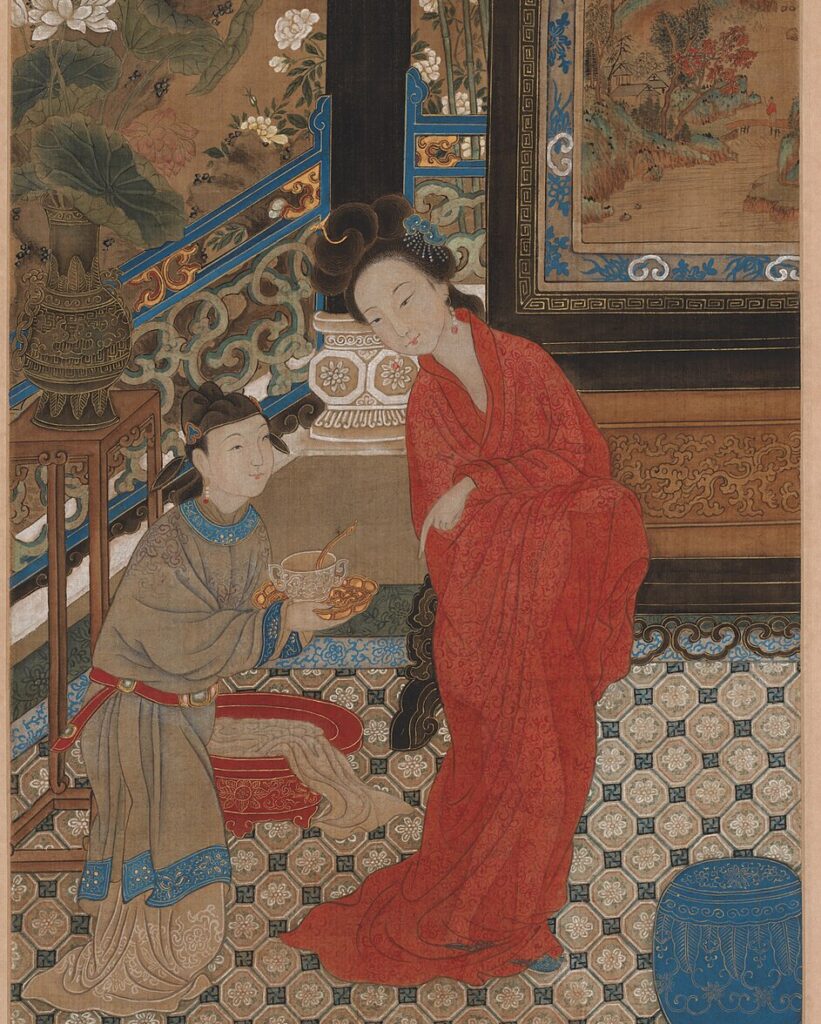
This painting alludes to the love story between Tang emperor Xuanzong (reigned 712–56) and his consort Yang Guifei. Yang’s nude body can be seen through the transparent silk-gauze robe as she leaves the bath. Cleveland Museum of Art. Credit: Gu Jianlong –Public Domain
Abelard and Héloïse: Love That Lived in Language (12th Century)
The love between Peter Abelard and Héloïse was born not of chance, but of intellect. Teacher and student, they met in a world where ideas were dangerous and women’s brilliance even more so.
Their connection deepened through conversation, argument, and admiration, until it crossed the boundaries their society fiercely guarded. Punishment was swift and brutal. Separated and forced into religious lives, they were denied a shared future. Yet love, stripped of touch and presence, transformed rather than vanished. Through letters, they revealed a bond stripped of illusion—Héloïse confessing that she loved Abelard not for safety or legitimacy, but for who he was, and Abelard wrestling with guilt, faith, and desire.
Their correspondence does not promise redemption. It exposes contradiction. It is love examined under the harshest light and still found alive. In a medieval world obsessed with obedience, their letters remain radical: a record of two minds refusing to pretend their hearts had been erased.
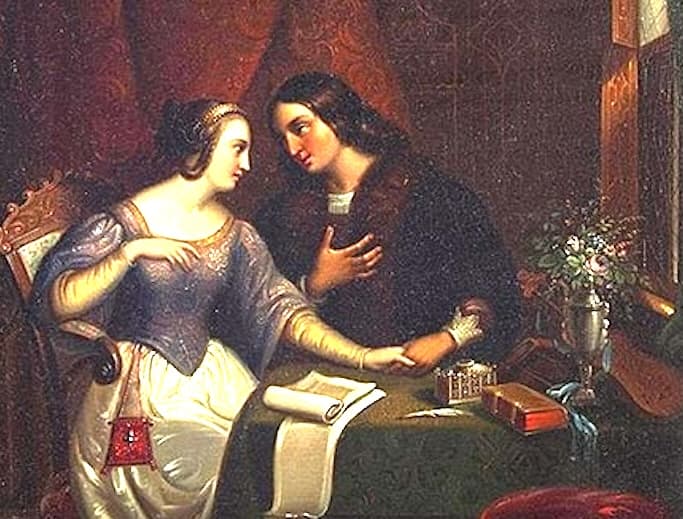
Jean-Baptiste Goyet, Héloïse et Abailard, oil on copper, c. 1829. Credit: Stevensaylor –Public Domain
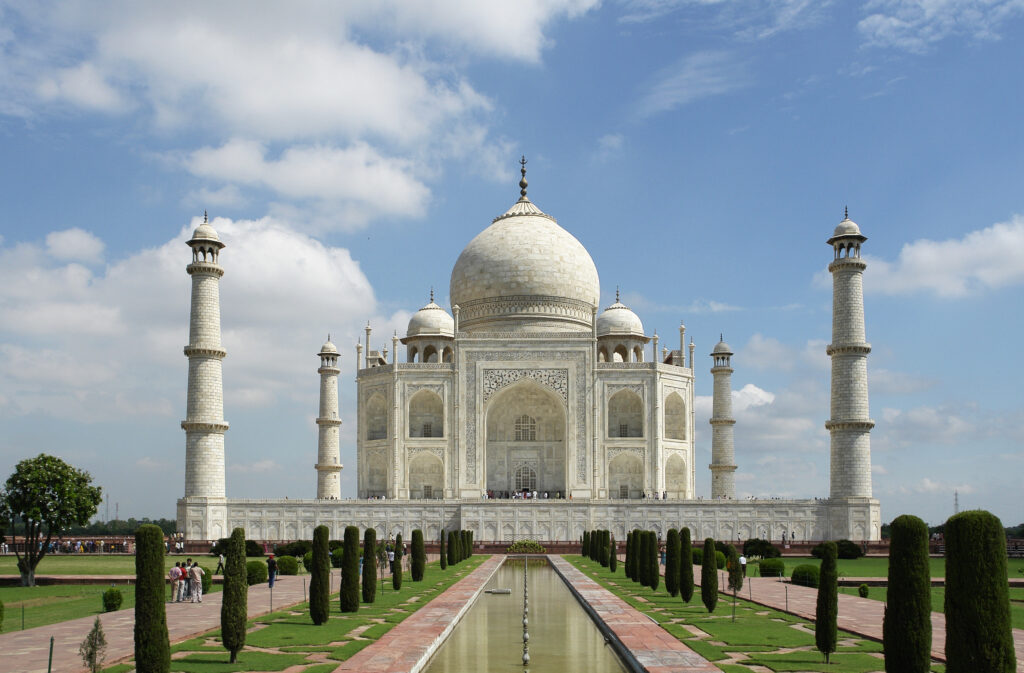
The Taj Mahal: Love Made Visible (17th Century)
When Şah Cihan lost Mümtaz Mahal, grief hollowed the center of power. She had been more than a wife—she was his advisor, his emotional anchor, his constant across campaigns and courts.
In mourning, Shah Jahan imagined a form worthy of his devotion, something untouched by decay. The Taj Mahal emerged from that vision: white marble that shifts with the light, symmetry so precise it feels devotional, stones set as carefully as prayers. This was not architecture meant to dominate a skyline, but to cradle memory.
Built over decades, at immense cost, it transformed sorrow into beauty. Unlike other monuments of power, it speaks softly. It does not declare conquest—it whispers love.
Centuries later, visitors stand before it not because they knew Mümtaz Mahal, but because they recognize the impulse behind it: the human desire to refuse forgetting. In the Taj Mahal, love was not spoken—it was built.
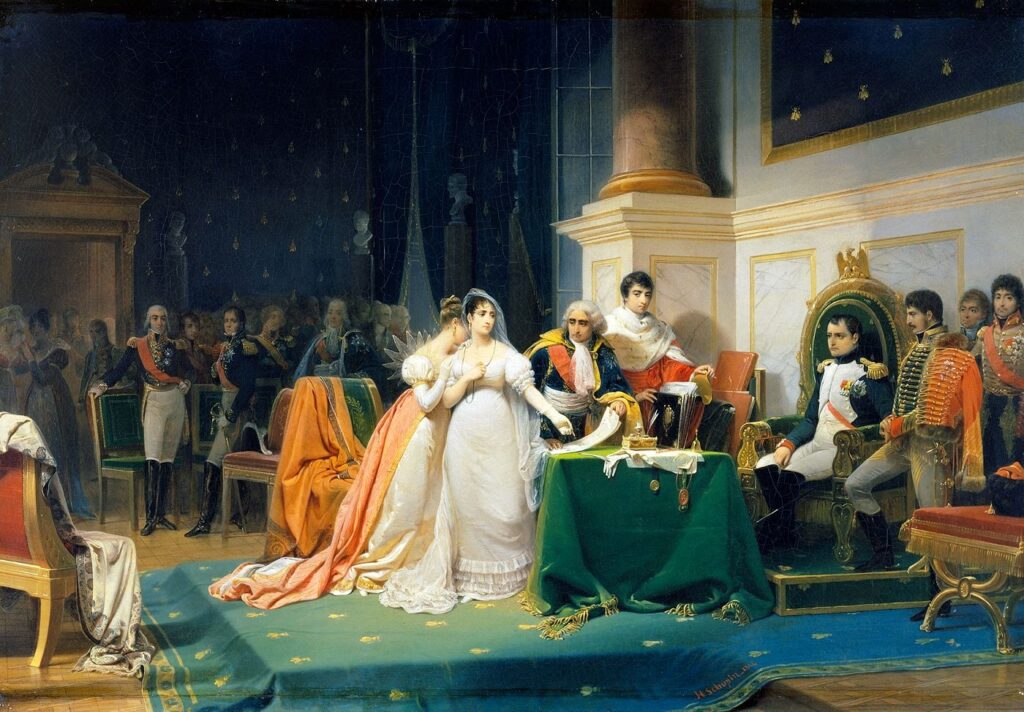
Napoleon and Joséphine: Love That Undid the Conqueror (18th–19th Century)
History frames Napoleon Bonaparte as relentless, calculating, unstoppable. His letters to Joséphine de Beauharnais tell another story entirely. In them, power dissolves.
Napoleon writes with urgency, vulnerability, and longing, confessing dependence he would never allow on the battlefield. He loved Joséphine obsessively, fearing her absence more than defeat. Yet this love was uneven. Joséphine’s affections were real, but not absolute. Their relationship oscillated between passion and distance, reassurance and doubt.
Even as Napoleon rose to dominate Europe, he remained emotionally exposed to one person who could wound him without effort. Ultimately, ambition demanded sacrifice, and their marriage ended—not for lack of love, but for lack of heirs.
The letters remain, stripped of titles and outcomes, revealing a man who conquered continents yet could not command the heart he wanted most. Their story endures because it is human: love not idealized, but painfully sincere.
Love, Then and Now
Across two thousand years, lovers have built cities, written poetry, raised monuments, and defied empires—all for the same reason we still celebrate Valentine’s Day today.
Because love has always asked us to leave proof that we were here—and that we cared.
Cover Image Credit: This panoramic digital artwork was created by AI under the guidance of the author, depicting five of history’s most iconic lovers with the Taj Mahal at its heart. It is an original illustration, designed to evoke the timeless emotion and devotion of these legendary romances.
