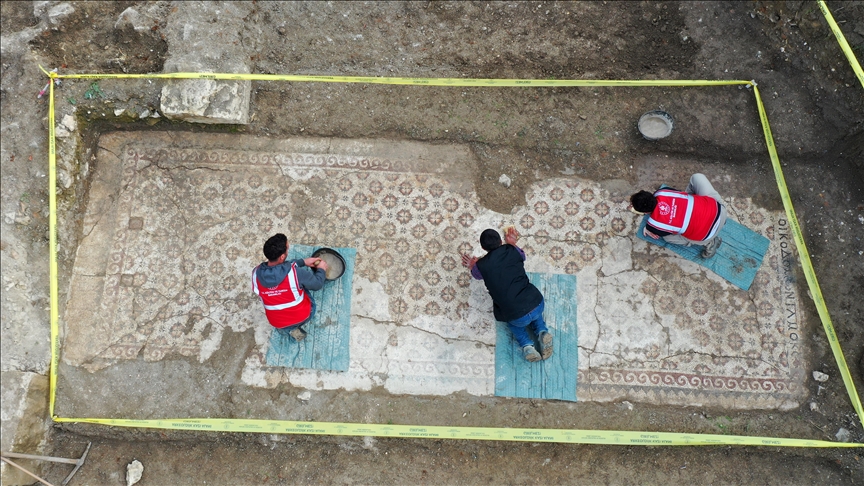
A rescue excavation in Türkiye’s southern province of Hatay has revealed a stunning Late Antique floor mosaic decorated with floral and geometric motifs and bearing a rare Greek inscription — an archaeological treasure uncovered during the rebuilding efforts that followed the devastating February 2023 earthquakes.
The mosaic was discovered in the Maşuklu neighborhood of Antakya after workers began foundation excavations on the site of a three-story building that collapsed during the twin earthquakes centered in Kahramanmaraş. When construction crews noticed patterned stonework beneath the soil, they immediately halted the project and notified authorities, triggering a scientific excavation led by the Hatay Archaeology Museum.
Since March, a team of archaeologists and technicians has been carefully exposing the remains. Their work revealed three separate mosaic areas, including a remarkably well-preserved 17.5-meter-long floor panel dated to the 5th–6th centuries AD, the Late Antique period. The newly exposed mosaic features interlocking geometric designs enriched with floral ornaments and a Greek inscription, elements that researchers say point to an elite residence or high-status civic structure.
According to archaeologist Ozan Demir, who is supervising the excavation, the mosaic stands out both for its craftsmanship and for the evidence of historical repairs visible across its surface.
“This mosaic is preserved as a single continuous panel, and we can clearly see traces of period restoration,” Demir explained. “It is not the kind of decoration one would find in an ordinary home. The artistic quality and inscription strongly suggest it belonged to a person of considerable social status.”
📣 Our WhatsApp channel is now LIVE! Stay up-to-date with the latest news and updates, just click here to follow us on WhatsApp and never miss a thing!!
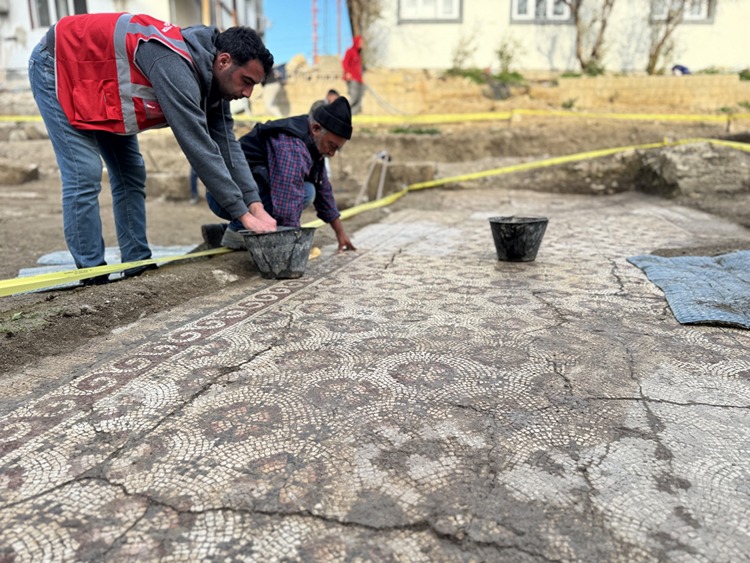
Demir added that conservation efforts are ongoing and that the mosaic is scheduled to be transferred to the Hatay Archaeology Museum in 2026, where it will be preserved and prepared for public display. Work will also continue in the surrounding area to uncover additional architectural remains and document further archaeological layers before new construction resumes.
Archaeologist Mert Nalbantoğlu emphasized the importance of the discovery not only for regional history but also for the broader study of Late Antique culture in the Eastern Mediterranean.
“The fact that the mosaic has survived in such a high state of preservation, together with its inscription, makes it exceptionally valuable,” Nalbantoğlu said. “Finds like this help us better understand the artistic traditions, daily life, and social hierarchy of the period.”
The discovery highlights a striking paradox of the post-earthquake reconstruction process in Hatay: while the disaster destroyed countless buildings and historical structures, it also exposed buried cultural heritage that had remained hidden for centuries beneath modern urban layers. Archaeologists describe the site as a powerful reminder of Antakya’s deep and continuous past, stretching from antiquity to the present.
As protective measures and documentation continue, officials stress that the mosaic will play a vital role in preserving the city’s memory and identity — transforming a space once marked by destruction into one of cultural renewal and historical insight.
Cover Image Credit: AA