
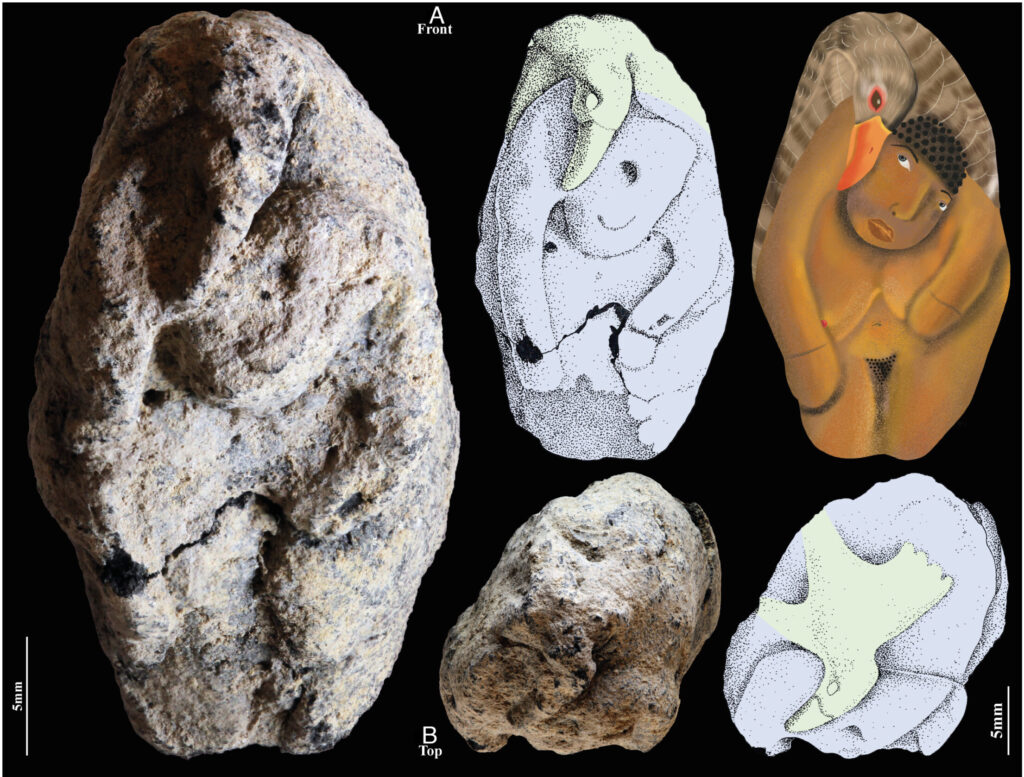
Long before Greek poets imagined Zeus seducing Leda in the guise of a swan, prehistoric communities in Southwest Asia were already crafting visions of human–bird entanglements. A newly analyzed 12,000-year-old fired-clay figurine from northern Israel reveals one of the earliest symbolic scenes ever modeled in clay — a goose attempting to mate with a woman — and offers an unprecedented window into the minds of Natufian hunter-gatherers on the cusp of the Neolithic world.
The discovery, reported this week in PNAS, is more than a curiosity. It represents the oldest known depiction of a woman in Southwest Asia and the earliest figurine anywhere in the world to show a human–animal interaction. For archaeologists, that combination is dynamite: it signals a moment when imagination, mythology and animistic belief began to crystallize into physical form.
The object was identified by Laurent Davin of the Hebrew University of Jerusalem while combing through tens of thousands of clay fragments collected from Natufian sites. In an email to Live Science, Davin described the shock of recognition: “When I took this small block of clay out of its box, I immediately recognized the human figure and then the bird lying on its back.”
A rare window into Natufian imagination
The Natufians, who lived between 15,000 and 11,500 years ago across the Levant, occupy a turning point in prehistory. They were still foragers, but they built stone houses, buried their dead in established cemeteries, and produced a symbolic repertoire far richer than many mobile Paleolithic groups before them. Yet depictions of full human bodies are exceptionally scarce, and scenes showing interactions between people and animals are almost nonexistent.
This makes the Nahal Ein Gev II figurine — recovered from the fill of a special-purpose structure built along a terrace above the Ein Gev stream — an outlier of enormous significance.
Though only 37 millimeters tall, the figurine was created with unexpected precision. A fingerprint preserved in the clay (likely belonging to a young adult or adult woman) suggests it was shaped with care and intention. After drying, it was heated to roughly 400°C — low by ceramic standards, but controlled enough to avoid cracking. Traces of red hematite pigment still cling to the woman’s shoulder and the goose’s beak, evidence that the object was once vividly colored.

The scene: not hunting, but myth
The goose is modeled in a posture that would puzzle a modern observer — but would be immediately recognizable to anyone who had seen geese breed. The bird crouches low on the woman’s bent back, wings partially wrapped around her, neck extended forward to grasp the back of her head. This is textbook mating behavior of male greylag geese.
That matters. It means the figurine is not a depiction of a hunt, a trophy, or a hybrid creature. It is a narrative — a deliberate evocation of an imagined encounter between species. And it reflects a worldview in which nonhuman beings were understood as possessing agency, intention, and a role within the spiritual order.
In other words: animism, not anatomy, shaped the artist’s choices.
Such beliefs are well documented in shamanistic and hunter-gatherer cosmologies around the world. But the NEG II figurine pushes their material expression in Southwest Asia far earlier than expected, predating the symbolic explosion seen in Neolithic ritual centers like Göbekli Tepe.
A woman represented with unprecedented detail
The human figure is equally revealing. Her bent posture, the modeled pubic triangle, inserted breast decorations, and carefully shaped facial features mark her as the earliest naturalistic female representation known from the Levant. Until now, Natufian depictions of women were highly stylized or fragmentary.
The figurine’s sophistication also hints at a broader technological transition. Clay objects from the Late Epipaleolithic are rare; intentional firing of clay in Southwest Asia was only beginning to develop. This object shows that the roots of ceramic technology — and the symbolic imagination tied to it — stretch deeper into prehistory than previously recognized.

Why a goose? Why this scene?
At the site, goose remains appear in notable quantities. The inhabitants focused overwhelmingly on greylag geese, especially their wings and feathers, which were used for ornaments and possibly ritual costumes. This preference, despite the availability of many other bird species, indicates selective cultural value rather than simple subsistence logic.
In that light, the figurine becomes a material expression of a relationship — practical, symbolic, and perhaps mythic — between people and geese. It may have referenced cosmology, personal identity, ritual practice, or stories now lost. What remains is a snapshot of a worldview in which human and animal realms were permeable, intertwined, and spiritually charged.
A turning point just before the Neolithic
By the time this figurine was made, Natufian communities were edging toward fully settled village life. Architecture was becoming more complex, social identities more formalized, and artistic traditions increasingly experimental. The NEG II figurine captures that moment of flux — a “technology of imagination,” as researchers put it, foreshadowing the symbolic revolutions that would accompany farming and permanent village life.
In short, a 12,000-year-old lump of fired clay shows us something profound: before temples, before agriculture, before mythology took written form, people were already asking the same questions that would animate ancient religions for millennia. They were imagining unions between species, worlds inhabited by animal spirits, and stories where humans and nonhumans were partners, rivals or lovers.
Zeus and Leda came much later. The Natufians were there first.
Davin, L., Munro, N. D., & Grosman, L. (2025). A 12,000-year-old clay figurine of a woman and a goose marks symbolic innovations in Southwest Asia. Proceedings of the National Academy of Sciences, 122(47), e2517509122. https://doi.org/10.1073/pnas.2517509122
Cover Image Credit: Davin et al., 2025 (PNAS). (Photos L.D., Technical drawing Dasha Lokshin, Artistic drawing Vic Oh).
